Governor Wi Seong-gon’s First Regular-Session Provincial Affairs Questioning to Conclude on the 7th: Missing Persons, Second Airport and Farm Debt at Issue
- Input
- 2026-09-07 07:10:18
- Updated
- 2026-09-07 07:10:18
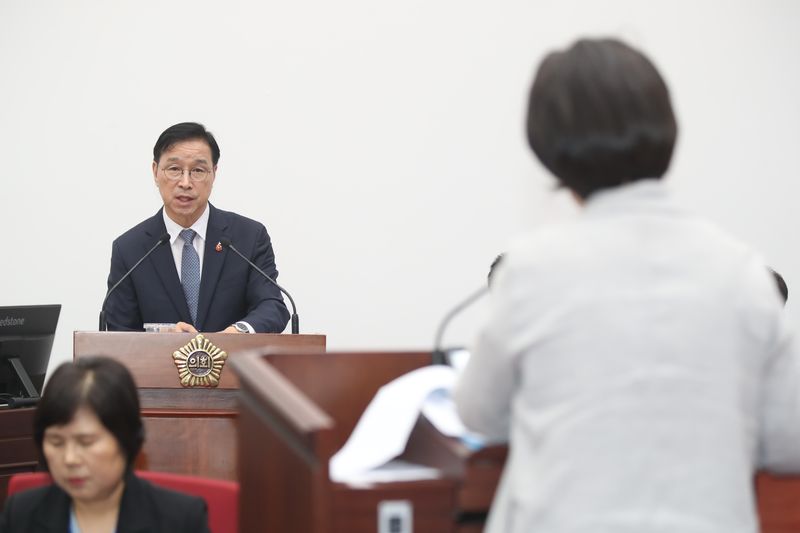
【Financial News Jeju = Reporter Jeong Yong-bok】 The first regular-session questioning of the provincial administration under Governor Wi Seong-gon’s ninth elected administration will conclude on the 7th after covering 38 issues, including safety, the Jeju Second Airport, youth jobs, artificial intelligence (AI) and farm debt. Wi, who outlined the direction of major policies during questioning on the 3rd and 4th, will again be pressed that day for specific implementation schedules, funding and performance targets.
According to the Jeju Special Self-Governing Provincial Council on the 7th, six lawmakers will question Governor Wi for a third day at 10 a.m. during the fourth plenary session of the 454th First Regular Session.
Kim Hwang-kok, Kim Bong-hyun and Im Jeong-eun will each conduct 40-minute question-and-answer sessions. Lee Nam-keun, Kim Hye-ji and Park An-su will use a format in which questions and answers are presented in batches.
There are 38 questions in total. The session is the final schedule for the first regular-session provincial-affairs questioning since Governor Wi’s administration began.
The most pressing issue is Jeju’s safety net. Kim Hwang-kok will ask about improvements to provincial-government operations following recent missing-person cases and measures to prevent damage to the tourism industry. He will also examine operational problems with and the need to improve the ordinance on the early discovery and support of missing persons in Jeju.
After reexamining 298 cases handled by an officer from its missing-persons team on the 1st, the Jeju police identified suspected or confirmed improper handling in 27 cases, including two that had already been subject to investigation. What began as a problem involving one officer’s handling of cases has developed into a broader issue of trust in Jeju’s entire safety net.
During the provincial-affairs questioning on the 3rd, Governor Wi proposed creating a “Safe Travel Organization” for tourists visiting Jeju alone and linking safety services with the tourism platform “NOWDA.” He also said he would expand AI-based closed-circuit (CCTV) systems and extend the period for retaining video footage.
Kim’s questions are expected to focus on when and through which organizations and budgets these measures will be implemented.
The Jeju Second Airport will also come under renewed scrutiny. Kim will ask about Governor Wi’s position on the conflict over the airport, which has continued for more than 10 years, as well as the future schedule and support measures for areas affected by airport noise. During questioning on the 3rd, Wi presented a schedule under which the province would discuss how to gather residents’ opinions by January next year, prepare specific measures around February and complete the process of collecting opinions by the first half of 2027.
The governor also stated that the Jeju Second Airport Conflict Mediation Council is not an organization that directly decides whether to proceed with the project, but a consultative body that develops a process for gathering opinions. He said the final opinions would be delivered to the Ministry of Land, Infrastructure and Transport (MOLIT). Since the basic schedule has already been disclosed, the key issue that day will be how specifically the province explains the method of gathering opinions and the conflict-management process.
Kim Hwang-kok will also question the livelihood economy and Jeju’s finances. His questions will cover responses to worsening major economic indicators, a medium- and long-term fiscal-management strategy, controversy over the omission of the Qingdao international route from the central government’s investment review, the status of loss-compensation payments, and the direction of the bus rapid transit (BRT) system.
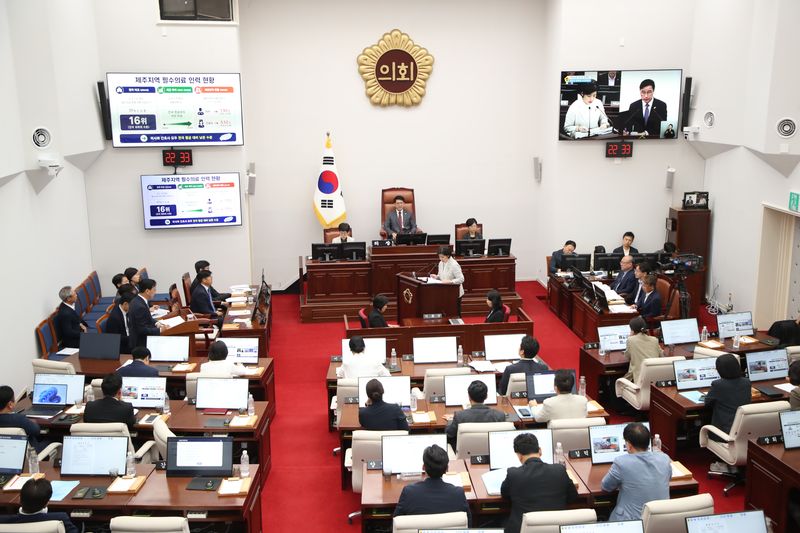
In the field of future talent, lawmakers will raise plans for a joint campus of the four institutes of science and technology and the establishment of the Jeju Institute of Science and Technology (JIST). The joint campus envisioned by Jeju would connect the educational and research capabilities of KAIST, GIST, DGIST and UNIST to Jeju, then lay the foundation for establishing JIST over the long term. The questions will address the implementation plan, including the site, funding and the schedule for consultations with the central government.
Kim Bong-hyun will focus on the “performance” of the ninth elected administration’s economic policies. He will examine whether the method of evaluating employment policies should shift toward “good jobs” that reflect wages, employment stability and career continuity rather than simply the number of employed people.
He will also ask whether the performance criteria for Jeju’s growth-engine industries should shift from securing national funds and counting projects to attracting companies, drawing private investment and creating quality jobs. Regarding AI, he will argue that indicators are needed to measure whether the technology has led to higher sales and productivity and more jobs for Jeju companies, rather than merely being introduced into public administration.
The tourism policy questions will address whether performance criteria should shift toward tourists’ length of stay and per-capita spending. Another issue is whether, when preparing the 2027 main budget, the province will adjust low-performing and customary projects and reallocate funds to future growth areas.
Im Jeong-eun will address agriculture and the space industry together. The questions will cover the possibility of designating a space-industry cluster in Jeju, concerns that Jeju could be excluded from major government projects, and a plan to establish the joint campus of the four institutes of science and technology at Hawon Techno Campus in Seogwipo.
In the primary sector, lawmakers will review measures to address farm debt and deteriorating business conditions, as well as the agricultural-policy pledges of the ninth elected administration. Im will also ask why the establishment of the Jeju Agricultural and Fisheries Products Distribution Corporation, presented as a key campaign pledge, was removed from the pledges.
Questions will also cover the reasons for the increase in national-fund repayments under the FTA Fund High-Quality Production Facility Modernization Project and its redesign, the revitalization of Jeju Cruise, welfare infrastructure in western Seogwipo, and reductions in sewerage-use fees for areas surrounding sewage-treatment plants.
Lee Nam-keun will ask about compact cities, support for residents of odor-management areas, abolishing the weekday-based recycling-disposal system, revitalizing the Jeju Youth Training Center, and ways to use the second citrus-processing plant. In particular, the status of preparations for a pilot project shifting from weekday-based recycling disposal to disposal every day, along with the future direction of waste policy, will be at issue.
Kim Hye-ji will question suicide prevention in Jeju and support systems for high-risk groups, policies for elderly people with disabilities, AX agriculture, which refers to introducing AI and data into the agricultural sector, and improvements to bus stops in towns and townships.
Park An-su will ask whether the existing 15-minute city policy should be redesigned as a plan for living areas. Other questions will concern expanding resident-profit energy projects such as Sunlight Income Village, natural-gas supply, improvements to the operation of the Observer Bus, and expanding residents’ councils.
The key points to watch in the final answers of the first provincial-affairs questioning, which has continued for three days, are when missing-persons safety measures will begin operating; the process for gathering opinions on the Jeju Second Airport; the economic results of youth employment and AI; responses to farm debt; and the goals and funding for reallocating the 2027 budget. The crucial question is not simply what the province “will do,” but by when, with what funding and with what measurable results it will proceed.
[email protected] Reporter Jeong Yong-bok Reporter