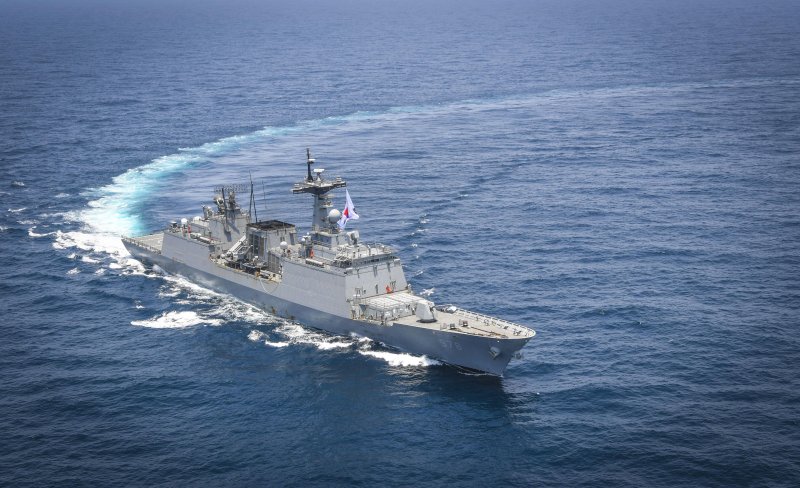
The Republic of Korea Joint Chiefs of Staff (ROK JCS) released images on September 29, 2024, showing an overseas deployment unit’s activities marking the 76th anniversary of Armed Forces Day. Established on March 13, 2009, the Cheonghae Unit is marking its 17th year of deployments this year. It has made a major contribution to protecting Korean vessels and citizens and deterring piracy in the Gulf of Aden. Provided by ROK JCS. [Financial News] As the second Trump administration makes an unprecedented overture to South Korea’s shipbuilding industry for maintenance, repair, and overhaul (MRO) work to rebuild the U.S. Navy, a security bill for “sharing maritime defense responsibilities in the Strait of Hormuz” is emerging behind the scenes. Analysts say the ROK-U.S. Alliance, described as a “security-industry convergence alliance,” is facing a “give-and-take” test: It can create tangible economic cooperation opportunities, but the two countries may also have to jointly defend major maritime transport routes around the world.
■ Deployment Debate Emerges, Heightening Tensions in Security PoliticsAccording to diplomatic and defense experts on the 7th, the government has recently been making close internal progress in reviewing a deployment to help stabilize the area around the Strait of Hormuz and ensure the safe passage of Korean vessels, including oil tankers. It is reportedly possible that the government will formally submit a deployment consent bill to the National Assembly during this month’s regular session.
South Korean military authorities have so far maintained an extremely cautious stance on deployment proposals, citing the grave security conditions on the Korean Peninsula, complicated legal procedures, and opposition within the National Assembly. However, amid growing pressure from Washington, D.C., to join maritime security efforts and changes in the regional security environment, the prevailing view is that the government has moved beyond a general review and entered the stage of developing concrete operational and administrative procedures for implementation.
Tensions in security politics are rising, particularly as reports suggest that the government is weighing whether to submit the deployment consent bill to the National Assembly this month. The issue is also closely tied to the diplomatic challenge of demonstrating the strength of the ROK-U.S. Alliance at home and abroad under the second Trump administration.
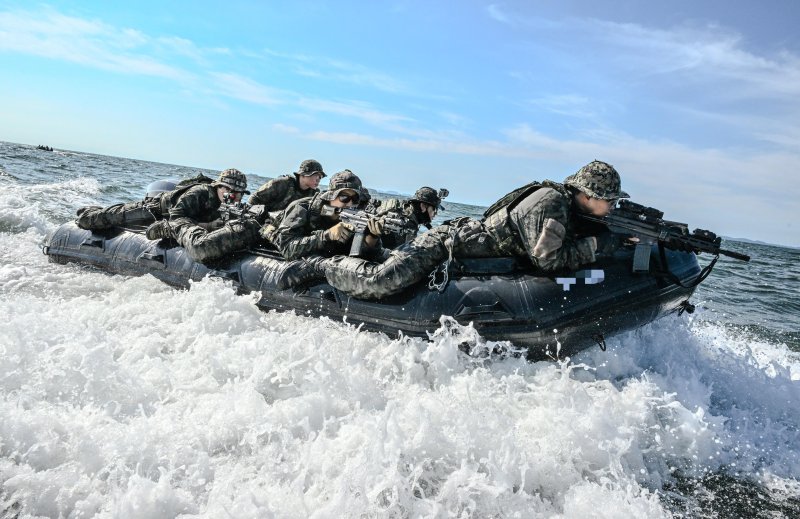
As part of the 2025 Ulchi Freedom Shield/TIGER exercises, the Republic of Korea Army Special Warfare Command (ROKA SWC) conducted a ROK-U.S. combined maritime infiltration exercise from August 25 to 27, 2025, in the waters near the maritime training area on Anmyeondo in Taean County, South Chungcheong Province. About 40 South Korean and U.S. service members, along with U.S. F-16 Fighting Falcon fighter jets and Sikorsky UH-60 Black Hawk helicopters, took part in the exercise to strengthen combined special operations capabilities. The photo shows special forces personnel who had exited a helicopter approaching a landing area in rubber boats. Provided by the Republic of Korea Army. ■ Conditions for Confidence in Extended Deterrence: “MRO Opportunities and Pressure to Share Security Responsibilities”According to analyses of U.S. security policy by experts inside and outside the military, Washington’s unprecedented MRO overture to South Korea’s shipbuilding ecosystem is by no means an independent economic cooperation issue. The United States is experiencing bottlenecks in warship construction and maintenance as its domestic shipbuilding manufacturing base has deteriorated. Analysts say that, in exchange for incorporating South Korea’s superior defense-industry capabilities into its supply chain, Washington is demanding comprehensive, practical burden sharing and responsibility sharing in major conflict zones around the world.
In fact, key thinkers in the second Trump administration, including former U.S. Deputy Assistant Secretary of Defense for Policy Elbridge Colby, who has played a behind-the-scenes role in shaping U.S. diplomatic and security policy, have emphasized that “U.S. military choices must be proportional to the strategic interests at stake for the United States itself.” Some interpret this as meaning that, in return for maintaining the credibility of the U.S. commitment to provide South Korea with extended nuclear deterrence, or the nuclear umbrella, South Korea must also closely link its military capabilities, geopolitical position, and shipbuilding and industrial base to U.S. Indo-Pacific and global regional strategies.
As North Korea’s nuclear and missile capabilities advance and reach a level that could threaten the U.S. mainland, the core of ROK-U.S. extended deterrence lies not simply in U.S. nuclear forces themselves, but in convincing North Korea that the United States will respond proportionally in an actual crisis. If the United States has only two extreme options—massive nuclear retaliation or restraint—the credibility of deterrence could weaken. Accordingly, Washington appears to be seeking to rebuild a wider range of credible and practical nuclear options. In this process, South Korea, as an ally, is expected to assume greater responsibility in conventional deterrence and maritime security.
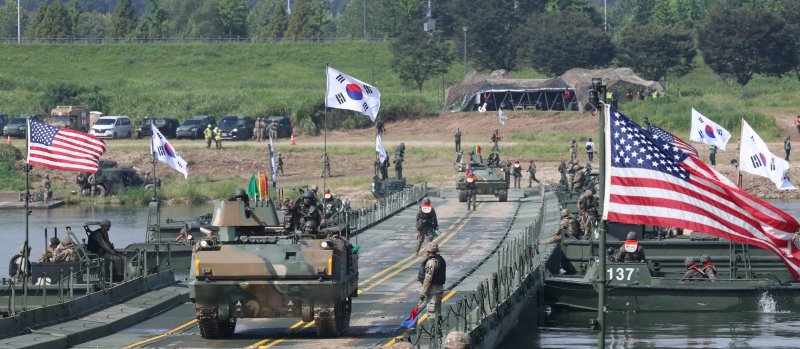
During a ROK-U.S. combined arms river-crossing exercise held on August 27, 2025, at a training site along the Namhan River in Yeoju, Gyeonggi Province, soldiers from the 7th Engineer Brigade and the U.S. 2nd Infantry Division/ROK-U.S. Combined Division conducted a pontoon-bridge crossing exercise. News1. ■ Preventing ROK-U.S. Alliance Fractures: K-Defense Urgently Needs Practical Diplomacy Integrating Nuclear and Conventional ForcesDiplomats and experts commonly diagnose the current moment as one requiring a prudent approach to prevent the ROK-U.S. Alliance from breaking down or developing cracks amid U.S. “give-and-take” pressure. They argue that even if the division of responsibilities changes in response to U.S. strategic demands, conventional and nuclear deterrence must not be separated into an absolute binary. Instead, South Korea should firmly establish a conventional-nuclear integration (CNI) framework centered on the ROK-U.S. Nuclear Consultative Group (NCG), closely linking U.S. nuclear options, the South Korean military’s advanced conventional capabilities, and combined operational plans.
There are also concerns that if the South Korean government responds passively only to demands for a greater global maritime role, such as a deployment to the Strait of Hormuz, and fails to create its own links to broader alliance cooperation, the United States could apply even harsher pressure to renegotiate Special Measures Agreement (SMA) defense cost-sharing payments or demand reimbursement for the deployment of strategic assets, creating risks across the alliance.
Yoo Ji-hoon, a researcher at the Korea Institute for Defense Analyses (KIDA), said, “The key is not a peripheral debate over issues such as whether tactical nuclear weapons should be redeployed. It is to build a practical system that allows the two countries’ decision-making and operations to function consistently in an actual crisis.” He added, “South Korea urgently needs an advanced national negotiating strategy that organically links its unparalleled shipbuilding and industrial base and its contribution to Indo-Pacific security with U.S. regional strategy, so that North Korea recognizes that it cannot separate the ROK-U.S. Alliance or gain strategic benefits through any form of provocation.”
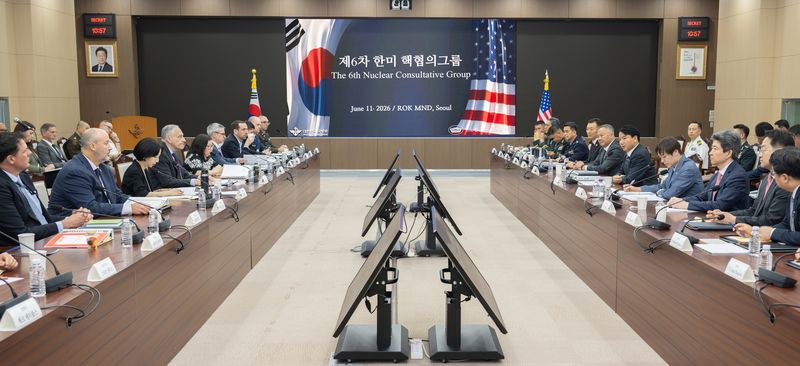
Participants, including Kim Hong-cheol, director general for defense policy at the Ministry of National Defense, Republic of Korea, and Robert Soofer, the U.S. deputy assistant secretary of defense for nuclear deterrence and WMD response policy, conduct the sixth ROK-U.S. Nuclear Consultative Group (NCG) meeting in the main conference room of the Ministry of National Defense in Seoul on June 11. Provided by the Ministry of National Defense, Republic of Korea. [email protected] Jong-yoon Lee Reporter