CalPERS and Norway’s central bank back MBK Partners [fn Market Watch]
- Input
- 2026-09-06 17:35:28
- Updated
- 2026-09-06 17:35:28
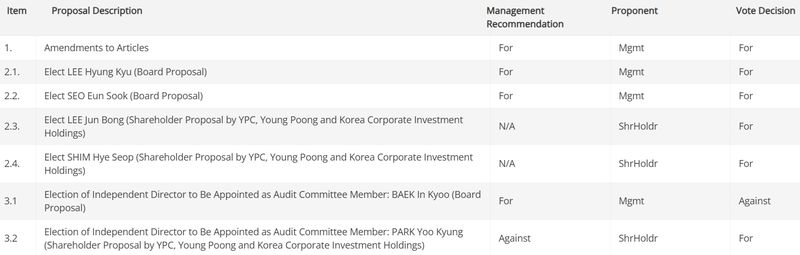
[Financial News] Norges Bank Investment Management (NBIM), one of the world’s largest pension funds, and the California Public Employees’ Retirement System (CalPERS), the largest public pension fund in the United States, have decided to vote in favor of the audit committee candidates recommended by MBK Partners and Youngpoong at Korea Zinc’s extraordinary general meeting. The decision is the opposite of the trend among most proxy advisers, which have supported Korea Zinc Chairman Choi Yun-beom’s side. In the first proxy fight involving a major listed Korean company to apply the “3% rule,” global institutional investors have effectively thrown their support behind MBK Partners.
According to investment banking industry sources on the 6th, NBIM disclosed in an advance voting filing that it would support the shareholder proposal to appoint Park Yoo-kyung, a former executive at Dutch pension fund APG, to Korea Zinc’s audit committee at the extraordinary general meeting scheduled for the 9th. It will vote against the company’s proposal to appoint Baek In-kyu. NBIM also decided to oppose the appointment of independent directors Lee Hyung-kyu and Seo Eun-sook, while supporting shareholder-nominated candidates Lee Jun-bong and Shim Hye-seop.
NBIM cited the principle that "shareholders should have the right to demand changes to the board when the board does not act in the best interests of shareholders" as the reason for its voting decision. It added, "We assess whether the board has failed to respond to significant shareholder demands, attempted to circumvent shareholder proposals, or implemented governance changes that restrict shareholder rights without shareholder approval."
Unsatisfactory financial and strategic performance, inadequate risk management, and inappropriate treatment of stakeholders were also cited as factors in its assessment. However, NBIM clarified that its voting decision was made internally, had not been agreed upon with any third party, and did not constitute a proxy solicitation intended to influence other shareholders’ votes.
CalPERS reached the same conclusion. It disclosed through proxy adviser Glass Lewis’s voting platform that it would support Park Yoo-kyung’s appointment. The decision is notable because CalPERS reached a different conclusion from Glass Lewis, which supported the company’s candidates. It demonstrates that proxy adviser recommendations do not necessarily align with actual voting decisions.
The key contest at the extraordinary general meeting is the appointment of one audit committee member. Under the first amendment to the Commercial Act, passed by the National Assembly in July last year, the “3% rule” will be applied to a major listed company for the first time. The rule limits the combined voting rights of the largest shareholder and related parties to 3% when electing a director who also serves on the audit committee. Because the structure effectively neutralizes the advantage of a higher ownership stake, the votes of the National Pension Service, foreign investors, and institutional investors will determine the outcome. Foreign investors hold roughly 20% of Korea Zinc, making their position a decisive variable.
Korea Zinc took the lead in the preliminary contest among proxy advisers. Eight firms—including Institutional Shareholder Services (ISS), PIRC, Egan-Jones Proxy Services, Sustinvest, Glass Lewis, Korea Proxy Advisory, Korea ESG Research Institute, and Korea Institute of Corporate Governance and Sustainability (KCGS)—recommended voting in favor of the company’s candidate, Baek In-kyu. MBK Partners and Youngpoong received a favorable recommendation from only one firm, KCGS, on the 30th of last month.
MBK Partners is emphasizing independence to make up for its disadvantage. Park Yoo-kyung was selected through an open recommendation process conducted by an independent screening committee formed by MBK Partners.
In materials for the shareholders’ meeting, MBK Partners stated, "Deloitte Korea, where Baek In-kyu served as a senior executive, has maintained an ongoing business relationship with Korea Zinc, which could create a conflict of interest." Deloitte Anjin is known to have conducted financial due diligence for the so-called Crucible Project last year. Baek In-kyu handled accounting, auditing, and financial advisory work at Deloitte Anjin and served as chair of Deloitte Korea’s board and head of its ESG Center.
MBK Partners also sent open letters to Hanwha Group and LG Chem, which have been classified as friendly shareholders of Chairman Choi Yun-beom’s side, asking them to support Park Yoo-kyung. Korea Zinc, meanwhile, maintains that it would be difficult to ensure the neutrality of an audit committee member who was recommended by a particular private equity fund.
An investment banking industry official said, "Global pension funds tend to prioritize the board’s oversight function under their own guidelines, independently of proxy adviser recommendations." The official added, "Under the 3% rule, even a minority stake can overturn the result, so vote counting will continue until the very end."
[email protected] Kang Gu-gwi Reporter