[On the Ground] E-Bikes Flood Banpo After E-Scooters Are Blocked: A Look at the Academy District
- Input
- 2026-09-07 06:30:00
- Updated
- 2026-09-07 06:30:00
[Financial News] “Every time an e-bike speeds past, my heart sinks.”
At 4 p.m. on the 4th, the academy district in Banpo-dong, Seocho District, Seoul, was crowded with elementary and middle school students pouring out after class. The narrow walkway, barely wide enough for three children to walk side by side, quickly became packed. Vehicles arriving to pick up children added to the congestion, leaving the alley tangled with students, parents and cars.
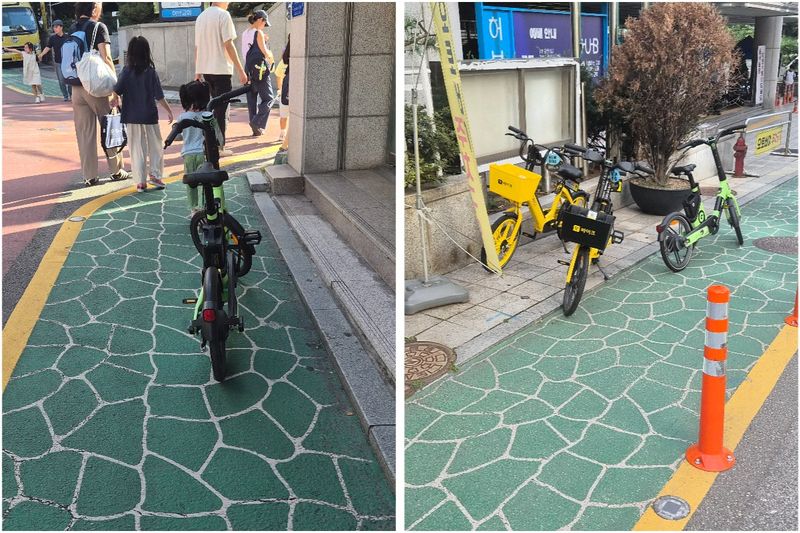
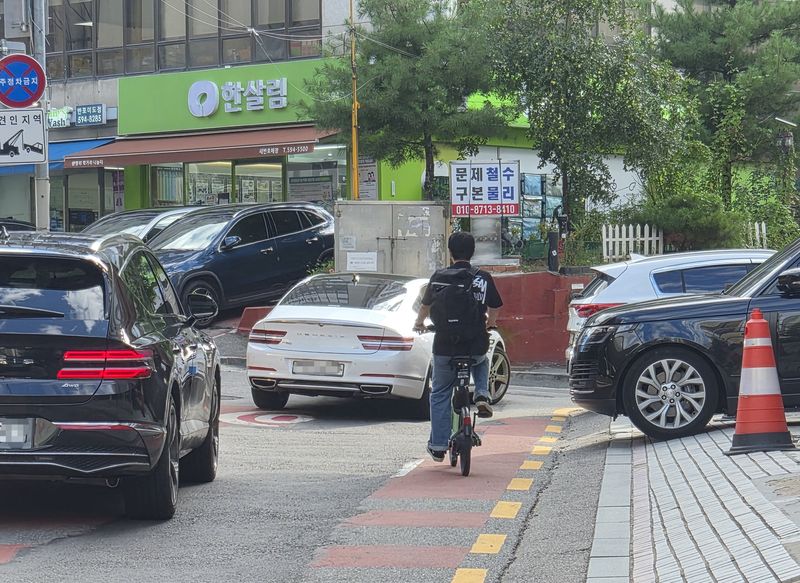
E-scooters and e-bikes parked in various spots blocked one side of the narrow walkway. Residents were seen moving along the edge of the road to avoid them, while e-bikes squeezed through alleys lined with vehicles.
The area has operated as a “no e-scooter” zone since May last year to reduce accidents involving personal mobility devices (PMDs). Most of the e-scooters once commonly seen there have disappeared, but e-bikes, which are excluded from the regulations, have taken their place.
A walk-through inspection of the area on the same day found only two e-scooters, whose use is prohibited, compared with 19 e-bikes. Contrary to the policy’s goal of ensuring pedestrian safety by restricting e-scooter traffic, e-bikes occupying various parts of the street have emerged as another obstacle to pedestrians.
Under current law, throttle-type e-bikes that can move solely through motor power without pedaling are subject to traffic restrictions. By contrast, pedal-assist (PAS) e-bikes, in which an electric motor assists the rider when the pedals are turned, are classified as bicycles and may be used even in areas where PMD traffic is prohibited.
The problem is that PAS e-bikes can also threaten pedestrian safety in academy districts, where walkways are narrow and student traffic is concentrated. Residents worry that illegally parked e-bikes block the paths and that, when in motion, they can pass students at high speeds, increasing the risk of accidents.
Lee, 71, who has lived in the Banpo area for 20 years, said, “There are many schools and academies nearby, so most children travel on foot and even cars have no choice but to drive slowly. Whenever an electric bicycle passes, it is faster than I expect, and I worry that my grandchildren could get hurt.”
The Seoul Metropolitan Government says there are limits to regulating PAS e-bikes in the same way as e-scooters because they are legally classified as bicycles. A Seoul Metropolitan Government official explained, “PAS vehicles are classified as bicycles and are not included among personal mobility devices. Because privately owned bicycles and public bicycles must also be considered, a careful review that takes into account the characteristics of each mode of transportation is necessary.”
Experts point out that regulations should be designed around the actual risks arising in pedestrian environments rather than the legal classification of each mode of transportation.
Song Tae-jin, an associate professor in the Department of Urban Engineering at Chungbuk National University, said, “PAS e-bikes pose risks from a safety perspective just like e-scooters. Rather than focusing only on the propulsion method, we need to examine what risks the mode of transportation poses to users of other forms of transport and to pedestrians.”
Experts also explain that the indiscriminate parking and stopping of shared mobility devices should not be addressed by treating e-scooters and e-bikes differently. Professor Song emphasized, “When a shared bicycle is parked in the middle of a pedestrian walkway, it poses a very serious risk to people such as those with visual impairments. We must consider not only the safety of riders but also the risks posed to pedestrians and users of other forms of transportation.”
He added, “Transportation safety requires examining both whether the infrastructure needed to use a mode of transportation is properly in place and whether users are operating it dangerously. Removing just one particular mode of transportation will not solve all the safety problems in an area.”
[email protected] Lee Dong-hyuk Reporter