Cheong Wa Dae Leaves Open Possibility of Troop Deployment...Will Lee Jae Myung and Macron Discuss Hormuz?
- Input
- 2026-09-06 16:31:35
- Updated
- 2026-09-06 16:31:35
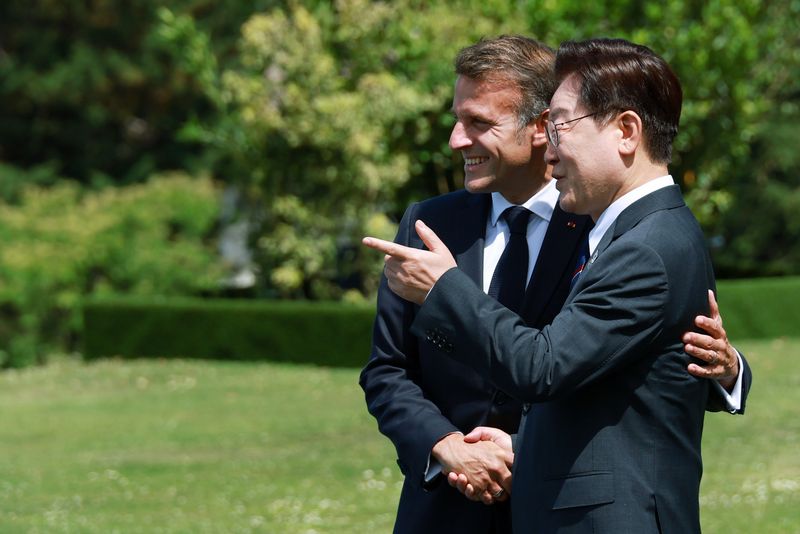
[Financial News] As President Lee Jae Myung carries out a state visit to France beginning on the 6th, discussions on deploying troops to the Strait of Hormuz are expected to be a key agenda item at the Korea-France summit. With U.S. President Donald Trump's dissatisfaction being expressed in various forms and pressure mounting, Cheong Wa Dae is broadly reviewing practical ways to contribute, including combat and noncombat missions as well as search operations, leaving open the possibility of troop deployment. Since the coalition led by France and the United Kingdom to ensure freedom of navigation through the Strait of Hormuz is also linked to the United States, observers say related issues are highly likely to be discussed at the summit between Lee and French President Emmanuel Macron. Attention is therefore focused on whether the review of a possible deployment to the Strait of Hormuz will accelerate.
A senior Cheong Wa Dae official said, "Freedom of navigation through the Strait of Hormuz is extremely important to our national interests. The Middle East accounts for nearly 70% of our crude oil dependence, so a blockade there would have a major impact on the economy as a whole." The official added, "That is why we actively consulted from the outset when the United Kingdom, France and the United States proposed an international coalition to ensure freedom of navigation through the Strait of Hormuz."
France has been active in international efforts to ensure freedom of navigation through the Strait of Hormuz while also continuing consultations with the Republic of Korea. Together with the United Kingdom, France has led discussions on a proposed "multinational mission" involving the international community since the early stages of the war with Iran. Accordingly, measures to ensure freedom of navigation are expected to be discussed at the summit between Lee and Macron in Paris on the 8th (local time). Lee also attended a video summit in April on freedom of navigation through the Strait of Hormuz, led by France and the United Kingdom. At the time, he said, "We will make a practical contribution to guarantee freedom of navigation."
At a meeting with civil society representatives chaired by Lee at Cheong Wa Dae on the 4th, he reportedly responded to a participant's question by saying, "Talking about troop deployment is really difficult. Nothing has progressed," and added, "We are taking it seriously." Cheong Wa Dae has continued to emphasize that nothing has yet been decided regarding a deployment. At the same time, it has left the possibility open by saying that it is comprehensively reviewing practical ways to contribute to freedom of navigation.
A senior Cheong Wa Dae official said, "We have spoken several times about making a practical contribution, and that includes a military contribution." The official continued, "We have said that we would review the matter in light of various aspects of the Republic of Korea's readiness on the Korean Peninsula and in accordance with domestic legal procedures. We are now at that review stage." The official also stressed, "We believe there is room to act as long as it does not significantly undermine readiness on the Korean Peninsula."
To deploy troops overseas, the government must first obtain approval from the National Security Council (NSC) and the State Council of South Korea, followed by consent from the National Assembly. Although Cheong Wa Dae has repeatedly stressed that nothing has been decided, the National Assembly is also closely monitoring the situation. A troop deployment consent bill passes only if a majority of all lawmakers are present and a majority of those present vote in favor. There are currently 299 lawmakers, meaning that, if all attend, at least 150 votes in favor would be required.
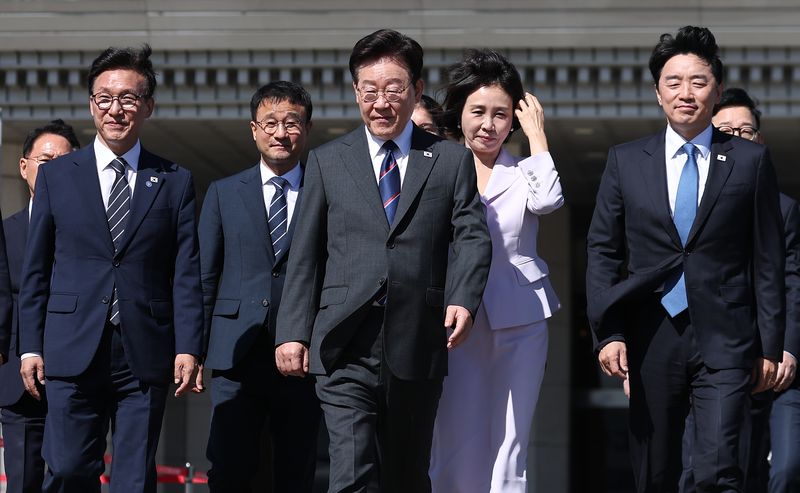
The Democratic Party of Korea (DPK) currently holds 161 seats, meaning it could pass the measure on its own if party members reach a consensus in favor. The DPK has not yet adopted an official position and is taking a cautious stance, saying it will deliberate carefully. The variable, however, is division within the ruling camp. Some DPK lawmakers, along with the Rebuilding Korea Party (RKP) and the Progressive Party, oppose the deployment.
Concerns have reportedly emerged within the DPK that a deployment to the Strait of Hormuz could become a catalyst for internal party conflict. In 2003, during the Roh Moo-hyun administration, a motion approving the deployment of troops to Iraq passed with 179 votes in favor. At the time, the ruling DPK experienced intense conflict, with 49 lawmakers voting for and 43 against. The People Power Party is watching the situation while pressuring the government, as the specific details of any deployment have not yet been finalized.
During his five-day, three-night state visit to France, Lee will attend the Lumière Summit in Saint-Paul-de-Vence in southern France on the 7th as co-chair with President Macron. The event is expected to create opportunities to expand joint projects, including the global spread of K-content. On the 8th, Lee will have a private luncheon with Macron in Paris, followed by an expanded summit meeting. The leaders will discuss the Strait of Hormuz issue, as well as joint research and development, corporate cooperation and reciprocal market access in future industries such as artificial intelligence (AI), space, nuclear power and biotechnology. Cooperation in the nuclear power sector is expected to draw particular attention.
Economic cooperation will also be expanded. Lee will attend a Korea-France business roundtable joined by about 20 companies from both countries to support private investment and cooperation between businesses. On the final day, the 9th, he will meet with Yaël Braun-Pivet, president of the National Assembly of France, attend a luncheon meeting with Korean residents, and receive Mathias Cormann, secretary-general of the Organisation for Economic Co-operation and Development (OECD).
[email protected] Choi Jong-geun Lee Hae-ram Reporter