'Lee Jae Myung Administration, Which Pledged “National Unity,” Has Changed in Its Second Year'
- Input
- 2026-09-06 14:40:24
- Updated
- 2026-09-06 14:40:24
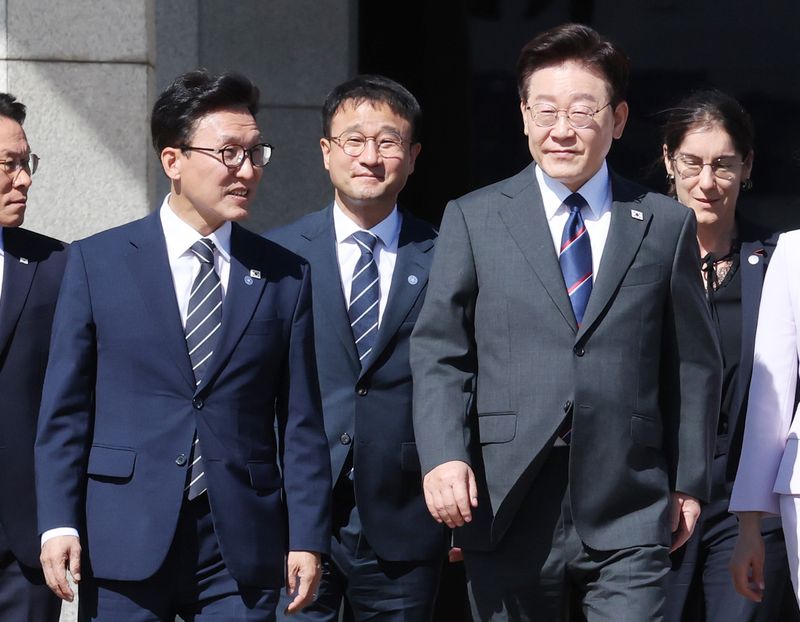
[Financial News] Signs have recently emerged that the Lee Jae-myung administration is shifting its approach to recruiting talent. The administration had championed pragmatism and appointed numerous figures from conservative parties. Immediately after taking office, it emphasized the importance of a “red team” and demonstrated its commitment to national unity through its governing personnel policy. However, during its second Cabinet reshuffle, it appointed no figures from conservative parties. Instead, the de facto dismissal of Lee Seok-yeon, chair of the Presidential Committee of National Cohesion, and Lee Byung-tae, former vice chair of the Regulatory Rationalization Committee, has prompted analysis that the administration is now prioritizing the recruitment of talent to secure governing momentum in its second year.
According to political sources on the 6th, President Lee Jae Myung appointed a considerable number of figures from the conservative camp to senior posts in the Cabinet and the presidential office after taking office. During the 21st presidential election, he brought in Kwon Oh-eul, a former lawmaker from the Hannara Party, and Heo Eun-ah, a former lawmaker from the People Power Party and the Reform Party. After the administration was launched, they were appointed minister of the Ministry of Patriots and Veterans Affairs and Secretary for National Integration, respectively. Lee later appointed former Minister of Government Legislation Lee Seok-yeon as chair of the Presidential Committee of National Cohesion and brought in Professor Lee Byung-tae, an aide to former Daegu Mayor Hong Joon-pyo, as vice chair of the Regulatory Rationalization Committee. Although she ultimately withdrew from consideration, former People Power Party lawmaker Lee Hye-hoon was also nominated as the first minister of the Ministry of Planning and Budget.
The Lee Jae-myung administration’s personnel appointments were viewed as “appointments for national unity.” Given that President Lee failed to win a majority of the vote and had a high unfavorable rating, the appointments were interpreted as an attempt to secure governing momentum through a centrist and pragmatic approach. Some observers said the strategy had achieved a degree of success. There were also concerns within and outside the opposition that the People Power Party could become isolated as the ruling bloc embraced centrist-conservative figures. President Lee’s approval rating also remained high, in the 70 percent range, as the KOSPI Composite Index continued to rise.
However, around the June 3 local elections, which marked the beginning of the Lee Jae-myung administration’s second year, its governing direction changed. President Lee recently carried out a mid-sized reshuffle involving six ministries, but none of the ministerial nominees came from conservative parties. Kim Seung-won, a lawmaker from his own party, was nominated as minister of the Ministry of Justice, while Soyoung Lee was nominated as minister of the Ministry of SMEs and Startups. Yong Hye-in of the Basic Income Party was selected as nominee for minister of the Ministry of Gender Equality and Family. The appointment of Lee Hae-min of the Rebuilding Korea Party as Senior Presidential Secretary for AI Future Planning also led to assessments that the administration was pursuing “appointments for unity across the ruling bloc.”
If the Lee Jae-myung administration’s first-year personnel policy focused on “integration between progressives and conservatives,” its second-year priorities appear to be “unity within the political camp” and “securing momentum for governance.” The administration is moving to prioritize talent capable of supporting the government as the appointments made in the name of unity failed to produce notable results and the time arrived to implement key government projects, including mega-projects. Some critics have also pointed out that the administration has become increasingly burdened by figures such as Chair Lee Seok-yeon, who voice “tough criticism” from within.
A dominant analysis is that this cannot be separated from the downward trend in the Lee Jae-myung administration’s approval rating. Public dissatisfaction with the administration became visibly apparent after its defeat in the Seoul mayoral election. In addition, support has reportedly begun to erode even among Democratic Party supporters amid the intense confrontation between the pro-Lee Jae Myung and pro-Jung Cheong-rae factions during the August 17 party convention. Some observers therefore believe the administration intends to pursue unity between the pro-Lee and pro-Moon factions by appointing figures from within the ruling bloc rather than recruiting people from conservative parties. A ruling-bloc official said, “Appointing figures from the opposing camp was a customary strategy viewed as a breakthrough amid low approval ratings, but that card was already used during the presidential campaign and the early days of the administration,” adding, “Recruiting conservative figures will not help the approval rating rebound.”
Some also predict that conservative figures would find it difficult to readily accept offers to join the government. At the beginning of the administration, the government could bring conservative figures into its fold on the strength of its high approval rating. But even if they joined a government that had lost some of its momentum, there would be little for them to gain as conservatives, the argument goes. With optimistic predictions emerging within the opposition that the Democratic Party could be defeated in the next general and presidential elections, the trend among conservative figures to defect is also weakening.
Some argue that the government has been placed in a difficult position as conservative voters and progressive voters, including pro-Moon supporters, have gradually begun turning away after its approval rating entered the 30 percent range. Even within the ruling bloc, voices are calling for the appointment of centrist-conservative talent to overcome the crisis. Another ruling-bloc official said, “After Kim Min-seok was elected party leader, it seems the administration shifted from integration toward governing through unity between the party and the government, weakening its integration agenda,” adding, “For the government to produce results, it needs a red team that can cooperate with the government while also criticizing it.”
[email protected] Lee Hae-ram Reporter