"Honey, are you only going to send our child to an elementary school in a villa neighborhood?"... The brutal reality of a couple with a 7-year-old child's 'all-in school district' [How Much Is It?]
- Input
- 2026-09-06 13:37:29
- Updated
- 2026-09-06 13:37:29
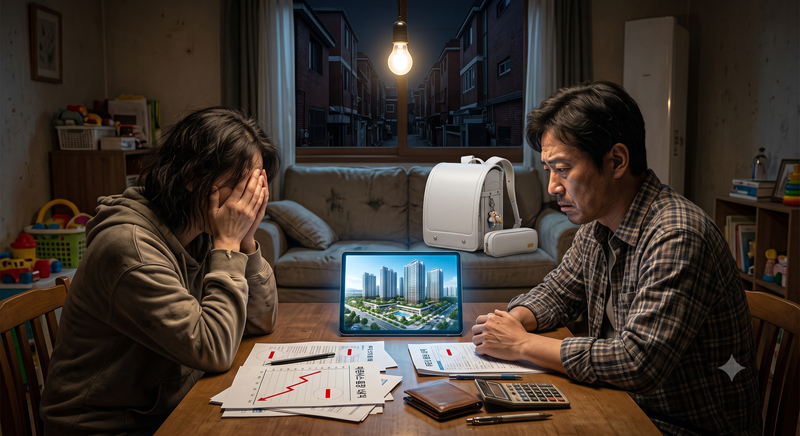
[Financial News] "Honey, are you only going to send our child to the elementary school in that villa neighborhood?"
At 11 PM on Friday night, the wife of Park Tae-su (pseudonym), an office worker in his 40s, spoke bitterly while staring intently at real estate jeonse listings on the computer monitor.
Faced with a school district map for their 7-year-old son Junu (pseudonym), who is set to enter elementary school next year, and an overdraft account balance they simply cannot afford to borrow any more from. For whom on earth are they so desperately agonizing over "going all out"?
◇ Starting with the number of students per class, it is different... Statistics prove the gap in 'environment'
It is not simply that the Park couple is troublesome because they are fussy or extravagant. This is an environmental disparity proven by extremely objective statistics.
According to the Education Statistics Service, the average number of students per class in elementary schools near large apartment complexes and in specific districts of Seoul known as "school districts" approaches 25 to 30, which is close to overcrowded classes.
On the other hand, elementary schools near nearby villa neighborhoods or aging residential areas are much quieter, with around 15 to 20 students per class. On the surface, a small number of students appears advantageous for the educational environment, but parents think differently.
Paradoxically, overcrowded classrooms signify a 'guaranteed demand for education and community.'
Parents hope that the infrastructure of an apartment in a school district, the area around private academies, and above all, the community created by neighbors with similar economic standing will become their child's 'ordinary environment'.
Although affording a 1.5-fold increase in jeonse deposit does not mean my child will become a genius, entering a school district is perceived as an inevitable capitalist survival cost, much like the 'production maintenance costs' required to generate and sustain that income.
◇ 'Academy pickup allowance' and two commuter vehicles... 'Childcare outsourcing' costs draining just by breathing
Entering an elementary school district is not simply a matter of the deposit.
The structure of 'fake income' is further intensifying. The 1.5 million won in compensation given to the mother, who handles the pickup of the child from the academy while the mother leaves the child in her care to go to work, changes its form into 'transportation costs and overtime outsourcing fees' as the academy district becomes further away after moving into the school district.
Although it is given the name of allowance for parents, this money is an absolute 'fixed expense' that cannot be cut off in order to maintain work life and the school district system.
On top of that, given the couple's different commuting routes, maintaining at least two vehicles is essential. When you add in the interest on the mortgage for the apartment in a good school district, purchased by borrowing heavily, the calculation shows that even just to survive, one spouse's entire monthly salary evaporates the moment things start.
◇ "Where would I find the strength to cook?"... The survival consumption of the 'time-poor' and the 'uneven playing field'
What is even more painful is the 'health defense cost'.
When I return to my apartment in the school district at 7:30 PM, completely exhausted after a long day at work, I don't have even 1% of the energy left to open the refrigerator door and cook stew.
Eventually, I lean back on the sofa, open a delivery app, and habitually pay for a dinner costing at least 40,000 won.
I am a father in my 40s who, in an attempt to save even a penny, cuts out even a 5,000-won after-meal coffee when out and soothes my upset stomach with a can of soda stocked in the office refrigerator. However, the contradiction repeats every night: after work, I pay for expensive delivery and dining out without hesitation to compensate for my depleted energy and avoid housework.
It amounts to exchanging one's insufficient absolute 'time' and 'stamina' for 'capital.' Experts refer to this as the 'Time Poor' phenomenon.
◇ 'Elementary School Housing Class Theory' Touches Parents' Deep Threat... "I Would Have Paid It That Way Too"
My parents' receipts tell a sad truth. The monthly income they earn is not my full income.
It is the cost of sending the child to an academy to go to work (sitter fees), replenishing depleted energy with delivery food after returning from work (delivery fees), heading to work (vehicle maintenance costs), and above all, ‘paying’ for the school district infrastructure (academy district) because I do not want my child to start on a ‘tilted playing field.’
For whom on earth are we grinding our bones like this?
The sigh Mr. Park's wife let out as she closed the credit card statement represents the existential reality check of all parents in their 30s and 40s living in South Korea in the autumn of 2026.
The desperation of people in their 40s who must floor the 'hamster wheel of monthly income' for the sake of their children, even if criticized for being "overzealous." This is the raw reality of the 'war for money' faced by parents in their 30s and 40s between apartments in school districts and elementary schools in villa neighborhoods in South Korea.
[email protected] Jeon Sang-il Reporter