Labor Minister Kim Young-hoon integrates youth policies in Jeju, expanding support to 67,000 people next year
- Input
- 2026-09-06 12:28:52
- Updated
- 2026-09-06 12:28:52
【Financial News, Jeju—Reporter Jung Yong-bok】 Starting next year, the government will combine the Youth Growth Project, which helps unemployed young people maintain their daily routines and motivation to seek work, with the Youth Challenge Support Program, which supports young people who have given up job hunting in entering the labor market.
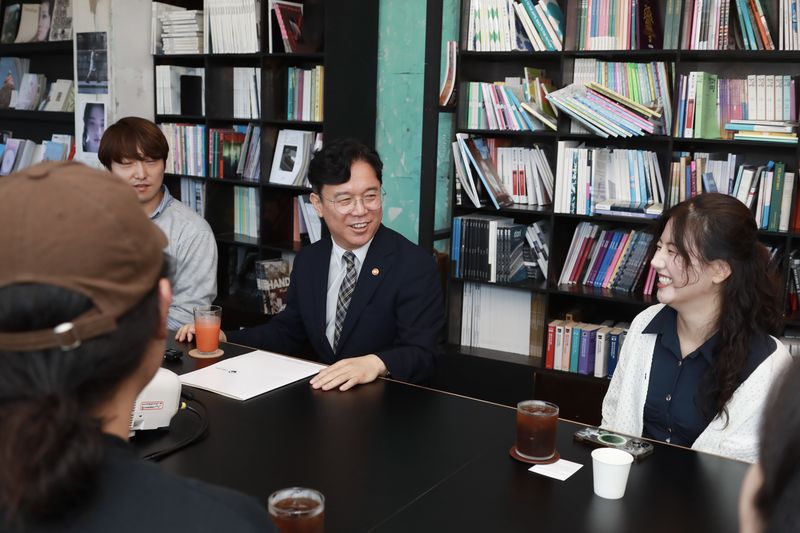
According to the Ministry of Employment and Labor on the 6th, Minister Kim Young-hoon visited the “Messy Stationery Shop” on Sanji-ro in Jeju City the previous day and held a meeting with participants in the Youth Growth Project.
Beginning in 2027, MOEL will combine the Youth Growth Project and the Youth Challenge Support Program into the Youth Challenge and Growth Support Program. The aim is to connect support for young people at different stages within a single program framework, allowing them to receive assistance suited to their circumstances.
The 2027 government budget proposal allocates 90.3 billion won to the Youth Challenge and Growth Support Program. This is 14.5 billion won more than this year. The proposal also calls for expanding the number of beneficiaries from 58,000 to 67,000. The program’s final scale will be determined after the National Assembly reviews the budget.
The Youth Growth Project is currently a joint initiative operated by MOEL and local governments that provides youth cafés for unemployed young people to use freely. It offers counseling, career and employment programs, and youth-friendly spaces to help them maintain their daily routines and motivation to seek work. This year, 64 local governments nationwide are participating and operating 94 youth cafés.
The Youth Challenge Support Program provides intensive counseling, confidence-building, career exploration, and employment-skills programs for young people who have given up job hunting and others. It supports their participation in the labor market and employment. After participants complete the program, they are also connected with other employment-support services, including the National Employment Support System (NESS), work-experience programs, and vocational training.
The decision to merge the two programs reflects the government’s view that the delivery system needs to be reorganized so young people do not fall through gaps between support programs. Rather than managing unemployed young people who have not yet lost their motivation to seek work and those already struggling with employment preparation as entirely separate policy groups, the government plans to connect them with programs suited to their circumstances.
Minister Kim Young-hoon’s visit to Jeju Province was also arranged to hear from policy beneficiaries ahead of next year’s integrated program.
The “Messy Stationery Shop” was a locally tailored program operated by a youth café in Jeju Province. Young people interested in starting businesses and exploring careers sold products they had made themselves, including photographs, candles, jewelry, and desserts.

One participant said, "The biggest takeaway was gaining the sense that I could try again even if one attempt did not go well."
After touring the pop-up store in the morning, Minister Kim held a tea meeting with four young participants in the Youth Growth Project. He heard what had led them to use the youth café, how they had changed since participating, and what difficulties they had encountered while preparing for employment. He also collected suggestions from the operating organization on improving the policy.
The still-challenging youth employment market lies behind the expansion of youth support. In July, the nationwide employment rate for young people was 44.2%, down 1.6 percentage points from a year earlier. The number of young people classified as “taking a break” among the economically inactive population stood at 367,000, down 69,000 from the same month last year, but the youth employment rate itself continued to decline.
Jeju Province shows mixed trends in overall employment indicators and conditions by industry. The employment rate in Jeju Province was 72.0% in July, up 1.9 percentage points from the same month a year earlier, while the number of employed people rose by 11,000 to 415,000.
By contrast, employment in wholesale and retail, accommodation, and food services—industries closely tied to tourism and consumer spending—fell by 7,000 from a year earlier to 93,000. This makes it difficult to assess the job-seeking conditions experienced by young people in Jeju based solely on the improvement in the overall employment rate.
The success of the integrated program will not depend solely on increasing the number of beneficiaries. It will also be important to determine how naturally young people who participate in youth cafés, counseling, and career-exploration programs move on to the vocational training, work-experience, and employment-support services they need.
Another challenge is incorporating regional differences in labor markets into the program. Jeju Province has a large tourism and service sector, while other regions are centered on manufacturing. Rather than applying the same programs uniformly, the government needs to reflect local young people’s employment conditions and needs.
MOEL plans to incorporate the opinions presented by young people and operating organizations in Jeju Province into the detailed design of next year’s Youth Challenge and Growth Support Program.
Minister Kim said, "Through youth-support policies, including next year’s Youth Challenge and Growth Support Program, we will support more young people so they can find their own paths at their own pace."
[email protected] Jung Yong-bok Reporter