Nine Years After BAI Warning, Financial Transactions in Deceased Persons’ Names to Be Rapidly Blocked From the 11th
- Input
- 2026-09-06 13:24:57
- Updated
- 2026-09-06 13:24:57
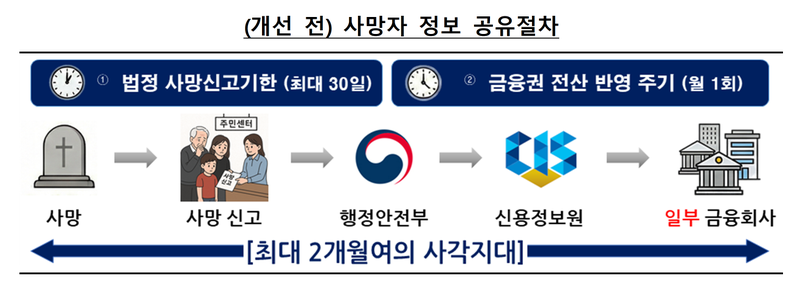
[Financial News] The government will fully launch a system on the 11th to immediately block illicit financial transactions in the names of deceased persons starting the day after a death is reported. The measure addresses a situation in which deceased persons’ accounts were exploited as “mule accounts” because information about their deaths was previously delivered to financial companies as late as two months after notification by surviving family members. It comes nine years after the Board of Audit and Inspection (BAI) ordered corrective action. <See the exclusive report on Page 1 of our November 18, 2025, edition>On the 6th, the Ministry of the Interior and Safety (MOIS), the Financial Services Commission (FSC), the Financial Supervisory Service, and Korea Credit Information Services announced that they would launch the Rapid Blocking System for Financial Transactions in the Names of Deceased Persons across the entire financial sector on the 11th. In 2017, the Board of Audit and Inspection (BAI) notified the Financial Services Commission of its opinion that supervision and management of financial transactions in deceased persons’ names were inadequate. At the time, the BAI said that 452,684 withdrawals totaling 337.5 billion won had been made in deceased persons’ names and ordered corrective action.
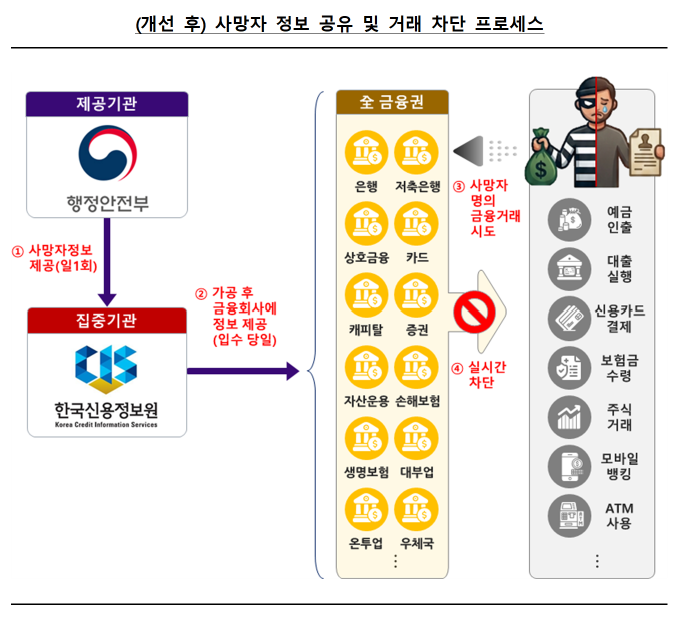
Nine years after the BAI’s warning, the Financial Services Commission, in cooperation with the Ministry of the Interior and Safety and Korea Credit Information Services, established a system under which information about a person’s death is shared with all 4,890 financial institutions the day after the death is reported. The measure addresses the misuse of deceased persons’ names and accounts by voice-phishing criminals seeking to evade the real-name financial system. Financial authorities explained that the measure will enable them to block fraudulent financial transactions proactively.
Until now, financial companies received information on deceased persons from the Ministry of the Interior and Safety once a month through Korea Credit Information Services and used it to block financial transactions. However, considering the deadline for reporting deaths and the information-sharing cycle, there was a loophole that could delay confirmation of a death by financial companies for up to about two months. Another limitation was that only some banks had used the system.
Under the new rapid-blocking system, the Ministry of the Interior and Safety will substantially shorten the frequency of providing information on deceased persons from “once a month” to “once a day.” Financial companies will be able to block transactions as soon as a person’s death is confirmed based on the information provided daily.
The scope of information sharing will also expand beyond banks to all financial companies, including insurers, card companies, securities firms, savings banks, and mutual finance institutions. Once a person is confirmed to be deceased, most financial transactions, except essential transactions such as deposits, will be immediately suspended. Korea Credit Information Services and financial companies will automatically complete the transaction-blocking process without requiring surviving family members to submit a separate request.
Safeguards will also be put in place to prevent abuse. The use of information on deceased persons for purposes other than blocking financial transactions, as well as its provision to third parties, will be prohibited. Transaction histories will be recorded and managed electronically. The Financial Supervisory Service plans to continuously inspect information-management practices and the status of internal controls.
Surviving family members who need emergency funds for a deceased person’s medical or funeral expenses may also use banks’ “exceptional withdrawal” procedures. The provision reflects concerns raised by the banking sector late last year that surviving family members could frequently file complaints when funeral or hospital bills had to be paid.
However, payment methods should be changed in advance to avoid inconvenience caused by unpaid utility bills or insurance premiums. Inherited assets can be checked through the Financial Supervisory Service’s “Heirs’ Financial Transaction Inquiry Service” and the “Safe Inheritance One-Stop Service.” If the deceased operated a business, funds for business operations should be transferred in advance.
The government said, “We expect this measure to help protect people’s assets and prevent fraudulent financial transactions,” adding, “We will work closely with Korea Credit Information Services and financial companies to minimize inconvenience for surviving family members.”
[email protected] Park Moon-soo Reporter