Online Fashion Market Expected to Exceed KRW 60 Trillion This Year
- Input
- 2026-09-06 12:40:59
- Updated
- 2026-09-06 12:40:59
[Financial News] The online fashion market is expected to exceed KRW 60 trillion this year. Specialized platforms such as MUSINSA, which leverage their fashion expertise, have been the main force behind the market’s near doubling in size over the past decade.
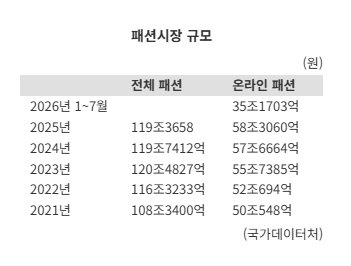
According to the Ministry of Data and Statistics on the 6th, online fashion transactions totaled KRW 35.1703 trillion from January through July this year, up 6.4% from KRW 33.0492 trillion during the same period last year. If the growth rate recorded through July is maintained through the end of the year, this year’s total online fashion transactions are widely expected to exceed KRW 62 trillion.
South Korea’s online fashion market has continued to expand despite stagnant growth across the fashion industry as a whole. After surpassing KRW 30 trillion in 2017, the online fashion market has grown every year and is on track to nearly double in size over the course of a decade.
By contrast, South Korea’s overall fashion market, measured by retail sales reported by the Ministry of Data and Statistics, contracted last year to KRW 119.3658 trillion, down from more than KRW 120 trillion in 2023. Compared with 2017, a decade ago, it grew by only 21%. The domestic fashion market’s average annual growth rate was 2.4%, just one-third of the online fashion market’s 7.7% average annual growth rate.
This means that while the online fashion market doubled over the past decade, the offline market shrank. Online sales accounted for half of the overall fashion market last year, up from one-third.
Specialized retailers, including MUSINSA, led the growth of the online fashion industry. Transactions through specialized fashion retailers rose every year from KRW 9.256 trillion in 2018 to KRW 22.5071 trillion in 2025, an increase of nearly 2.5 times. By contrast, general online retailers operated by department stores and others peaked at KRW 36.5425 trillion in 2023 and have since declined. Last year, fashion transactions through general online retailers totaled KRW 35.7989 trillion, up 30% from KRW 27.5909 trillion in 2018.
However, growth in the online fashion market has slowed from previous years, rising just 1.1% last year. The growth rate in 2024 was also only 2.4%. Analysts say the personal-information leak at Coupang last year also affected the fashion industry. This year, the growth rate of fashion transactions through general online retailers, which include Coupang, fell below the overall average except in January.
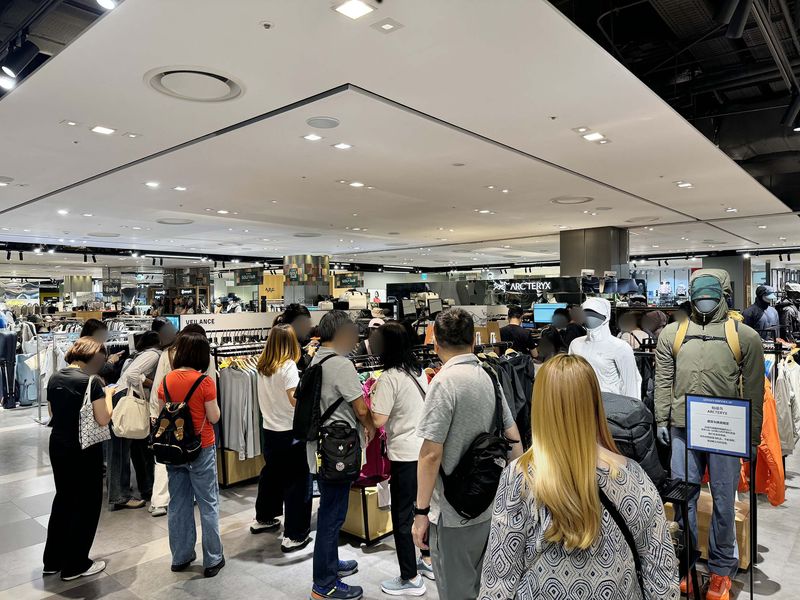
As experience-driven consumption has recently regained importance, concerns have emerged that the online fashion market could stagnate. In addition to MUSINSA, which has been the most active in expanding offline, online-focused fashion platforms such as ABLY and Zigzag are also increasingly moving into physical retail.
Fashion platforms are seeking new growth drivers overseas.
MUSINSA is focusing on improving profitability through its private-label brand, Musinsa Standard. Overseas sales of Musinsa Standard rose 196% in the first half of this year, while its total transaction value increased 162% last year, continuing its rapid growth. Offline, the company expanded from China, where it entered at the end of last year, into Southeast Asia this year. ABLY, a fashion platform built around small businesses, launched the Japanese local platform “Amood” in 2020 and has recorded 6.5 million cumulative downloads.
A fashion-industry official said, “There were expectations for older consumers, but their online shopping experience is also increasing, and some believe that overall growth in the domestic market has reached saturation. The trend of platforms with clear identities further solidifying their market share is expected to continue for the time being.”
[email protected] Reporter Kang Myeong-yeon Reporter