Charge Cheaply During the Day, Feed Power Back to the Grid in the Evening: Jeju Island’s V2G Pilot Tests EVs as Grid Resources
- Input
- 2026-09-06 12:11:54
- Updated
- 2026-09-06 12:11:54
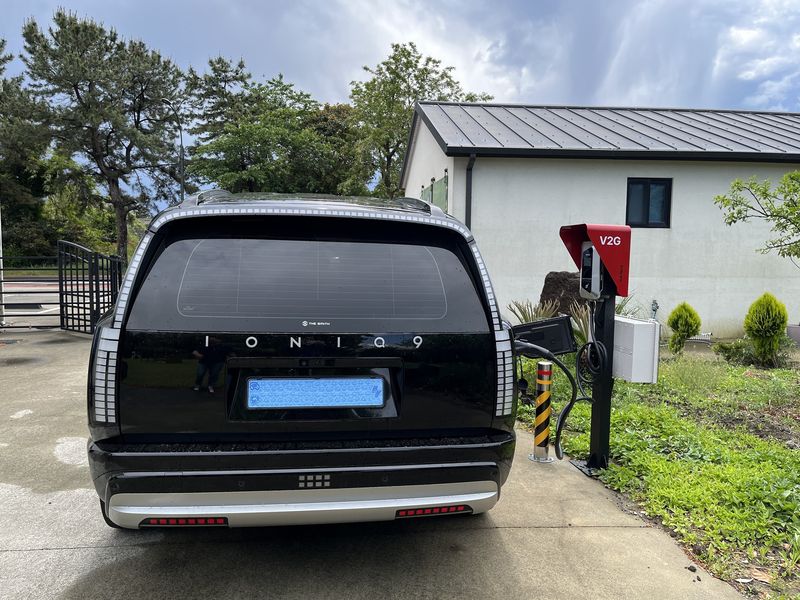
【Financial News Jeju Island=Yong-bok Jeong, Reporter】 A power-consumption model is being tested on Jeju Island in which electric vehicles are charged at lower rates during the day, when renewable-energy power is in surplus, and electricity stored in vehicle batteries is sent back to the grid in the evening, when demand rises.
The Ministry of Climate, Energy and Environment said on the 6th that the government will discount electricity usage charges for EV charging from 11 a.m. to 2 p.m. on 21 weekends and public holidays, from the 5th through October 31.
Chargers for self-consumption installed at homes or workplaces will receive a 50% reduction in electricity usage charges, equivalent to a discount of 40.1 to 48.6 won per kWh.
About 14,000 public fast chargers operated by the Ministry of Climate, Energy and Environment and Korea Electric Power Corporation (KEPCO), along with about 3,400 KEPCO slow chargers, are also eligible for the discount. Of these, about 9,600 public fast chargers operated by the Ministry of Climate, Energy and Environment will offer an additional in-house discount, reducing the actual consumer charging rate by up to 32%, or 85.4 to 97.2 won per kWh.
The government limited the discount period to three hours in the afternoon to shift charging demand to a time when electricity is relatively abundant because solar power generation is high.
Jeong Seon-hwa, director of green transition policy at the Ministry of Climate, Energy and Environment, said, "Electric vehicles are a good means of efficiently using surplus electricity. The key is to shift charging demand to times when surplus electricity is abundant."
The spring discount program confirmed that charging times could shift. According to the government’s analysis, the average daily number of charging sessions on discount days increased by 9.2% from before the discount. Charging volume during the discount period was about 0.1 GWh per day and about 17 GWh in total. About 20% of self-charging users were found to have moved their charging times to holidays or Sundays.
During this fall’s discount program, the government will vary the discount level by charger to examine how price changes affect the choice of charging times. It plans to review charging operators’ billing systems and the application of time-based rates before moving toward the actual introduction of the system.
Jeju Island is also testing V2G, which takes the concept a step further. V2G is a technology that connects EV batteries and the power grid in both directions, charging vehicles when electricity is in surplus and supplying electricity from vehicle batteries when demand is high.
In response to a question about the V2G pilot on Jeju Island, Jeong said, "Hyundai Motor Group, SOCAR and other relevant industry participants are consulting with one another and conducting a pilot project on Jeju Island." She added, "It is a bidirectional charging and discharging system that can charge vehicles when electricity rates are low during the day, then discharge in the opposite direction and contribute when electricity is in short supply in the evening."
Hyundai Motor Group is conducting a V2G pilot for local residents on Jeju Island using the Hyundai Ioniq 9 and Kia EV9. SOCAR is also testing technology that uses rental-car batteries as power resources on Jeju Island.
The government expects the role of EV users to change once V2G is commercialized.
Jeong said, "Once V2G is commercialized, electric vehicles themselves will actively contribute to the power grid, while consumers will be able to charge electricity at low prices and even sell it."
The government is currently pursuing one-way demand management to increase daytime charging separately from the V2G pilot. It is also operating a separate consultative body for V2G and reviewing ways to link the technology with the electricity market.
Challenges remain before commercialization. The government must verify the impact of repeated charging and discharging on battery life, as well as bidirectional charging infrastructure, charging and discharging efficiency, and electricity-market trading and settlement methods.
The government was also unable to analyze how much the spring charging-rate discount actually contributed to grid stability or reduced renewable-energy output curtailment.
Jeong stated, "Because the spring discount was not large, we were unable to analyze the extent of its contribution to the power grid. However, we confirmed that charging demand shifted to times when surplus electricity was available."
[email protected] Yong-bok Jeong Reporter