"It even covers the costs after you buy the car"—A visit to Renault Korea's Changwon service center [Report]
- Input
- 2026-09-06 13:00:41
- Updated
- 2026-09-06 13:00:41
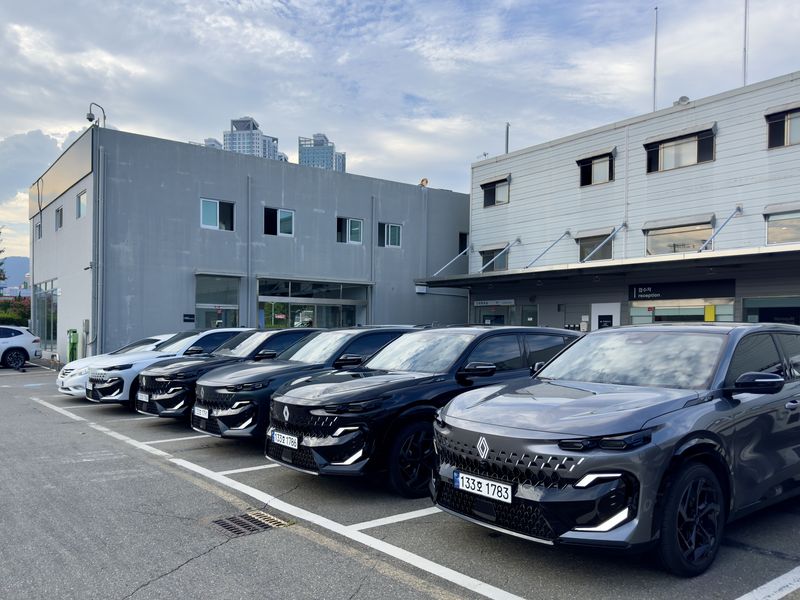
The confidence of Lee Jeong-gwi, general manager of the integrated Changwon Jungang Service Center and Changwon dealership, was evident when he spoke about the so-called cost-of-ownership competitiveness during a visit to Renault Korea's Changwon Jungang Service Center in Changwon, South Gyeongsang Province, on the 2nd. He explained that Renault Korea has lowered repair costs through localization while securing new-car-level restoration quality through the expertise of body repair and painting personnel handling accident and insurance repairs, along with investments in facilities.
■12-point inspections, body repair and painting all under one roof
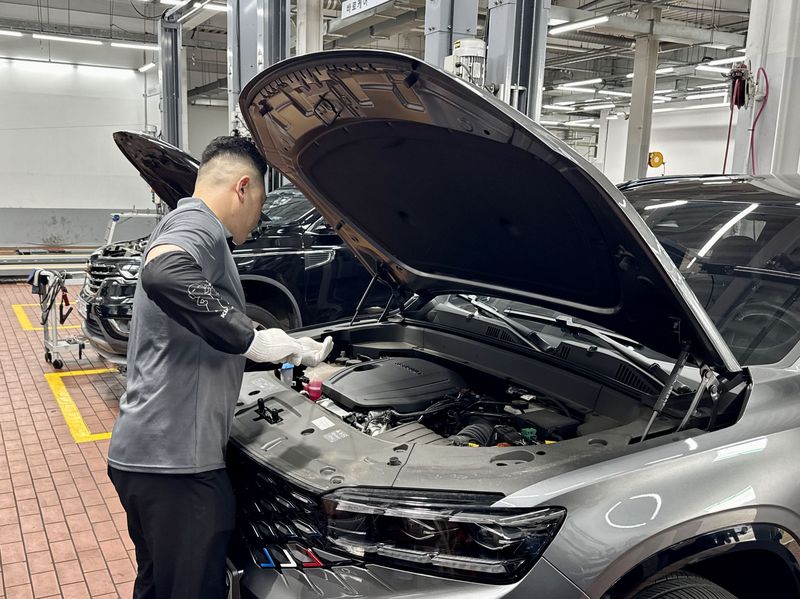
In the general repair area, where lifts moved up and down, two mechanics worked in pairs to complete an inspection checklist. One mechanic sat in the driver's seat, pressed the brake and switched on each light, while the other walked around the vehicle to check that the lights were working properly. They also opened the hood to inspect the oil levels, coolant and battery condition. Adding brake-pad and tire wear, as well as the wipers, brought the total to 12 inspection items and took about 15 minutes.Kim Young-hoon, head of the general repair team, said, "This is a basic service provided even when customers do not make a separate request," adding, "In summer, we also inspect air-conditioning items, while in winter, we add heater-related items." Electrified vehicles require a broader inspection. Hybrid vehicles undergo checks of 38 items, while electric vehicles undergo checks of 40 items, taking about 20 minutes. Components that cannot be assessed visually, such as the cells and charge level of the high-voltage battery and the motor, must be read using dedicated diagnostic equipment.
The complimentary inspection program changed this month. Renault Korea extended the body and general-parts warranty for customers who purchase the 2027 Grand Koleos or Renault Filante from the previous three years or 60,000 km to seven years or 140,000 km. It also extended the warranty for major engine and powertrain components from five years or 100,000 km to seven years or 140,000 km. In return, customers must receive one complimentary inspection per year and pay for engine-oil replacement to maintain the warranty. The coverage transfers to a used-car buyer as long as these conditions are met.
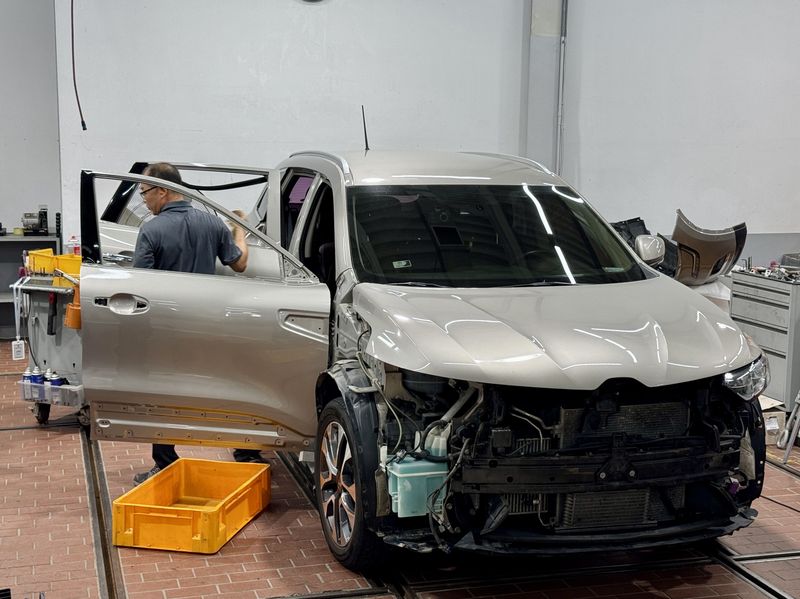
As we moved farther into the general repair area, the machinery grew louder. This was the body repair and painting section. The facility can handle up to four vehicles at once—one in each paint booth and two in the large sanding booth. The number increases when working on individual parts such as bumpers or doors.
The most sensitive decision in this area is whether to perform bodywork. All three models currently on sale—the Grand Koleos, Renault Filante and Renault Arkana—use ultra-high-strength steel, which is stronger than conventional steel. Choi Yong-kwon, who has more than 30 years of experience in body repair, said, "Applying heat to damaged ultra-high-strength steel can affect its rigidity and corrosion resistance," adding, "If safety and appearance cannot be properly restored, we recommend replacing the part rather than repairing the bodywork."
■A push based on consumables, repair costs and tire life
Renault Korea's service network has 365 locations nationwide, including seven directly operated centers. Of these, 88 can handle body repair and painting. As of January, Renault Korea had 3,419 registered vehicles per service center, fewer than KG Mobility (KGM) with 2,307 and GM Korea Operations with 3,273. The fewer vehicles each center serves, the denser the service network is considered to be.The parts-supply system is also designed to reduce waiting times. Lee said, "Our 274-pyeong parts warehouse holds about 5,100 items worth 470 million won," adding, "We can carry out repairs quickly without many stockouts." The 146 parts dealerships nationwide, including this warehouse, ship orders received that day on the same day. The on-site fulfillment rate for parts needed at service locations reaches 93%.
Costs were also presented in figures. As of the end of June, a single engine-oil set replacement for the Renault Filante cost 131,000 won based on parts and labor at directly operated centers, below the 137,000 won charged for comparable competing models. An air-conditioning filter cost 57,000 won versus 58,000 won. Lee said, "It is true that parts prices were high in the past because some parts were imported," adding, "Recently, however, parts prices have fallen considerably through localization." The two models have a parts localization rate of about 60%.
Renault Korea also worked to extend tire replacement intervals. At the Kumho Tire Central Research Institute in Yongin, Gyeonggi Province, which we visited before Changwon, the development process for the 20-inch Crugen HP71 (245/45 R20), jointly used on the Grand Koleos and Renault Filante, was unveiled. Lee Jae-hyun, a senior researcher at Kumho Tire, said, "At the first development meeting, Renault Korea's evaluation team asked us to focus on fuel economy and ride comfort," adding, "It was an idea that challenged tire developers' conventional wisdom."
In general, as wheel diameter increases, tires become heavier and their contact patch with the road grows. Because the sidewalls become thinner, there is less room to absorb bumps. Steering response, however, becomes sharper. That is why a request to prioritize fuel economy and ride comfort for a 20-inch tire was unusual.
Kumho Tire repeatedly refined the compound, tread pattern and structure, lowering the rolling-resistance index to the target of 6.1. This was 16% lower than comparable products sold on the market. Taking the weight of the hybrid body into account, it also improved the compound's wear performance by more than 30%. As a result, wear resistance improved by more than 17% compared with the 19-inch tires on the Renault QM6. The company estimates that, assuming annual driving of 20,000 km and regular tire rotation, the tires can last about 20,000 km, or roughly one additional year, longer.
The improvement in fuel economy was also evident during the drive. The Renault Filante E-Tech hybrid traveled 214.5 km from Goesan Rest Area to Changwon Jungang Service Center, recording an average fuel economy of 19.6 km/L on the instrument panel. That was more than 4 km/L above its official combined fuel economy of 15.1 km/L. Despite riding on 20-inch tires, impacts did not linger when the vehicle crossed road joints.
[email protected] Dongchan Kim Reporter