"My Favorite Is AI"—Teens and Twentysomethings Chat with AI for Two Hours a Day
- Input
- 2026-09-07 16:16:47
- Updated
- 2026-09-07 16:16:47
[Financial News] Beyond generative artificial intelligence (AI) used for searches and work, relationship-oriented AI that users converse with like a friend or romantic partner is rapidly spreading, particularly among people in their teens and twenties. General-purpose AI services such as ChatGPT dominate in terms of user numbers, but the average usage time per user for some relationship-oriented AI services was as much as six times that of ChatGPT. Analysts say AI is expanding beyond being a tool for obtaining information and is increasingly being consumed as content for conversation and spending time.
According to an AI app analysis by IGAWorks' Mobile Index released on the 7th, general-purpose generative AI services led in terms of user numbers in August. ChatGPT ranked first with 17,099,052 monthly active users (MAU), followed by Claude, A., Perplexity AI, and Grok.
However, relationship-oriented AI services stood out in terms of total usage time and time spent by users. PolyBuzz, an AI character chat app, ranked third among all AI apps with 1,362,125 total hours of usage. That was a 232% increase from 410,769 hours during the same period a year earlier. Babechat, another AI character chat service, ranked fifth with 483,115 hours.
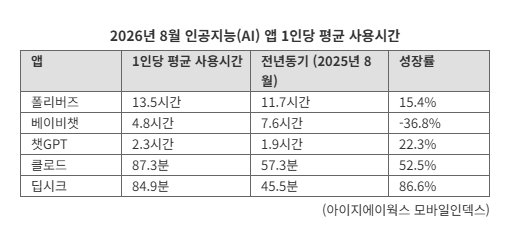
The rankings were reversed for average usage time per user. PolyBuzz recorded the longest average monthly usage among all AI apps at 13.5 hours, while Babechat ranked second at 4.8 hours. Compared with ChatGPT's 2.3 hours, those figures were approximately six times and twice as high, respectively. Claude recorded 87.3 minutes, while DeepSeek recorded 84.9 minutes. General-purpose AI has attracted a broad user base, whereas relationship-oriented AI has produced a high-engagement pattern in which a relatively smaller number of users spend far more time on the services.
New users are also continuing to join. PolyBuzz recorded 67,945 new installations last month, ranking fifth among all AI apps and marking a 215% increase from the same period a year earlier. With both total usage time and new installations more than tripling in one year, the service is expanding its user base and the intensity of use at the same time.
PolyBuzz and Babechat allow users to choose AI characters and converse with them as friends or romantic partners, or create stories together. Unlike general-purpose AI, whose use typically ends after a user asks a question and receives an answer, these services place greater emphasis on entertainment, with the conversation and the formation of a relationship with the character serving as ends in themselves.
People in their teens and twenties form the core user base of relationship-oriented AI. In August, users aged in their teens or younger and those in their twenties accounted for approximately 70% of PolyBuzz's total MAU. At Babechat, the proportion exceeded 91%.
Young users are also prominent on domestic character chat services. At Zeta, operated by Scatter Lab, users aged in their teens or younger and those in their twenties accounted for 82% of all users in August. Their usage intensity was also high. Average monthly usage time per user exceeded 47 hours among users aged in their teens or younger and 61 hours among those in their twenties.
At Crack, operated by Wrtn Technologies, users aged in their teens or younger and those in their twenties likewise accounted for approximately 90% of all users. Average monthly usage time per user exceeded 24 hours for those aged in their teens or younger and 30 hours for those in their twenties. The service structure, which encourages users to converse continuously with specific characters and build relationships and narratives, is believed to lead to extended use among younger people. However, Zeta and Crack are classified as dating and chat apps in Mobile Index's data and were therefore not included in the AI app rankings.
Kim Na-jeong, a legislative researcher at the National Assembly Research Service (NARS), wrote in a report, "Character-based AI conversation services are designed to allow users to establish the worldview or relationship they want, which can strengthen emotional immersion." Kim added, "However, concerns have also been raised that they could replace real-world human relationships or intensify social isolation and emotional problems."
[email protected] Choi Hye-rim Reporter