Ulju County Hospital Opens Under Private Consignment Management and Begins Full-Scale Medical Services
- Input
- 2026-09-06 10:21:20
- Updated
- 2026-09-06 10:21:20
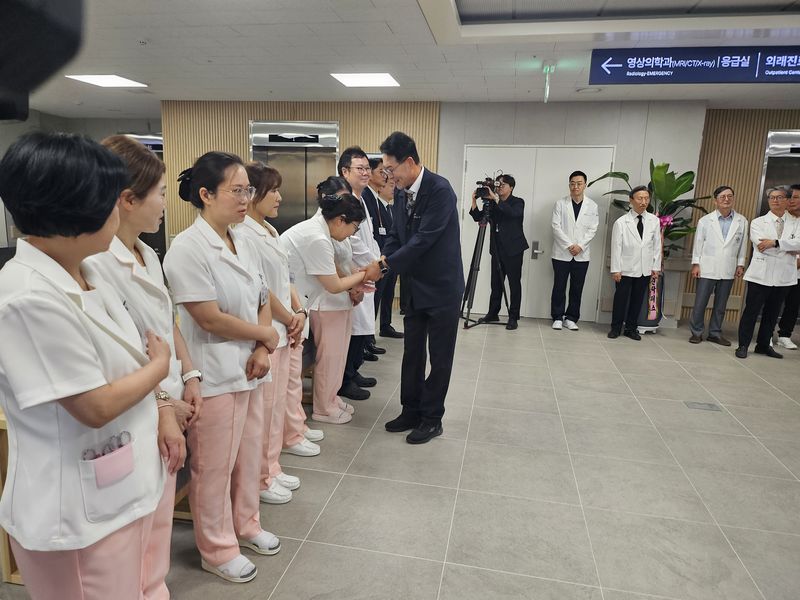
[Financial News] As the annual medical losses of the nation’s 35 local medical centers exceed 500 billion won and most public hospitals suffer from capital impairment and chronic deficits, Ulju County in Ulsan is embarking on an ambitious challenge to shed the chronic deficit stigma attached to public medical institutions.
Ulju County, Ulsan, has decisively adopted a private consignment-management model, entrusting the management and operation of its county-run medical institution, Ulju Hospital, to a private medical foundation.
The county plans to erase the vicious cycle of finances and the stigma characteristic of public hospitals by entrusting the hospital and medical facilities it established to a private medical corporation. The entrusted corporation will open and operate the medical institution and take responsibility for hiring 150 employees, including doctors and nurses, thereby bringing in the private sector’s strong medical capabilities and efficient management methods.
Ulju County, the entrusting party, will cover operating losses for three years. After that, the entrusted operator, Ongroup Medical Foundation, will assume full responsibility for employment and management.
Under this unusual arrangement, a private medical corporation leases a public hospital built by a local government, opens a medical institution there and operates it. If the hospital generates profits through surplus management beginning in its fourth year, Ulju County and the entrusted operator will split them equally. This distinctive consignment model has drawn attention from local governments and the medical community nationwide.
■ Full-scale medical services begin on the 4th; 53.4 billion won invested to establish an essential-care hub
Ulju Hospital, officially named Ulju Hospital of Ulsan Metropolitan City and Ulju County, opened its doors on September 4 and began full-scale medical services. The hospital is intended to serve as an essential-care hub and fulfill a long-standing wish of residents in southern Ulju County. It treated about 50 patients on its first day.
Ulju Hospital was created by purchasing and remodeling the site and building of the former Onyang Boram Hospital at 233 Deoknam-ro, Onyang-eup, Ulju County. The building has one basement level and seven above-ground floors, with a total floor area of approximately 4,429 square meters. About 53.4 billion won was invested in the project, based on the 2026 supplementary budget. Tens of billions of won were spent on structural reinforcement and pipe replacement due to the building’s age, seismic upgrades for the emergency and operating rooms, and advanced medical equipment, including an MRI costing about 2.3 billion won, a CT scanner costing about 1.1 billion won and endoscopy-center equipment costing about 900 million won. The hospital has 100 beds.
Since the 4th, the hospital has provided services mainly through five departments—family medicine, internal medicine, surgery, radiology and anesthesiology and pain medicine—as well as an artificial kidney unit, a comprehensive health-screening center and operating rooms.
The operating suite has two operating rooms for general and orthopedic surgery. Orthopedic services will be added in late September, and additional departments, including neurology, will be introduced in stages depending on the availability of medical staff. The 24-hour emergency room, a key part of the regional medical safety net, is scheduled to begin operating in stages during October once staffing is complete.
■ Transferring the know-how of Busan’s established hub, On Hospital Group, to achieve both medical quality and management efficiency
The entrusted operator of Ulju Hospital is Ongroup Medical Foundation, a leading medical institution in Busan, chaired by Yoon Sun-hee. Ulju County and On Hospital Group signed a consignment contract in November 2024. The five-year contract runs from January 1, 2026, through December 31, 2030.
The greatest source of momentum Ulju Hospital is expected to gain from the private consignment arrangement is On Hospital Group’s proven medical infrastructure and advanced management system. Since On Hospital opened in March 2010 with 180 beds under its founder, Dr. Jeong Geun, who also heads Jeonggeun Eye Hospital, it has grown rapidly over 16 years into a leading mid-sized hub medical institution in the Busan-Ulsan-Gyeongnam region, with university-hospital-level clinical capabilities and high bed-occupancy rates.
On Hospital Group currently operates a large medical system with approximately 1,300 beds, including 700 acute-care beds at On General Hospital and 650 beds at its long-term-care hospital. It also operates a cancer center and a comprehensive health-screening center regarded as among the best in the Busan-Ulsan-Gyeongnam region. Ulju County expects that transferring On Hospital’s strong network of medical personnel and its treatment and testing systems directly to Ulju Hospital will eliminate uncertainties that may arise during the hospital’s early operation and raise the quality of care to a university-hospital level within a short period.
■ Independent accounting and performance-based management: “Escaping deficits while securing a safety net for residents”
Unlike existing local medical centers, which have faced financial difficulties because of large organizational structures and rising salaries for employed doctors amid recruitment challenges, Ulju County plans to establish a rational accounting structure and a swift decision-making system by applying the accumulated hospital-management expertise of On Hospital Group.
Under the contract, Ulju Hospital’s accounts will be managed strictly as independent accounts. The entrusted operator must submit an annual business plan and an audit report from an external certified public accountant to the county. About 6.6 billion won has been budgeted for consignment operating expenses in the hospital’s first year. During the initial three years, the county will cover all operating losses generated by the hospital. For the following two years, it will cover losses in public emergency medical services, including the 24-hour emergency room.
The contract also includes an incentive allowing up to 50% of remaining revenue to be paid to the entrusted operator if a balance remains after settlement of consignment fees or if the hospital succeeds in operating independently on its own revenue. This is expected to encourage the private operator to improve management efficiency autonomously. In addition, an operations committee comprising representatives recommended by Ulju County and the county council, as well as medical experts, will provide oversight and supervision to safeguard the hospital’s public role.
■ Attention from local governments nationwide: A new paradigm for public healthcare
Residents in southern Ulju County have long faced the inconvenience of traveling to nearby urban centers for simple treatment or detailed examinations because of the lack of comprehensive medical infrastructure. Once Ulju Hospital becomes fully operational, access to medical care for local residents is expected to improve significantly, while the hospital could also become a new model for overcoming the chronic financial crisis facing public healthcare.
An Ulju Hospital official said, “We will become a reliable health safety net where residents of southern Ulju County, who have long experienced inconvenience when using hospitals, can receive treatment nearby with peace of mind.” The official added, “Beginning with the launch of medical services, we will proceed without disruption with the expansion of care, including the phased operation of the emergency room, and establish ourselves as a hospital that local residents can trust and visit.”
With Ulju Hospital seeking to create “sustainable public healthcare” by combining the limitations of public service with the management efficiency of the private sector, attention is focused on whether its private consignment experiment can become a successful case that ends the tragic history of public hospitals. The opening has also drawn interest from local communities concerned about revitalizing regional healthcare and the disappearance of local areas, as well as from local governments nationwide.
[email protected] Byun Ok-hwan Reporter