[Exclusive] 21 Arrested Daily on Fraud Charges... 7,788 Teenagers and Younger Arrested Last Year
- Input
- 2026-09-06 14:05:03
- Updated
- 2026-09-06 14:05:03

[Financial News] More than 7,000 suspects aged teenagers and younger were arrested on fraud charges last year, data showed. As young people increasingly participate in crimes resembling those committed by adults through online platforms and social networking services (SNS), experts say measures are needed to raise awareness of crime and prevent repeat offending and organization.
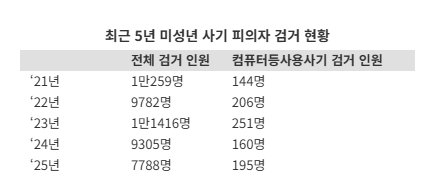
Data submitted by the Korean National Police Agency to the office of Kang Myung-gu of the People Power Party, a member of the National Assembly’s Security and Public Administration Committee, and obtained by Financial News on the 6th showed that 7,788 suspects aged teenagers and younger were arrested on fraud charges last year. That amounts to an average of about 21 a day.
The number of fraud suspects aged teenagers and younger fell from 10,259 in 2021 to 9,782 in 2022, before rising to 11,416 in 2023. It then declined for two consecutive years, to 9,305 in 2024 and 7,788 last year. Their share of all fraud suspects also fell from 6.3% in 2021 to 5.8% in 2022, 6.1% in 2023, 4.4% in 2024 and 4.0% last year.
Some categories, however, followed a different trend. The number of suspects aged teenagers and younger arrested for "fraud using computers, etc." rose from 144 in 2021 to 206 in 2022 and 251 in 2023. Although the figure fell to 160 in 2024, it rose again to 195 last year. That was a 35.4% increase from 2021.
Experts focused on the environment in which young people routinely use social media and secondhand trading platforms. Because crimes can be committed without meeting the other party in person, fraud may be easier to approach, while offenders may perceive the risk of detection as lower than in face-to-face scams. Online crimes can also take relatively more time to trace and verify the identities involved. Young people may become involved as perpetrators, rather than merely victims, while directly buying and selling goods or game items.
In cases of small-value fraud, an investigation does not always follow even when victims request one. Individual victims often find it difficult to respond on their own, so multiple victims may file a joint report or pursue civil litigation. Analysts say that young people’s awareness of these limitations in the investigation and punishment process could lower the psychological barrier to committing such crimes.
Yeom Gun-woong, a professor in the Department of Police and Fire Administration at Yuwon University, emphasized, "Some young people tend to take small-value crimes lightly, but they are ultimately fraud offenses and will result in criminal punishment. We need to raise awareness of this."
To prevent youth fraud from recurring and expanding, experts have also called for differentiated responses from the early stages, based on the seriousness of the offense and whether the offender is a repeat offender. Even in small-value cases, first-time offenders should be distinguished from repeat and habitual offenders, with appropriate measures such as education or community service. More severe punishment should be imposed when the conduct is particularly egregious, such as repeated offenses or actions causing numerous victims. This would help prevent crimes from expanding into schemes involving multiple participants.
Professor Lee Keon-su of Baekseok University advised, "The adultification of crime is emerging as young people deceive others and obtain money while buying and selling goods or game items. We must prevent youth crime from expanding and becoming organized."
Measures are also needed to block online offenses at an early stage. Police, information and communications-related agencies, and secondhand trading platforms could share crime-related information to quickly block accounts used in offenses, while dedicated teams continuously search for and track related crimes.
Kang Myung-gu said, "Although the overall number of youth fraud suspects is declining, certain types of crime, such as fraud using computers, etc., are increasing. We need to closely examine the routes through which young people become involved in fraud." He added, "The police and relevant agencies must systematically analyze the causes of youth involvement in fraud and the extent of repeat offending, and develop effective measures to keep young people from entering a life of crime."
[email protected] Kim Ye-ji Reporter