"How can I leave 300 million won in insurance benefits to my young daughter?" A father's decision after agonizing over how to pass on a death benefit
- Input
- 2026-09-06 14:58:23
- Updated
- 2026-09-06 14:58:23

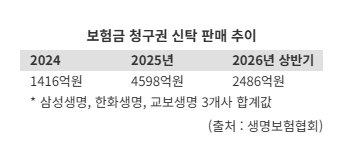
[Financial News] Insurance benefit claim-right trusts, which distribute death benefits in installments when needed rather than paying them all at once, are rapidly gaining ground. Sales by the top three life insurers—Samsung Life Insurance, Hanwha Life Insurance and Kyobo Life Insurance—nearly reached 250 billion won in the first half of this year alone. They are expected to surpass last year's sharply increased total. Industry analysts say demand is growing to use death benefits not merely as a lump sum, but as a tool for inheritance and asset management, as sales have surged since the system was introduced in 2024.
According to the insurance industry on the 6th, sales of insurance benefit claim-right trusts by the three largest life insurers—Samsung Life Insurance, Hanwha Life Insurance and Kyobo Life Insurance—totaled 248.6 billion won in the first half of this year. That was equivalent to 54.1% of last year's full-year sales of 459.8 billion won. The three companies' sales rose 3.2-fold in one year, from 141.6 billion won in 2024 to 459.8 billion won in 2025. With first-half sales already exceeding half of last year's annual figure, the insurance benefit claim-right trust market continues to expand.
An insurance benefit claim-right trust is a system that allows a policyholder to predetermine not only who will receive the insurance benefit after the policyholder's death, but also when and how it will be paid. The system was formally permitted through an amendment to the Financial Investment Services and Capital Markets Act in November 2024.
For example, parents can designate their child as the insurance benefit beneficiary while arranging for the benefit to be paid as a fixed monthly living allowance instead of in a lump sum immediately after their death. They can also structure the payments to cover education expenses or wedding costs when the child reaches a certain age. This expands on the previous system, under which the benefit was simply paid to the beneficiary upon the policyholder's death, by allowing the policyholder to plan the management and payment of the benefit during their lifetime.
The insurance industry views population aging and growing demand for inheritance and asset management as the backdrop to the market's expansion. As more people seek to transfer assets gradually, rather than all at once, while taking into account their children's ages and financial circumstances, the use of insurance benefit claim-right trusts is also expected to increase.
In particular, demand has recently emerged for using death benefits according to specific purposes and timing, rather than simply receiving them. In addition to insurance benefit claim-right trusts, which allow policyholders to plan how death benefits will be passed on after their death, a liquidity program enabling policyholders to use part of the death benefit during their lifetime also took effect on October 30 last year. As a result, death benefits are beginning to be viewed as assets that can serve various purposes, including retirement living expenses as well as inheritance.
Insurers are also expanding related products and services. This allows them to extend their business beyond simply selling insurance products into inheritance and asset management. Some are also seeking to use these services as a new customer-management tool, since they can maintain contact with customers even after the insurance benefit has been paid.
An insurance industry official said, "Insurance benefit claim-right trusts differ from conventional insurance in that they allow policyholders to plan during their lifetime not only how to pass on a death benefit as a lump sum, but also when and in what manner it will be paid. As population aging and demand for inheritance and asset management continue to grow, we expect a variety of trust services tailored to customers' circumstances to emerge in the future."
[email protected] Hong Ye-ji Reporter