[Exclusive] “Even 70 million won in moving expenses was rejected”... Landlord offers a ‘blank check’
- Input
- 2026-09-06 14:49:13
- Updated
- 2026-09-06 14:49:13
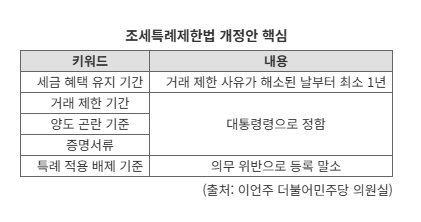
Registered rental business operators who had been blocked from selling their homes by redevelopment restrictions are expected to have a broader exit route. A proposal is being pursued to extend the period for retaining capital gains tax benefits from “until one year after the public notice of transfer” under the existing government plan to “at least one year after the reason for the transaction restriction is removed.” Specific standards for the transaction-restriction period will be set later by presidential decree.
Relaxation from up to one year to at least one year
According to Financial News reporting on the 6th, the office of Lee Un-ju of the Democratic Party of Korea is preparing an amendment to the Restriction of Special Taxation Act containing these provisions. The key measure is to exclude the period during which a rental home could not be sold because of a redevelopment project and guarantee at least one year to sell after transactions become possible.
The biggest difference from the government’s finalized tax reform plan concerns the “period for retaining benefits.” In its recently announced final plan, the government set the period for capital gains tax benefits for rental business operators holding redevelopment properties at one year after the public notice of transfer.
The period, which was effectively capped at one year, would be significantly relaxed to at least one year. “Of course, we need to watch how things develop, but depending on how it is interpreted, the period for retaining tax benefits could be extended by five or even 10 years,” a senior rental-industry official who requested anonymity predicted.
The amendment also states that details concerning the starting and ending dates of the transaction-restriction period, the criteria for determining cases in which a transfer is exceptionally difficult, and applications and supporting documents will be prescribed by presidential decree. An official from Lee Un-ju’s office explained, “Registered rental business operators are people who have contributed to supplying jeonse and monthly rental housing during a specific period. While aligning with the government’s finalized plan, we intend to give landlords who have fulfilled their obligations some ‘room’ in the period available for selling.”
“More wide-ranging improvements are needed”
The amendment would provide some rental business operators with relief in disposing of their homes. However, critics say broader improvements are needed because regulations such as land transaction permit zones remain in place, while many rental business operators are set to reach the end of their mandatory rental periods by 2028.
According to the rental industry, 24,267 households in Seoul apartments are scheduled to reach the end of their mandatory rental periods this year. Including next year and the year after, the figure will far exceed 45,000 households.
The problem is that all of Seoul and major areas of Gyeonggi have been designated as land transaction permit zones, Areas Subject to Adjustment, or Speculative Overheating Districts. As a result, even properties outside redevelopment areas may require actual-residence obligations to be sold.
Recent meetings with rental business operators confirmed that some are struggling because they cannot sell their homes due to their tenants.
Mr. B, who operates an apartment rental business in Seoul, recently offered his tenant 70 million won in moving expenses in exchange for vacating the home so he could sell it, but the offer was rejected. Even after Mr. B offered, “I’ll give you a blank check, so tell me what you want,” the tenant reportedly responded, “You make the first offer.” From Mr. B’s perspective, he cannot offer 100 million won either, leaving him in an agonizing daily struggle.
Another problem is that tenants may exercise their renewal rights again after eight years of rental. Mr. C, a rental business operator, completed the mandatory eight-year rental period but had to renew the lease for another two years because of a difference of just a few days. Mr. C lamented, “If the tenant exercises the right to request a contract renewal in the 10th year, I will be forced to provide the property as a rental for 12 years,” adding, “There needs to be a more fundamental solution.” Lee Sang-young, a professor in the Department of Real Estate at Myongji University, said, “The problem is that a tenant cannot be immediately evicted simply because the mandatory rental period has expired. Ultimately, the property cannot be sold until the tenant’s rental period ends.”
[email protected] Kwon Jun-ho, Jung Kyung-soo Reporter