Chairman Chung Eui-sun: "We Will Supply High-Grade Steel Sheets Made at the First K-Steel Mill in the U.S. to Cars, Robots and Rockets"
- Input
- 2026-09-05 12:22:07
- Updated
- 2026-09-05 12:22:07
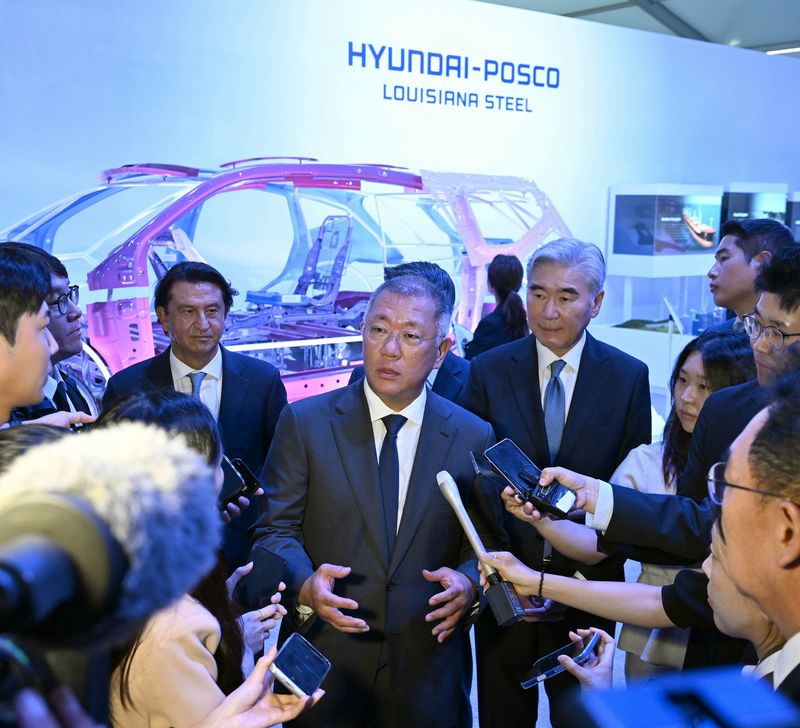
At the groundbreaking ceremony for the Hyundai-POSCO Louisiana Steel (HPLS) electric-arc-furnace steel mill held in Donaldsonville, Ascension Parish, Louisiana, on the 4th local time, Chung Eui-sun said, "We will combine direct reduced iron and electric-arc-furnace technologies to produce high-grade, low-carbon steel. It will be used in next-generation mobility produced by Hyundai Motor Company, Kia Corporation and other automakers, as well as in AI data centers and power-generation facilities." Later, when reporters asked whether the steel produced there could be used in Atlas, Hyundai Motor Group’s humanoid robot, Chung replied, "I think we certainly should apply it." He added, "I hope that, by working harder in the future, we will be able to supply steel for rockets, including those made by SpaceX."
Hyundai Steel Company is partnering with POSCO to build the HPLS electric-arc-furnace steel mill in Donaldsonville, with annual capacity of 2.7 million tons—1.8 million tons for automobiles and 900,000 tons for general applications. HPLS will produce direct reduced iron (DRI), a raw material for steelmaking, using iron ore and natural gas, then melt it with high-grade steel scrap in an electric arc furnace to manufacture finished products. Hyundai Steel Company says the process can reduce carbon emissions by about 70% compared with molten iron produced at Dangjin Steelworks. Construction is scheduled to begin in the fourth quarter, after the local government completes its permitting procedures. The total investment is $5.8 billion, or approximately 8 trillion won, with commercial production targeted for 2029.
Hyundai Steel Company plans to operate HPLS to reduce the burden of U.S. tariffs on steel products while improving access to the North American market through low-carbon steel products.
Chung Eui-sun, who announced plans last March at the White House to invest more than $20 billion in the United States, including the construction of a steel mill, said he was pleased that HPLS had taken its first major step. "With the state government and everyone working together to help, the project is proceeding on a normal track," he said. Noting that the United States imports 20 million tons of steel annually and will be able to source high-value specialty steel and low-carbon steel through HPLS, Chung said, "I think there are benefits for both sides—the United States and Hyundai Motor Group—and that we can create synergies."
José Muñoz, president of Hyundai Motor Company, also told reporters, "We want to use HPLS steel in the cars we produce in the United States." He added, "We plan to apply it to all vehicle types, and to as many models as possible. We want to localize as much as possible the steel used at our U.S. plants in Alabama and Georgia." Emphasizing that HPLS steel will be produced locally in the United States and will be a low-carbon product, Muñoz said, "Other automakers are also interested in HPLS steel, and we may be able to produce and supply steel to them as well." He added, "We are actually in discussions with some of them."
[email protected] Eun-hyo Cho Reporter