Jeju Education Office to Cut Headquarters Bureaus and Divisions, Strengthen School Support; Reorganization to Be Redrawn in 2028
- Input
- 2026-09-05 01:38:14
- Updated
- 2026-09-05 01:38:14
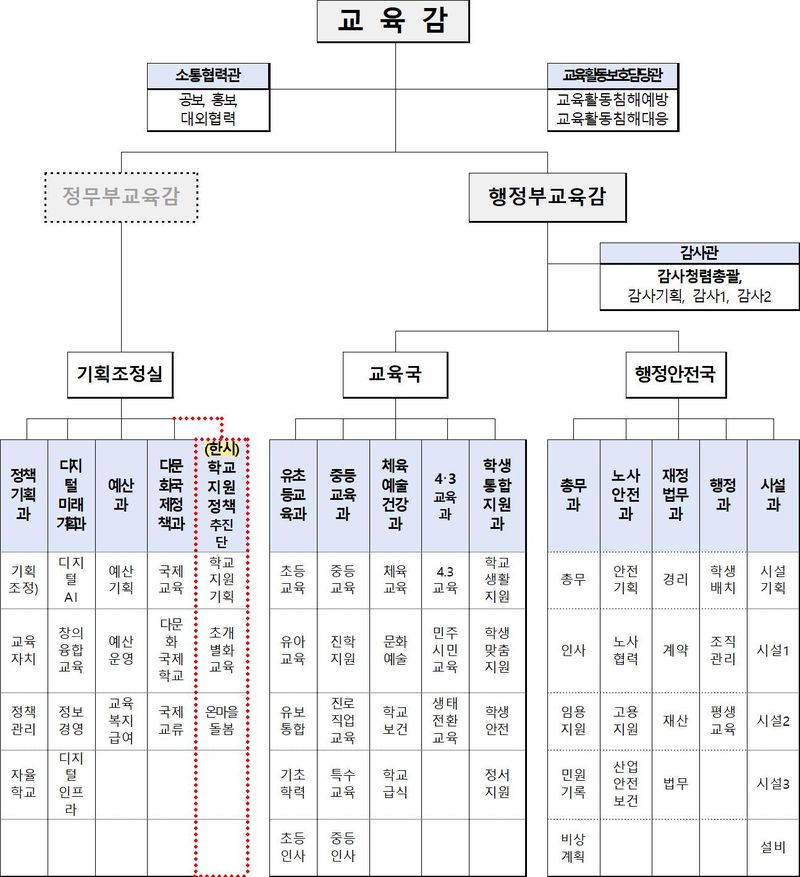
【Financial News Jeju = Reporter Jeong Yong-bok】 The Jeju Special Self-Governing Provincial Office of Education is moving to reorganize its headquarters by reducing bureau- and division-level units while strengthening functions related to protecting teachers’ rights, providing integrated student support and assisting schools. The headquarters will be reorganized first next year, followed by a two-stage overhaul in 2028 after a yearlong analysis of the support services schools actually need. The second stage will include education support offices and affiliated institutions.
According to the Jeju Special Self-Governing Provincial Office of Education on the 5th, the current headquarters structure of one office, three bureaus, two officers, 16 divisions and 64 units will be reorganized from January 2027 into one office, two bureaus, three officers, 14 divisions, one task force and 68 units.
The plan will eliminate one bureau and two divisions while creating one officer and one temporary task force, increasing the number of units by four. It is designed to reduce organizational layers while subdividing the practical functions that carry out the work.
Regular staffing will increase by five, from 1,564 to 1,569. The number of education professionals will rise by six, from 166 to 172, while general staff will decrease by one, from 1,387 to 1,386.
Temporary positions, which are not included in the regular staffing total, will increase by eight from the existing 25 positions for directors of extended-care support offices, bringing the total to 33. The figure of “13 additional positions” presented by the provincial education office combines the net increase of five regular positions with the eight new temporary positions.
The most notable change is the elevation of the education activity protection function. An Education Activity Protection Officer will be established directly under the superintendent to handle the prevention of and response to interference with educational activities within one organization. The plan is to build a system linking prevention, response and the restoration of the educational community, rather than merely processing cases after violations of teachers’ rights occur.
The existing Public Information Officer will be expanded and reorganized as the Communications and Cooperation Officer. In addition to public information and promotion, it will combine cooperation functions involving the provincial council, local governments and the community, serving as a communications channel directly under the superintendent.
The status of the auditor will also be elevated. The auditor directly under the deputy superintendent for administration will be upgraded from Grade 4 to Grade 3, and investigation functions related to sexual misconduct, which had been divided among departments, will be consolidated under the auditor.
A separate organization will also be created to redesign school support functions. The School Support Policy Task Force, a temporary organization for 2027, will be established under the Planning and Coordination Office. It will consist of three units: school support planning, highly individualized education and community-wide care.
The school support planning unit will analyze school support services currently scattered across the headquarters, education support offices and affiliated institutions, and identify functions whose coverage should be expanded to high schools. After gathering field opinions and analyzing functions in 2027, the overall support system will be redesigned in 2028 by expanding the school support functions of education support offices or reorganizing affiliated institutions.
Education support offices will also undergo changes. The Jeju City Office of Education will retain its current 25 units, while eliminating three facilities operations units and creating three school support units. The Seogwipo City Office of Education will increase its total from 18 to 19 units and establish three school support units. Under the plan, education support offices will take charge of such services as supporting field trips for schools at all levels.
Student support will be consolidated into the newly established Student Integrated Support Division. Functions related to school life support, customized student support, student safety and emotional support, which are currently divided among several departments, will be placed under the Education Bureau’s Student Integrated Support Division. If a student faces complex safety, emotional and daily-life support issues, one organization will connect and provide the necessary assistance instead of departments responding separately.
The Safety Bureau will be merged with the Administrative Bureau and reorganized as the Administrative and Safety Bureau. Student safety will be handled by the Student Integrated Support Division, while organization- and facility-centered safety functions, including disaster safety and industrial safety and health, will be transferred to the Labor Relations and Safety Division.
The Future Space Planning Division and the School Facilities Division will be merged into the Facilities Division. Similar functions will be combined into one department to reflect changes in the scale of facility projects and workload.
The Jeju Uprising Education Division will also be established to reflect the region’s historical identity in the organization. It will reorganize the functions of the existing Democratic Citizenship and Culture Education Division and take charge of the peace and human rights values of the Jeju uprising, education about Jeju, democratic citizenship education and ecological transition education. The organizational chart places units for Jeju uprising education, democratic citizenship education and ecological transition education under the Jeju Uprising Education Division.
Functions related to basic academic skills and the integration of early childhood education and care will also be strengthened. The existing Elementary Education Division will be renamed the Early Childhood and Elementary Education Division, with a dedicated basic academic skills function and links between early childhood education and integration-related work.
The groundwork for an AI-based personalized education organization will also be laid. The highly individualized education unit of the School Support Policy Task Force will pursue the development of an education support system tailored to each student’s characteristics and growth, while also reviewing a plan to establish a tentatively named “AI Future Education Institute.” However, the establishment of the AI Future Education Institute has not been finalized in this reorganization plan; preparations for its implementation will be developed in 2027.
Budget functions will be moved to the Planning and Coordination Office. The aim is to link policy planning with the allocation of financial resources and to formulate and manage budgets, including education welfare spending, in line with policy priorities.
The core of this reorganization is not simply to make the headquarters smaller. While reducing bureaus and divisions, it will increase the units and personnel that directly support schools and students, and elevate education activity protection to a function directly under the superintendent. Similar or dispersed functions, such as administration, facilities and safety, will be consolidated, while school support services will be transferred to education support offices.
The 2027 reorganization will not be the final structure. Over the next year, the provincial education office plans to reanalyze the functions of school support services and the roles of each institution, then complete an overall reorganization in 2028 covering education support offices and affiliated institutions.
The reorganization plan will undergo advance notice of legislation through the 10th, followed by legal review and deliberation and approval by the Jeju Provincial Council. It is scheduled to take effect on January 1, 2027.
An official from the Jeju education office said, “The headquarters will focus on policy, planning and coordination functions, while education support offices and affiliated institutions will strengthen their functions for supporting and implementing services at schools. We plan to complete the school support system in 2028 based on field opinions and functional analysis conducted in 2027.”
[email protected] Reporter Jeong Yong-bok Reporter