"Could the exchange rate reach the 1,200-won range?" Won falls into the 1,340-won range intraday for the first time in 14 months
- Input
- 2026-09-04 17:31:47
- Updated
- 2026-09-04 17:31:47
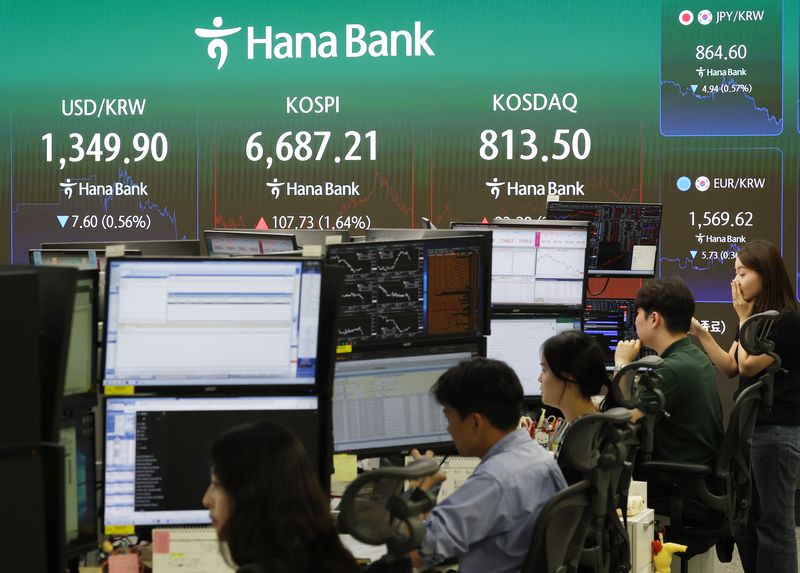
[Financial News] The won-dollar exchange rate entered the 1,340-won range during intraday trading for the first time in 14 months, posting a sharp decline. The drop came as the yen strengthened following strong verbal intervention by Japan’s foreign exchange authorities, while expectations that the Federal Reserve (Fed) would keep its policy rate unchanged also grew.
In the Seoul Foreign Exchange Market on the 4th, the won-dollar exchange rate closed at 1,350.4 won per dollar as of 3:30 p.m., the closing rate for regular trading, down 8.9 won from the previous trading day.
The exchange rate opened at 1,358.5 won and remained below the 1,360-won level throughout the morning. It then accelerated its decline in the afternoon, falling to 1,349.5 won at around 3:14 p.m. The won-dollar exchange rate entered the 1,340-won range for the first time in 14 months since July 1 last year, when it stood at 1,348.5 won. Based on the closing rate, it was the lowest level since June 30 last year, when it stood at 1,350.0 won. The rate has fallen by as much as 20 won over the past three trading days alone.
Compared with the year-to-date high of 1,559.2 won recorded on July 1, the rate had plunged by 209 won in just two months.
The key factor behind the sharp decline was the yen’s strength. Atsushi Mimura, a senior official at Japan’s Ministry of Finance, unsettled the market by warning of continued vigilance over recent exchange-rate movements, saying, "We are neither satisfied nor reassured by anything" and "will continue to remain on a war footing."
As a result, the dollar-yen exchange rate, which had been in the 158-yen range per dollar in the New York foreign exchange market the previous day, fell sharply into the 155-yen range. As of 3:30 p.m. on the 4th, the dollar-yen rate had also fallen 1.03 yen to 156.185 yen. At one point during the session, it dropped to 155.286 yen, a level seen immediately after the joint intervention by the United States and Japan last month. At the same time, the won-yen cross rate rose 0.23 won to 864.62 won per 100 yen.
Market expectations that the U.S. rate-hike cycle had effectively ended also fueled the dollar’s weakness. Federal Reserve Governor Christopher J. Waller said at a Reuters-hosted event the previous day, "If the data released over the next two weeks confirm that inflation is slowing, I will support keeping interest rates unchanged," sending a strong dovish signal. In fact, the U.S. Dollar Index (DXY), which measures the dollar’s value against the currencies of six major economies, fell 0.36 to 98.993 that day.
Downward pressure from domestic supply and demand was also strong. Exporters sold large amounts of dollars, while foreign investors made net purchases of 479.3 billion won on the Korea Exchange Main Board that day alone. Their buying advantage for the second consecutive trading day added further momentum to the exchange-rate decline.
[email protected] Jeon Sang-il Reporter