National Fire Agency Proposes 371.3 Billion Won Budget for Next Year; 41.1 Billion Won for Unmanned and Quadrupedal Robots and National Fire Hospital [2027 Budget Proposal]
- Input
- 2026-09-04 15:58:47
- Updated
- 2026-09-04 15:58:47
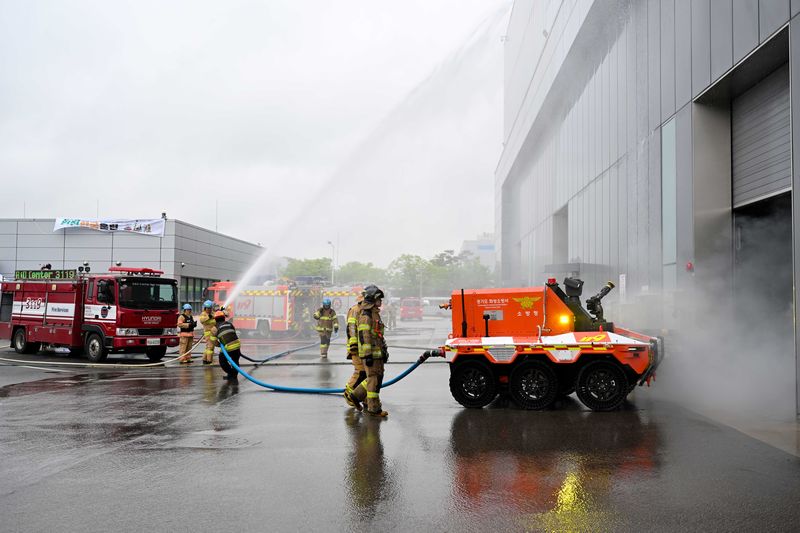
[Financial News] The National Fire Agency will invest 60.8 billion won in firefighting research and development (R&D) next year and 41.1 billion won in operating the National Fire Hospital. It will also expand investment in advanced firefighting equipment, allocating 16 billion won for 40 quadrupedal robots and 10.8 billion won for nine unmanned firefighting robots to be deployed at disaster sites. The NFA said on the 4th that it had set its 2027 government budget proposal at 371.3 billion won, up 10.3% from this year.
40 quadrupedal robots to be introduced; 10.8 billion won allocated for nine unmanned firefighting robots
The NFA will focus next year’s budget on expanding advanced equipment, research and development, reinforcing fire-prevention facilities, and supporting the safety and health of firefighters.
First, the agency will increase the number of unmanned devices that can be deployed ahead of firefighters at disaster sites to assess conditions. It allocated 16 billion won to introduce 40 quadrupedal robots and 10.8 billion won for nine unmanned firefighting robots. It will also spend 1.1 billion won to deploy three additional large wildfire-specialized firefighting vehicles to local governments for use in suppressing wildfires in rugged terrain.
The agency will also launch a new project to prevent factory fires. It allocated 5.9 billion won to install automatic fire-extinguishing devices at factories without sprinklers. These devices automatically release extinguishing agents when a fire breaks out and are easier and less expensive to install than sprinklers.
The NFA plans to provide automatic fire-extinguishing devices to 19,806 factories over the next five years, beginning next year. The average annual number of recipients will be 3,961. Priority will be given to factories more than 20 years old, small manufacturers, areas with a high concentration of industrial complexes, and workplaces where fires have repeatedly occurred.
The agency allocated 6.2 billion won to distribute standalone smoke detectors to aging apartments, a program launched this year, and 2.3 billion won to install emergency firefighting equipment in villages near forests.
The budget will also be used to improve firefighting communications networks. The agency allocated 3.1 billion won to establish a nationwide integrated control system for firefighting helicopters. The project will separate frequencies and duplicate radios to prevent control communications from being cut off while firefighting helicopters transport emergency patients.
A further 2.7 billion won will be invested in improving the firefighting wireless communications network. When a nationwide firefighting mobilization order is issued, the system will automatically create a call group on the disaster-safety communications network and convert radio voice communications into text for transmission.
The firefighting R&D budget was set at 60.8 billion won. A new 3 billion won allocation will fund the joint development with police of integrated command and communications technologies for public safety and firefighting operations. Another 4.5 billion won was newly allocated for the development of disaster-safety “physical AI” by the NFA, police, and the Korea Coast Guard. The project will develop and field-test technology that enables AI to independently detect, assess, and act on hazards at disaster sites.
The agency will spend 1.6 billion won to establish additional centers for strengthening command capabilities at disaster sites. Beginning with Daegu next year, the centers are scheduled to be established in South Jeolla Province in 2028, North Chungcheong Province in 2029, and northern Gyeonggi Province in 2030. Ten centers are currently operating nationwide.
15.7 billion won allocated for integrated firefighting helicopter management
Investment will also increase to improve the operational availability and flight safety of firefighting helicopters. The agency allocated 15.7 billion won for a nationwide integrated firefighting helicopter management project, including the construction of the 119 Aviation Maintenance Facility. The facility is scheduled for completion and operation beginning in July next year.
The budget also includes funding for the health and safety of firefighters. The agency will spend 8.1 billion won on mental and physical health support for firefighters, maintaining a system of 265 counselors for its “visiting counseling offices.” It allocated 41.1 billion won to operate the National Fire Hospital, including funding to build dormitories for medical staff. The National Fire Hospital is a specialized medical institution dedicated to treating work-related illnesses among firefighters and managing exposure to hazardous factors.
The agency will spend 4.6 billion won on the construction and operation of the National Fire Museum. Separately from the general account, it also secured funding for expanding rescue and emergency medical equipment. A total of 4.9 billion won from the National Property Management Fund will be used for the annex dormitory at the Cheonan campus of the National Fire Service Academy and the construction of a firefighter mental and physical training center. Another 41.2 billion won from the Emergency Medical Services Fund will be used to replace and reinforce 270 ambulances, while 2.3 billion won from the Lottery Fund will be used to replace specialized negative-pressure ambulances.
National Fire Agency Commissioner Choi Yong-cheol said, "We will strengthen our response capabilities at disaster sites by expanding advanced equipment and increasing investment in research and development." He added, "We will prepare for the future of firefighting so that technology supports firefighters’ safe operations in the field and leads to a safety system that the public can feel."
[email protected] Lee Bo-mi Reporter