Five Power Generation Companies to Launch Integrated Entity in October 2027; New Headquarters Also Planned
- Input
- 2026-09-04 14:57:54
- Updated
- 2026-09-04 14:57:54
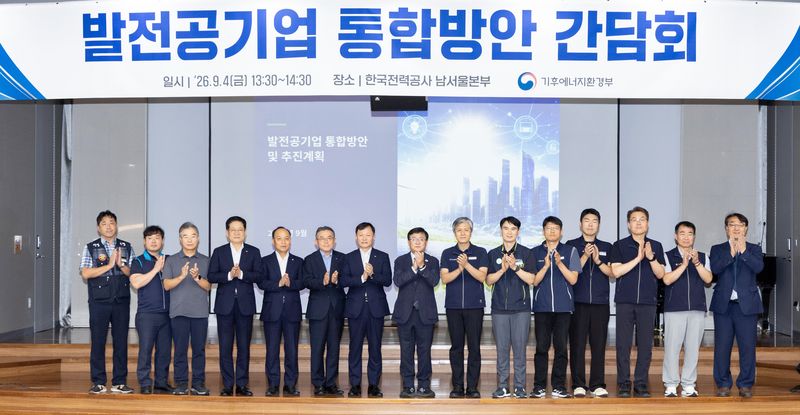
[Financial News] Korea South-East Power, Korea Midland Power, Korea Western Power, Korea Southern Power, and Korea East-West Power will be consolidated into a single company, Korea Power, in October 2027. The five headquarters currently located in Jinju, Boryeong, Taean County, Busan, and Ulsan will be combined into a new integrated headquarters employing approximately 1,800 people. About 600 employees from the existing headquarters will be assigned to three or four newly established regional renewable-energy headquarters. The Ministry of Climate, Energy and Environment announced the plan on the 4th at a meeting on the integration of state-owned power-generation companies held at the KEPCO Namseoul Headquarters in Seoul. Under the plan, the five companies will be consolidated into Korea Power, a wholly owned subsidiary of KEPCO.
Since February this year, the government has conducted a research project on restructuring the state-owned power-generation companies and gathered opinions from experts, labor unions, and the five companies. The study proposed consolidating the five companies into a single entity.
The organizational overhaul will also be substantial. The current structure of five presidents, five auditors, and 10 executive directors will be replaced after the integration by one president, one auditor, and four executive directors. In effect, the number of executive positions will fall from 20 to six.
The integrated headquarters will consist of four divisions: Renewable Energy, Just Transition, Safety and Technology, and Planning and Management. Of the approximately 2,400 employees currently working at the five company headquarters, 1,800 will work at the integrated headquarters, while the remaining approximately 600 will be assigned to three or four regional renewable-energy headquarters.
The regional renewable-energy headquarters will oversee local renewable-energy projects, including solar power and onshore wind power. The thermal power headquarters currently operating in each region will maintain their existing structure for the time being because of power plant operations and on-site safety. If coal-fired power plants are later retired or converted to other energy sources, the government will also consider redeploying personnel and adding more regional renewable-energy headquarters.
The location of the integrated headquarters has not yet been decided. The five power companies currently have headquarters in Jinju, Boryeong, Taean County, Busan, and Ulsan. However, the government believes their existing buildings, each capable of accommodating approximately 500 people, would be unsuitable for use as an integrated headquarters employing about 1,800 people.
Rather than dividing the organization among the five existing buildings, the government is considering constructing a new integrated headquarters. The specific location will be decided later after considering the current locations of the state-owned power companies, the regional impact of coal-fired power plant closures, and residential and working conditions, in connection with the government's second policy for relocating public institutions.
The government is also pursuing a special law for the integration. The bill is expected to include the legal basis for establishing Korea Power, procedures for handling permits and approvals related to power-generation businesses, the succession of existing companies' rights, obligations, and employment contracts, simplified merger procedures, and reduced tax burdens. The government is also considering provisions that would allow an exemption from corporate merger reviews. It aims to enact the special law during this year's regular session of the National Assembly.
Separately from the legislation, the Preparatory Committee for the Integration of State-Owned Power Companies, chaired by the second vice minister of the Ministry of Climate, Energy and Environment, will be formed this month. The five power companies, KEPCO, and experts in various fields will participate to discuss the organizational structure, personnel assignments, operating systems, integration procedures, and overseas businesses.
The companies will also work to consolidate their information technology, accounting, and human resources systems. The five power companies currently operate a total of 575 systems and software programs separately. The government has decided to commission a joint post-merger integration project involving the five companies to unify core systems, including enterprise resource planning (ERP), as well as organizational, human resources, accounting, and contract-management systems.
Once the special law is enacted, an integration promotion committee established under the law will take over the work of the preparatory committee. Following approximately one year of integration work, the government aims to complete Korea Power's corporate registration and appoint its executives in September 2027, then officially launch the company on October 1 of the same year.
[email protected] Lee Yu-beom Reporter