[Editorial] Korea Ranks Second Worldwide in First-Half Current-Account Surplus; It Must Tighten Its Focus on Fostering Growth Beyond Semiconductors
- Input
- 2026-09-04 14:48:40
- Updated
- 2026-09-04 14:48:40
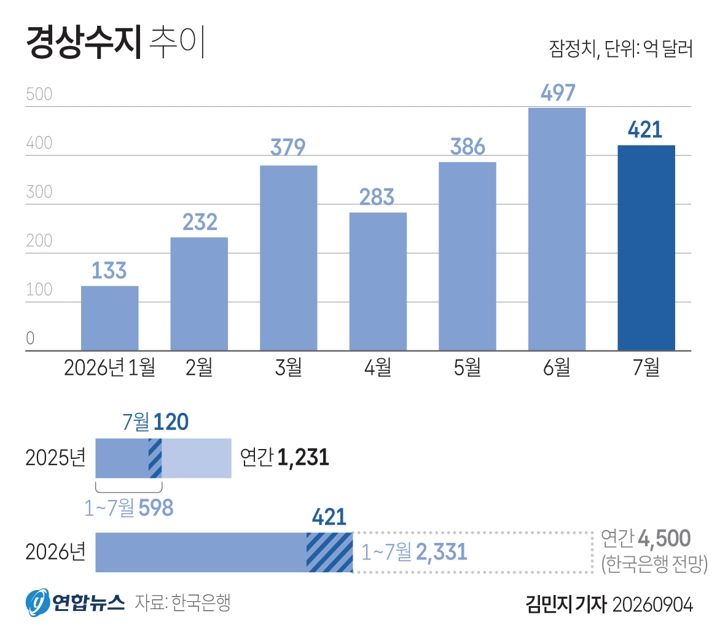
[Financial News] Buoyed by a semiconductor boom, South Korea’s current account has continued to post record surpluses. According to provisional balance-of-payments data released by the Bank of Korea (BOK) on the 4th, the current account recorded a surplus of $42.1 billion (approximately 57 trillion won) last month. It was the largest surplus ever recorded for July and the second-largest on a monthly basis. The cumulative surplus through July this year reached $233.1 billion, nearly four times the figure for the same period last year. In the first half, South Korea ranked second worldwide, behind China. It surpassed Germany, Japan, and Taiwan. This is welcome news that provides firm support for the external soundness of the South Korean economy.
The source of this overwhelming performance was, once again, semiconductors. Total exports rose 65.3% year on year last month, exceeding $100 billion for the second consecutive month, while semiconductor exports surged by a remarkable 176%. Demand for artificial intelligence (AI) investment is boosting corporate earnings and, in turn, driving exports, the current account, and South Korea’s economic growth. Strong semiconductor exports also made a significant contribution to the 3.8% growth recorded in the first quarter.
The problem is that far too many indicators of the South Korean economy are premised on an unprecedented semiconductor boom. This applies not only to exports and growth. The government has set next year’s national tax revenue at 584.4 trillion won, including 216.7 trillion won in corporate tax revenue. That is more than double this year’s figure. The estimate reflects the expected increase in semiconductor companies’ profits. The decision to raise total spending next year to a record 821 won and to create a 162 trillion-won Future Response Fund using excess tax revenue was also made possible by semiconductor profits.
There would be no reason for concern if the boom continued for an extended period. The outlook for semiconductor exports remains favorable for now. Investment in AI data centers is still running hot, and supplies of high-performance memory remain tight. However, warnings that the market may have peaked have recently begun to emerge. There are concerns that prices for commodity memory and semiconductor companies’ earnings could peak this year and slow from next year. Demand could weaken because of high prices, while large-scale capacity expansions could come online next year. The memory industry’s cycle—from rising prices and increased capital investment to oversupply and falling prices—has repeated in the past. A safety net for the downturn must be put in place now.
If the semiconductor cycle turns downward, the shock will spread throughout the national economy. If the expected tax revenue fails to materialize, the government may have to rely on issuing government bonds and could fall into a vicious cycle of fiscal deterioration. That is why the country must stake everything on identifying “growth beyond semiconductors” and the next major growth engines. It should accelerate the creation of higher value-added industries in competitive sectors such as automobiles, shipbuilding, defense, biotechnology, and robotics.
It is also worth revisiting the fact that the services balance was in a deficit of nearly $2 billion even though the goods balance posted a surplus of $40.4 billion. Regulations in the services industries—including tourism, finance, healthcare, and education—must be eased, and their competitiveness strengthened to create new sources of foreign-currency earnings comparable to goods exports. Every effort must be made to build an industrial structure and fiscal foundation capable of withstanding the end of the semiconductor boom.