'Copper Is Not No. 1 in Bonding': 70-Year-Old Chemistry Textbook Orthodoxy Overturned
- Input
- 2026-09-06 12:00:00
- Updated
- 2026-09-06 12:00:00
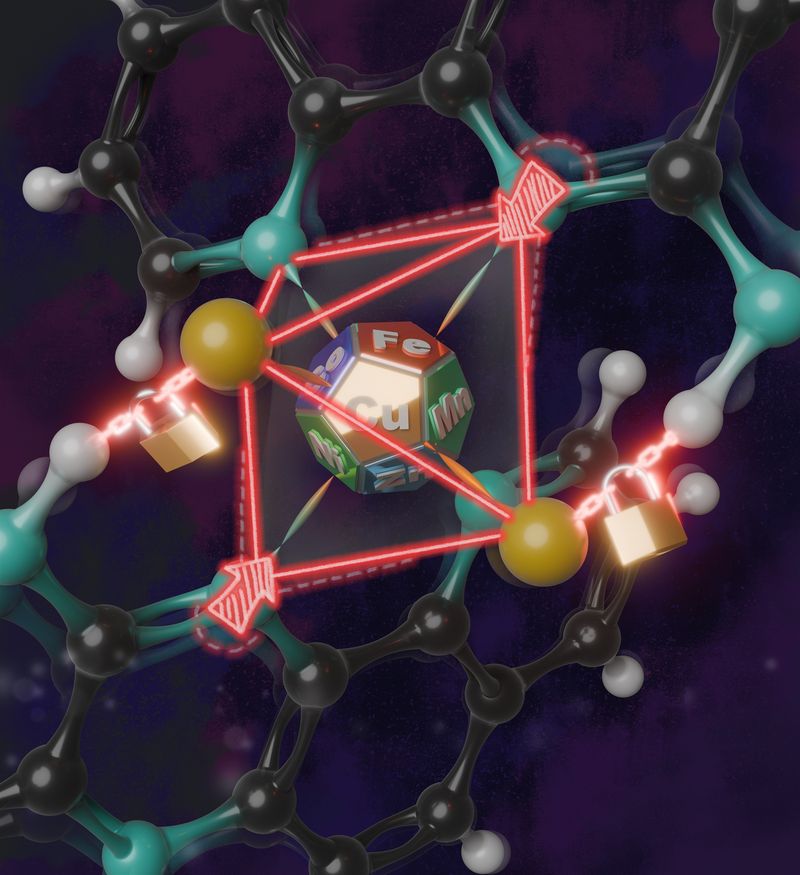
[Financial News] The long-standing chemistry textbook belief that copper forms the most stable bonds has been overturned. Researchers found that copper can play the opposite role when only the weak hydrogen bonds around it are adjusted while leaving the structures directly bonded to the metal unchanged. The findings show that changing a metal’s environment can alter its bonding properties. They are expected to open new possibilities for separation technologies that selectively extract desired metals and for catalyst design.
The Korea Advanced Institute of Science and Technology (KAIST) said on the 6th that a research team led by Professor Baek Yoon-jung of its Department of Chemistry used flavin, a core structure of vitamin B2, to develop metal complexes in which multiple molecules surround and bond to a central metal. By controlling hydrogen bonding around the metal, the team reproduced a metal-stability trend opposite to the conventional Irving–Williams series.
The Irving–Williams series is an empirical rule that ranks how stably transition metals—including iron, nickel, and copper, which bond with other substances in various ways—bind to surrounding molecules. Among manganese (Mn), iron (Fe), cobalt (Co), nickel (Ni), copper (Cu), and zinc (Zn), stability generally increases from manganese to copper, with copper known to form particularly stable bonds.
This difference has traditionally been understood in terms of the electronic structure, or how electrons are arranged within each metal. In other words, researchers believed that a metal’s ability to bind was largely determined by its inherent properties. The research team, however, focused on hydrogen bonding, which acts outside the area directly bonded to the metal. Hydrogen bonding is a relatively weak force between molecules that helps hold surrounding structures in a fixed shape. After keeping the basic conditions around each metal the same, the team examined how hydrogen bonding affected the stability of each metal.
The researchers found that hydrogen bonding particularly prevents the structural changes needed to stabilize copper. Copper tends to become more stable by slightly distorting the surrounding bonding structure to create a form favorable to itself. In the structure developed by the team, however, the surrounding hydrogen bonds firmly constrained copper, producing an anti-Irving–Williams trend opposite to the conventional pattern.
The key finding is not simply that copper was displaced from the top position in bonding. Rather, the study showed that the order in which metals were thought to bind most effectively could be controlled by changing their surrounding environment. If desired metals can be made to bind more strongly while other metals bind less strongly in a mixture, the approach could be used to selectively extract or recover specific metals.
The same principle is also expected to be useful in catalyst design, where the surrounding environment is adjusted so that a desired metal functions more effectively. In addition, just as proteins and enzymes in the human body select the metals they need from among iron, copper, zinc, and others, the findings are expected to offer a new method for designing biomimetic systems that reproduce biological operating principles to achieve desired functions.
The study was published on September 3 in the Journal of the American Chemical Society (JACS), an international journal issued by the American Chemical Society. It also drew attention at the International Conference on Coordination Chemistry (ICCC) held in Denmark. First author Lim Ha-neul, a student in the integrated master’s and doctoral program in KAIST’s Department of Chemistry, presented the research as a poster and became the only Korean student to receive an award for an outstanding poster.
[email protected] Yeon Ji-an Reporter