"AI for All to Launch This Year with Goal of 15 Million Users"... SKT, Kakao and KT Join the Race
- Input
- 2026-09-04 15:16:35
- Updated
- 2026-09-04 15:16:35
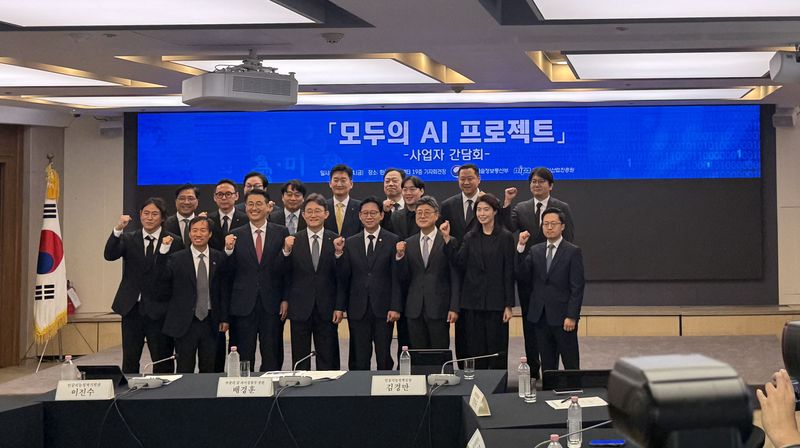
[Financial News] SK Telecom, Kakao and KT are officially beginning development of services under the government's nationwide artificial intelligence (AI) project, "AI for All." The initiative aims to go beyond chatbots that simply answer questions by connecting AI services integrated into people's daily lives—including public services, finance, education and shopping—and having them handle applications, reservations and payments on users' behalf. The government plans to launch the services this year and invest 250 billion won next year to support AI adoption nationwide.
The Ministry of Science and ICT held a kickoff meeting for the "AI for All Project" at the Korea Press Center in Jung-gu, Seoul, on the 4th and unveiled the service development plans of three consortia led by SKT, Kakao and KT.
Mobilizing telecom, KakaoTalk and search touchpoints... Bringing "action-oriented AI" into everyday life
AI for All is a project that combines domestic AI models, infrastructure and platforms so that anyone in Korea can easily use AI in daily life. The Ministry of Science and ICT plans to launch a nationwide service this year by supporting connections with public AI agents, privacy and security measures, and public-private cooperation to attract users.
The three consortia will differentiate themselves by leveraging their respective platforms and user touchpoints. The SKT consortium is focusing on action-oriented AI that goes beyond answering questions to handle actual tasks, from authentication to applications and payments. It also plans to offer agents based on phone calls and text messages, in addition to apps and websites, allowing people less familiar with digital environments to access AI services.
The KT consortium will introduce e-Um, which connects a real-time search-based general-purpose AI agent with specialized services in more than 10 fields, including public services, education, finance and shopping. It plans to build an open ecosystem based on Token Factory, an AI operations platform that integrates domestic AI models with infrastructure such as graphics processing units (GPUs) and neural processing units (NPUs), and automatically connects users to models suited to their requests.
The Kakao consortium will use domestic AI models, including Kakao's Kanana and LG AI Research's EXAONE, through familiar channels such as KakaoTalk and phone calls. It will provide a general-purpose chatbot and public and specialized AI agents that handle everything from information searches to applications, reservations and payments within a single conversation. It also plans to gradually expand personalized AI agents and an open agent marketplace.
Targeting 5 million MAUs by year-end... 250 billion won to support expansion
The competition to attract users is also getting underway in earnest. The three consortia each set an initial target of around 5 million monthly active users (MAUs) by the end of the year. SKT aims to increase its users from 5 million at year-end to 10 million next year. KT also expects about 5 million users by year-end and is preparing its systems to accommodate up to 20 million users. Kakao unveiled a roadmap to reach 5 million MAUs in December and expand to 30 million by 2030.The government emphasized cooperation rather than excessive competition among the three services. Bae Kyung-hoon, Deputy Prime Minister and Minister of Science and ICT, said, "AI for All will never encourage competition among the consortia. We need to emphasize cooperation among the consortia and work together to create a single brand so that AI for All can move forward with one identity." The services will be developed independently by each consortium, while the government seeks to establish a shared identity for the public as "Korea's flagship AI service."
Financial support for expanding the services will also begin in earnest. The government has allocated 250 billion won in next year's budget for AI for All. About 170 billion won of that amount is expected to go toward GPU support, enough to lease approximately 2,000 NVIDIA B200 units. The government plans to allocate 30 billion won to support the operation, stabilization and cooperation of the three consortia's systems, and about 50 billion won to expand AI agents.
The government will also expand the use of domestically produced AI semiconductors. It plans to pursue both technological advancement and service deployment so that domestic AI semiconductors can eventually process a substantial portion of the tokens generated by AI for All.
Bae said, "What matters most is how easily people can access the service, how often they use it and how much it actually helps their lives. We will provide unwavering support so that AI for All can establish itself as Korea's flagship AI service."
[email protected] Hyelim Choi Reporter