Hyundai Motor India: "We will increase EV sales to 7–8% next year"
- Input
- 2026-09-04 17:27:40
- Updated
- 2026-09-04 17:27:40
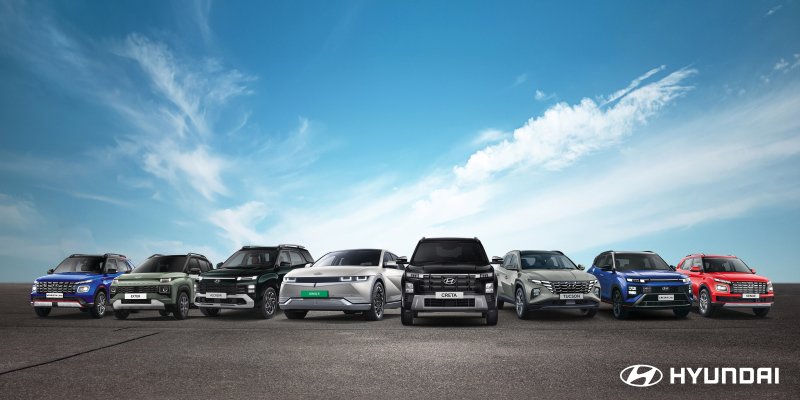
[New Delhi (India) = Correspondent Pragya Awasati] Hyundai Motor India's EV sales are projected to reach 7–8% of total sales next year. Hyundai plans to accelerate its penetration of the Indian EV market by successively introducing new EV models, including a dedicated compact electric vehicle.
According to local media reports on the 4th, Tarun Garg, CEO of Hyundai Motor India, recently stated, "We expect the share of electric vehicles in the Indian automotive market to reach 7–8% next year," adding, "The share of electric vehicles in Hyundai's own sales will also reach a similar level."
Hyundai Motor India sold 584,906 units in the Indian domestic market during the 2025–2026 fiscal year. Sales from April to August this year also increased by 12.6% compared with the same period last year, and 54,396 units were sold last August, marking the highest August sales on record.
In the electric vehicle market, the Creta Electric is targeting the mass market, while the Hyundai Ioniq 5 is targeting the premium market. Monthly sales of the Creta Electric have recently increased from the previous 400–500 units to approximately 1,000 units. Garg assessed this as a steady increase in demand rather than a temporary phenomenon. There are also plans to reduce the current waiting period of 4–8 weeks.
Hyundai Motor plans to introduce a dedicated model into the small electric SUV market under 4 meters in length to make it a new growth engine. In this market, Tata Motors' Tata Punch.ev and Tata Nexon EV are competing, and competition in the Indian electric vehicle market is becoming increasingly fierce with the launch of various electric vehicles such as the MG Windsor and Mahindra XEV 9e and Mahindra BE 6.
Hyundai Motor is pursuing a strategy of utilizing various power sources, including electric vehicles, hybrids, and compressed natural gas (CNG), rather than focusing solely on electric vehicles. The goal is for these three types of eco-friendly and alternative-fuel vehicles to account for approximately 50% of total sales by 2030. The plan envisions each power source accounting for about one-third of the total.
To this end, Hyundai Motor India plans to expand its lineup of EV, hybrid, and CNG vehicles to four to six models each by 2030. However, sales of CNG vehicles are expected to focus on models priced at approximately 1.5 million rupees (about 21.51 million won) or lower.
Hyundai Motor does not plan to rush the market launch of hybrid vehicles. Although the company has already secured the relevant technology, it plans to release them only after increasing the proportion of local production and parts procurement sufficiently to ensure competitive pricing. The company believes that while consumer interest in hybrids is expected to be high, actual purchasing decisions ultimately depend on price competitiveness.
In India, preferred power sources vary distinctly by vehicle class. Diesel models of the Creta account for approximately 40% of total demand, while CNG vehicles make up about 18% of Hyundai's total sales. Demand for CNG is particularly high for the Hyundai Aura and Grand i10 Nios.
Hyundai Motor is also strengthening its charging infrastructure to expand the adoption of electric vehicles. It provides access to approximately 37,000 chargers through the myHyundai app. The company is also pursuing the expansion of its fast-charging network and the introduction of battery subscription and battery-as-a-service models. Hyundai Motor's strategy is to respond to demand in the Indian market by utilizing various power sources, including EVs, hybrids, and CNG, and to strengthen its competitiveness in the eco-friendly vehicle market by 2030.
[email protected] Correspondent Pragya Awasati Reporter