"50 million won for my daughter's wedding is nothing"... Dad who was about to break into his severance pay 'hesitates' [Money Planning Office]
- Input
- 2026-09-05 15:00:00
- Updated
- 2026-09-05 15:00:00

The worries of a couple nearing retirement are
Mr. Kim Seong-ho (pseudonym), 57, who lives in Suwon, Gyeonggi-do, is a sales management manager at a mid-sized company. He is scheduled to retire in three years. His wife, Ms. Lee Jeong-eun (55, pseudonym), who works as an accountant at a small to medium-sized enterprise, plans to quit her job two years later than her husband.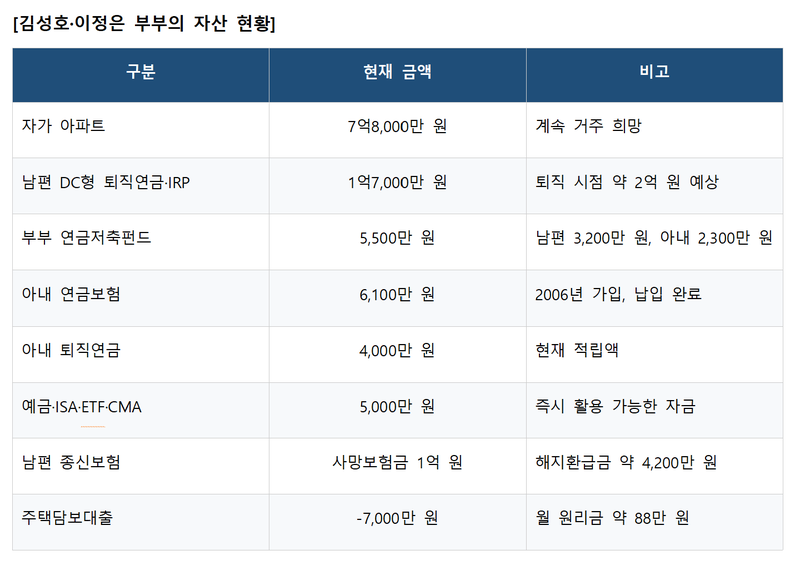
The couple's biggest concern was their 'children.' This was because their eldest daughter, who is scheduled to get married within a year, had asked for 50 million won to help secure a jeonse (lease deposit) house in the metropolitan area.
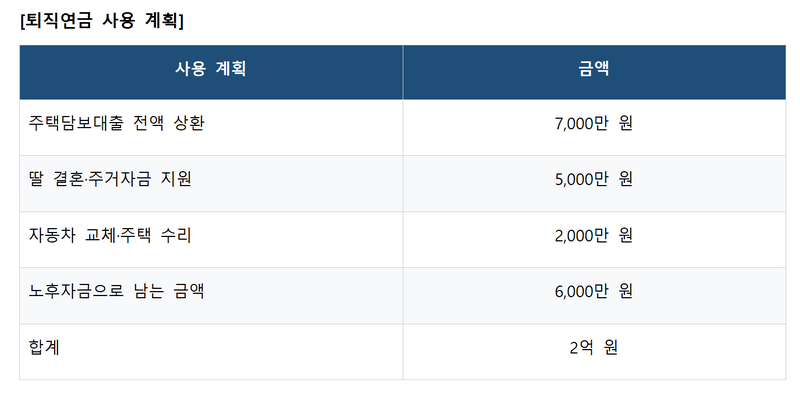
They thought giving their daughter 50 million won would be enough, but their second child, their son, weighed on their minds. Although they didn't discuss immediate support, the couple believed it would be fair to give their son the same amount when he gets married or buys a house. In effect, the couple's retirement 'child support fund' amounts to 100 million won.
Why You Need a Retirement Salary Schedule
The problem lies in the retirement income that the remaining 60 million won in retirement pension can generate. If this money is managed at a real annual return of 3% after retirement and received in installments over 25 years, the monthly disposable income amounts to only about 280,000 won. In contrast, if the 200 million won retirement pension were managed in the same way, the amount received would be around 950,000 won.Loan repayments and support for children are one-time expenses, but living costs for retirement are required every month. The couple estimated that they would need 3.3 million won per month for minimum living expenses after retirement. Their estimated National Pension Service (NPS) payouts are 1.7 million won per month for Seong-ho and 900,000 won for his wife, but both will only be eligible to receive them upon reaching the age of 65.
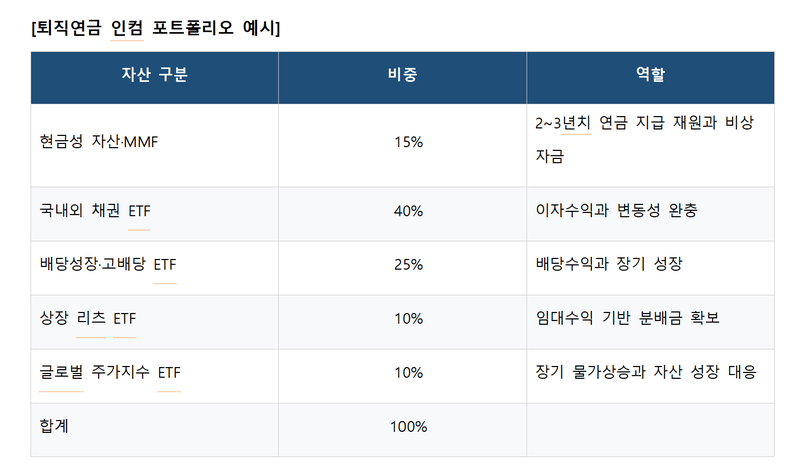
We also decided to receive my wife's pension insurance starting at age 60, paying 250,000 won per month, without waiting until age 65. Although the amount received will be slightly lower, this is to fill the income gap before the National Pension Service (NPS) starts.
During the two years that Seongho's wife continues to work after his retirement, they can accumulate 3.35 million won per month by combining his retirement pension of 800,000 won, pension savings of 350,000 won, and his wife's monthly salary of 2.2 million won.
The problem arises after his wife retires as well. Even with pension insurance added, the couple's monthly income amounts to only 1.4 million won. This is 1.9 million won short of the minimum cost of living, so 68.4 million won is needed over the three years until Mr. Seongho's National Pension Service (NPS) starts.
This is the reason he decided not to withdraw more money from his retirement pension. It is because he can cover the shortfall with the 50 million won in liquid funds he currently holds, the savings he plans to accumulate over the next three years, and his wife's retirement pension.
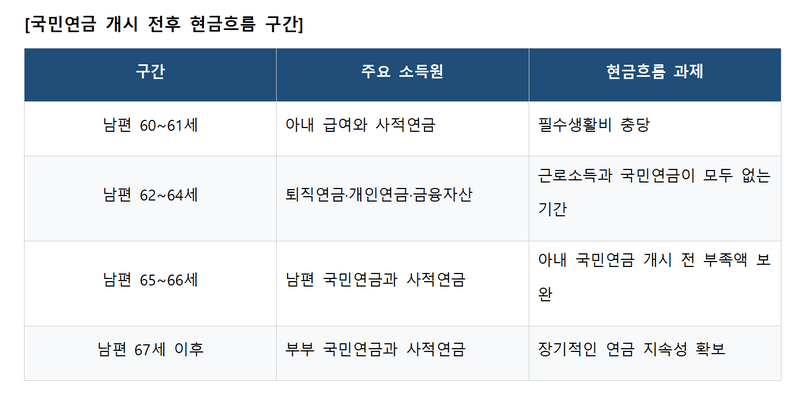
The problem was not a lack of assets. It was that among the assets scattered in various places, it had not been decided which one would cover how much of the living expenses, and when.
Only half of the loan repayment, and 30 million won in support funds for the daughter.
Planner Jo also revised the loan repayment and child support plans to protect the couple's retirement income.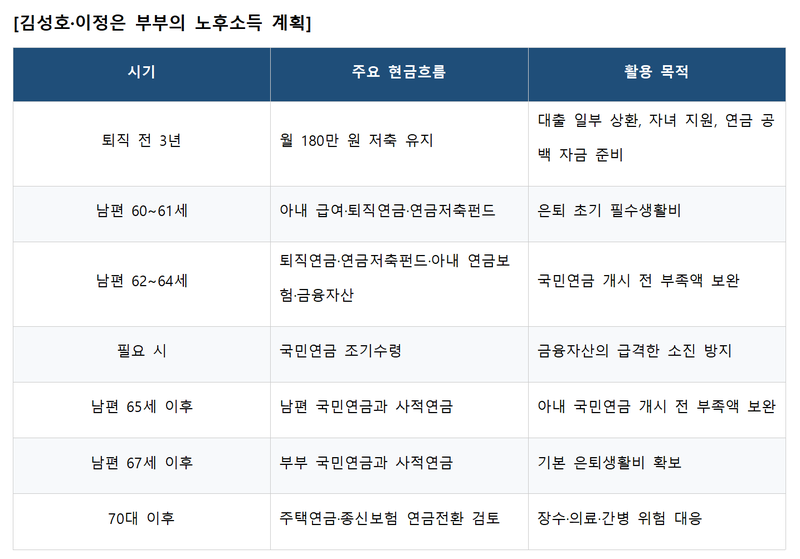
The marriage and housing support funds for the daughter were also lowered from 50 million won to 30 million won. Giving a lump sum to children by drawing on retirement funds does not eliminate the burden. It can shift the greater pressure of living expenses and caregiving costs onto the children in the future.
If financial assets decrease faster than expected, receiving the National Pension Service (NPS) early can be used as an 'emergency card.' If Mr. Seong-ho receives it three years early at age 62, his monthly payment will decrease from 1.7 million won to 1.39 million won. While this can fill the immediate income gap, it has been kept as a reserve measure since he will have to receive the reduced amount for the rest of his life.
I plan to utilize the Korean Home Pension (reverse mortgage) and whole life insurance after the age of 70. The Korean Home Pension (reverse mortgage) is available to couples where one spouse is 55 years of age or older and owns a home with a combined officially assessed value of 1.2 billion won or less. It is structured so that one can continue living in their current home while receiving a monthly pension until the death of both the individual and their spouse.
As of March this year, if you choose the fixed-amount lifetime payment type, the younger spouse is 70 years old, and the price of a standard house is 800 million won, the monthly payment is approximately 2,462,000 won. The actual amount received varies depending on the age at the time of enrollment, the recognized house price, and the payment method.
Architect Jo pointed out that leaving a house entirely to one's children is not the only good form of inheritance. He explained that parents independently securing their own retirement living expenses and care costs, so as not to rely on their children, is also an important aspect of asset transfer.
Planner Jo stated, "You should not prepare for retirement with the money left over after paying off loans and helping your children," adding, "A retirement pension is not the final lump sum received upon retirement, but rather the retirement salary you should receive first once your monthly wage disappears."
Earning, spending, and saving money are repetitive tasks throughout our lives, yet financial planning is always put on the back burner. However, money has an age and does not wait for anyone. If you do not make a choice each time, it will be neglected, and if you do not set a direction, it will slip away. This is why we must create a financial flow that runs through our entire lives.[Money Planning Office]It supports life planning together with the Korea Financial Planner Association (IFPK), an AFPK certification body.
[email protected] Lee Hyun-jung, Kim Tae-il Reporter