China’s Foreign Ministry Objects to Gwangju Biennale’s ‘Taiwan Pavilion,’ Demands Implementation of One-China Principle
- Input
- 2026-09-04 10:56:34
- Updated
- 2026-09-04 10:56:34
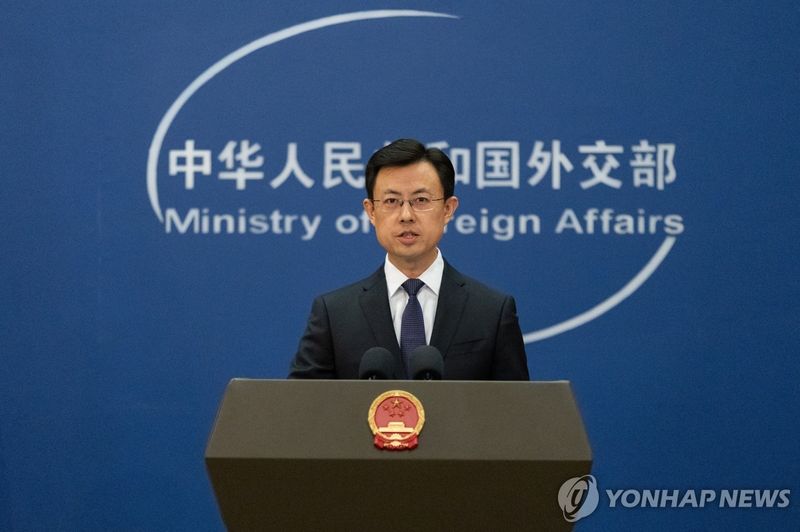
[Financial News] The Chinese government has taken issue with the use of the name ‘Taiwan Pavilion’ at the Gwangju Biennale and demanded that South Korea implement the one-China principle through concrete actions.
Guo Zhaokun, a spokesperson for the Ministry of Foreign Affairs of the People’s Republic of China, said in a statement released on the ministry’s website late on the 3rd in the form of a question-and-answer session with a reporter, “The Gwangju Biennale organizers insisted on an incorrect approach and allowed Taiwan, China, to participate in the exhibition under a designation that does not correspond to its status.” He added, “This is an open violation of the one-China principle.”
He continued, “China firmly opposes this and has already lodged a strong diplomatic protest with the South Korean side, demanding that the parties concerned immediately correct the erroneous approach.” The phrase “lodged a strong diplomatic protest” refers to China’s use of diplomatic channels to issue a forceful objection.
Guo particularly stated, “We hope that the South Korean government will honor its political commitments, faithfully fulfill its responsibilities, and uphold the one-China principle through concrete actions.”
Referring to the 1992 joint communiqué on the establishment of diplomatic relations between South Korea and China, he emphasized, “The government of the Republic of Korea clearly stated that it recognizes the government of the People’s Republic of China (PRC) as the sole legitimate government of China and respects the position that there is only one China and that Taiwan is part of China.”
He added, “Since the beginning of this year, the South Korean side has repeatedly and clearly stated that there has been no change in its position of upholding the one-China principle.”
Guo also accused Taiwan’s ruling Democratic Progressive Party (DPP), saying, “It is using opportunities for cultural exchanges, conferences, and exhibitions to engage in political manipulation and provocations aimed at pursuing independence.” He claimed, “Its political scheme will not succeed.”
The controversy arose over the name of the pavilion operated by the National Taiwan Museum of Fine Arts (NTMoFA), which participated in the Gwangju Biennale.
Taiwan’s Ministry of Culture protested that, after initially discussing the name Taiwan Pavilion, the organizers suddenly changed it in June to NTMoFA, an abbreviation of the museum’s name.
The Gwangju Biennale Foundation argued that, because it had contracted the venue as an institutional pavilion rather than a national pavilion, the institution’s abbreviated name had to be used.
As criticism of the name change continued from Taiwan and from cultural and artistic circles in South Korea and abroad, the foundation approved the National Taiwan Museum of Fine Arts’ application to change the designation to a national pavilion in order to ensure a smooth exhibition.
In response, the Chinese pavilion team, made up of Chinese artists and others, halted the installation of its works and officially announced its withdrawal at a press conference on the 3rd.
The Chinese team said, “We unanimously decided to withdraw from the exhibition to express our strong protest.” It claimed, “By using an incorrect designation in connection with Taiwan’s participation in the exhibition, the Gwangju Biennale organizers created a situation in which political factors intervened in the realm of art.”
The Chinese Embassy in South Korea also criticized the organizers in a statement issued in the spokesperson’s name the same day, saying, “The organizers openly allowed Taiwan, China, to use a designation that does not correspond to its status in any way.” It added, “This directly undermines the political foundation of China-South Korea relations.”
By contrast, the South Korean Ministry of Foreign Affairs drew a clear distinction, saying that the matter was unrelated to the government’s position on Taiwan.
Park Du-sun, a spokesperson for the South Korean Ministry of Foreign Affairs, said at a regular briefing on the 3rd, “There has been no change in our government’s basic position regarding Taiwan.” He added, “This matter was decided independently by a private entity in the field of culture and the arts, and is unrelated to our government’s position regarding Taiwan.”
[email protected] Lee Seok-woo, International Affairs Specialist Reporter