My Fingerprint Authenticated Without Storage, Eliminating Data-Leakage Concerns
- Input
- 2026-09-04 10:42:26
- Updated
- 2026-09-04 10:42:26
[Financial News] A biometric authentication technology that can verify users without storing their fingerprints has been developed. It is expected to reduce security concerns such as information leakage.
A research team led by Professor Junsuk Rho of the departments of mechanical engineering, chemical engineering, electrical engineering, and the Graduate School of Convergence Science and Technology at Pohang University of Science and Technology (POSTECH), along with mechanical engineering researcher Seokho Lee and integrated-course student Beomseok Oh, announced on the 4th that it had developed a new biometric authentication technology capable of identifying users without storing fingerprint information as digital data. The study was published in the international academic journal Nature Sensors.
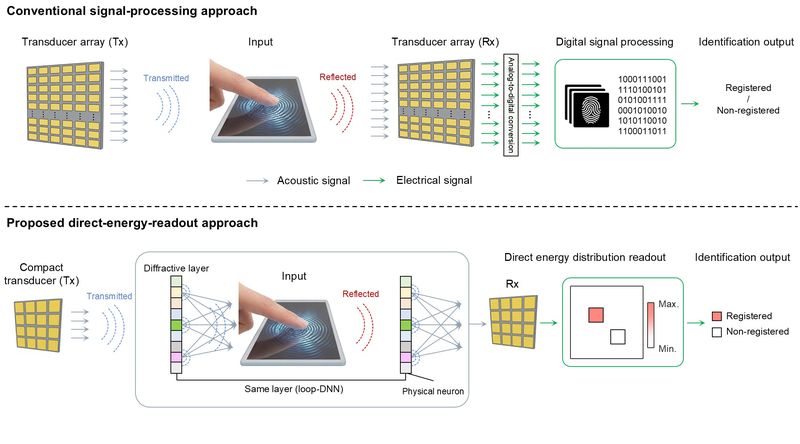
According to POSTECH, fingerprints are used for everything from unlocking smartphones to financial transactions and access security. Unlike passwords, however, fingerprints are difficult to change once leaked. Existing biometric authentication systems read fingerprints, convert them into digital data, and then verify users by comparing that data with previously stored fingerprint information.
The researchers addressed this problem not by finding a way to store fingerprint information more securely, but by eliminating the process of storing and comparing fingerprints as digital data altogether. Instead of sending fingerprints to a computer for analysis, they designed the authentication calculations to be completed as ultrasound interacts with the fingerprints. To achieve this, the team proposed a structure called a “metasurface-driven loop-diffractive neural network (loop-DNN).” A metasurface is an artificial structure that can precisely control the direction, intensity, and phase of ultrasound. In this study, it operates like the neurons of an artificial intelligence neural network.
The team designed the metasurface so that ultrasound passing through it would converge at different locations depending on the fingerprint. When a registered fingerprint is presented, the ultrasound concentrates in the “registered” region; when a different fingerprint is presented, it concentrates in the “unregistered” region. No separate digital processing is needed to reconstruct the fingerprint image or extract minutiae. In particular, the researchers simultaneously controlled the ultrasound phase, amplitude, and switch states, enabling a single metasurface to process fingerprint information.
In an experiment using fingerprints from four people, the system recorded 97.92% accuracy after validating a total of 192 data points. An additional analysis using an international fingerprint-recognition database confirmed accuracy of up to 99.75% for a single user. The researchers also found that recognition performance tended to improve as the metasurface’s design flexibility increased.
The significance of the study lies in shifting biometric authentication from a technology that “stores and compares” information to one that “physically computes and determines” identity. Because fingerprint information is not stored separately, the approach could reduce the risk of biometric-data leakage. The team expects the technology to be applicable to a wide range of biometric authentication fields, including high-security areas such as finance, healthcare, and defense, as well as automobiles, smartphones, and wearable devices.
However, before the technology can be applied to commercial products, the current experimental structure, which operates at approximately 40 kHz, must be miniaturized for MHz-band industrial sensors. The technology must also be further developed to register multiple users. The team plans to advance the technology by combining multilayer metasurfaces with digital technologies.
Professor Junsuk Rho, who led the study, said, “Rather than developing a faster algorithm or stronger encryption technology, this study represents an attempt to change the very starting point of biometric authentication.” He added, “Because biometric information is not stored, we expect it to develop into a new authentication method that can reduce the risk of fingerprint-information leakage caused by hacking.”
[email protected] Yeon Ji-an Reporter