Successive Typhoons in China Compound Worsening Global Port Congestion
- Input
- 2026-09-04 10:01:06
- Updated
- 2026-09-04 10:01:06
[Financial News] Global port congestion is worsening amid a series of typhoons that have struck China, triggering a chain reaction of port disruptions across Asia. The resulting delays could increase upward pressure on freight rates, particularly on routes with strong demand.
Korea Ocean Business Corporation (KOBC) said on the 4th that it had published a special report titled “Worsening Global Port Congestion and Its Impact on the Container Market.”
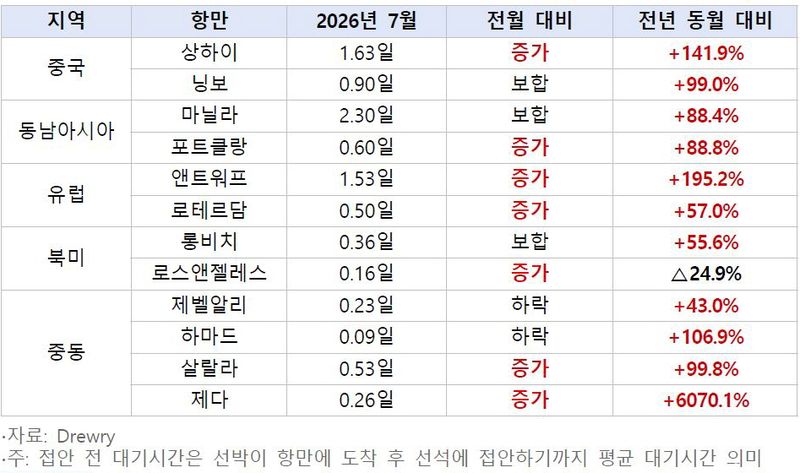
The report found that logistics bottlenecks that began in Northern Europe have recently spread through major transshipment ports in the Middle East and Asia to North Asia. Congestion has intensified as cargo volumes increased earlier than usual ahead of the peak season, vessel arrivals became concentrated, and regional disruptions to port operations overlapped.
In particular, major Chinese ports were hit by a series of typhoons in July and August, further disrupting logistics flows. Vessels delayed in China either converged on their next ports of call, including Busan and Singapore, or failed to arrive as scheduled. As a result, disruptions at one port spread sequentially to others.
In addition, container throughput at all Chinese ports totaled approximately 182.92 million TEUs in the first half of this year, up 5.9% from the same period a year earlier. With cargo volumes already rising and port disruptions occurring in succession, the report analyzed that it could take considerable time to clear the accumulated vessel queues and unprocessed cargo.
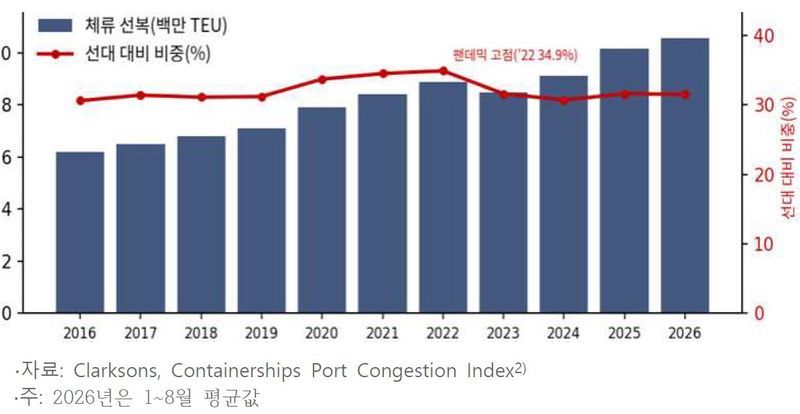
The number of container ships held up at ports is also rising. According to maritime analytics firm Linerlytica, container-ship capacity waiting to berth at ports worldwide last month stood at 4.31 million TEUs.
More than half, or 51.4%, was concentrated in North Asia, while more than 34.8% of capacity at the Port of Shanghai was unable to berth. Including vessels waiting in anchorage areas, the volume of ships awaiting berths stood at 11.13 million TEUs by Clarksons’ measure, setting a record high.
As port congestion disrupted sailing schedules, the on-time performance of maritime transport also declined. According to an analysis by Sea-Intelligence, the schedule reliability of international container ships fell from 62.6% in June to 56.4% in July, while average delays increased from 5.31 days in June to 6.06 days in July.
These waiting delays are causing vessel shortages. When ships are trapped at ports and their round-trip times lengthen, even if new vessels are deployed, fewer ships may actually be available to carry cargo, creating both the misleading appearance of a shortage and an effective supply constraint. As a result, upward pressure on freight rates is expected to persist, particularly on major routes with strong cargo demand.
The report analyzed, “Even if operations at major Chinese ports return to normal, port congestion will be difficult to resolve in the short term. Whether congestion spreads to major transshipment ports such as Busan, Singapore, and Port Klang will be a key variable shaping market conditions going forward.” It added, “If the congestion persists, the vessel capacity actually supplied to the market will decline, potentially increasing upward pressure on freight rates, particularly on routes where demand remains solid.”
[email protected] Byun Ok-hwan Reporter