KDCA: "Brain vascular damage from ultrafine dust may be more severe in people with diabetes"
- Input
- 2026-09-04 09:15:15
- Updated
- 2026-09-04 09:15:15
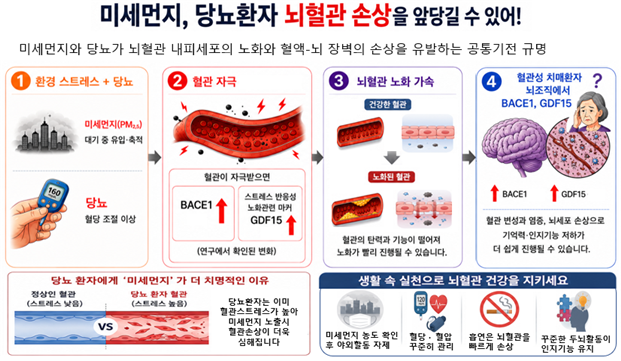
The National Institute of Health under the Korea Disease Control and Prevention Agency (KDCA) announced on the 4th that it confirmed this fact as a result of analyzing the effects of ultrafine dust exposure and diabetes on cerebrovascular function.
Ultrafine dust consists of particles with a diameter of 2.5μm or less that can enter deep into the body through the respiratory system and is a major environmental risk factor.
The research team analyzed the effects of ultrafine dust and diabetes on cerebral blood vessels using human brain microvascular endothelial cells, vascular endothelial cells derived from diabetic patients, animal models exposed to ultrafine dust, and post-mortem brain tissue from patients with vascular dementia. As a result, BACE1, a protein associated with changes in cerebral vascular function, and Growth Differentiation Factor 15 (GDF15), a stress-responsive protein, increased in cases of exposure to ultrafine dust or the presence of diabetes.
In particular, when vascular endothelial cells derived from diabetic patients were additionally exposed to ultrafine dust, abnormalities in vascular endothelial function were more pronounced. This result suggests that cerebrovascular damage may be more severe in people with diabetes when exposed to fine dust.
Increased GDF15 levels and vascular endothelial dysfunction were also confirmed in the post-mortem brain tissue of patients with vascular dementia. The research team believes that BACE1 and GDF15 may be involved in the process of cerebrovascular damage and the development of vascular dementia.
Vascular dementia is a type of dementia that occurs when cerebral blood vessels are damaged, resulting in insufficient blood and oxygen supply to the brain. It is important to manage vascular risk factors such as high blood pressure, diabetes, hyperlipidemia, and smoking. The mortality rate for vascular dementia in 2024 was recorded at 0.7 per 100,000 people.
The World Health Organization (WHO) also newly recommended reducing exposure to air pollution as an environmental management method to lower the risk of cognitive decline and dementia in its 2026 guidelines on reducing the risk of dementia.
This study was published in the international journal 'Free Radical Biology and Medicine' in the field of oxidative stress and apoptosis.
The research team led by Dr. Ko Young-ho of the National Institute of Health, who spearheaded the study, stated, "This research demonstrates that fine dust and diabetes can contribute to abnormalities in the blood-brain barrier function through the BACE1-GDF15 pathway in cerebral vascular endothelial cells," adding, "This will serve as important evidence for establishing future strategies for the prevention and early management of cerebrovascular diseases and vascular dementia."
Kim Won-ho, Head of the Chronic Disease Convergence Research Department, emphasized, "Patients with underlying conditions such as diabetes often have impaired vascular function, so special caution is required." He added, "If you have underlying conditions like diabetes or hypertension, it is necessary to manage your health by considering environmental factors, such as minimizing exposure to fine dust and adjusting outdoor activities by checking air quality information."
[email protected] Jeong Sang-hee Reporter