"Kim Jong Un's Visit to the United States Is Imminent... U.S.–North Korea Summit Possible in November or December"
- Input
- 2026-09-04 08:42:00
- Updated
- 2026-09-04 08:42:00
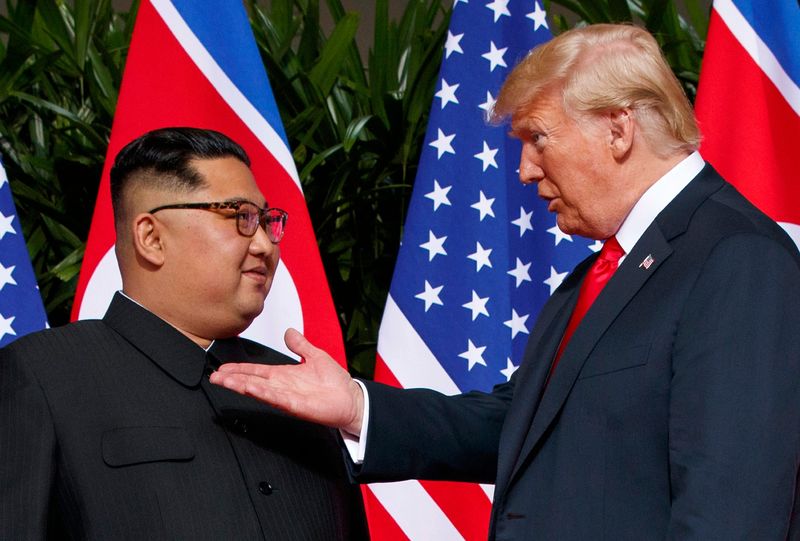
[Financial News] A U.S.–North Korea summit between U.S. President Donald Trump and North Korean leader Kim Jong Un could take place as early as November or December this year, analysts said.
Vincent Brooks, former commander of U.S. Forces Korea, emphasized during a discussion hosted on the 3rd (local time) by the Center for Strategic and International Studies (CSIS), a Washington, D.C.-based think tank, that "we need to recognize that signals are being sent constantly" from North Korea.
He interpreted North Korea's decision not to use the "insulting language" it directs at South Korea toward the United States as a sign that it has "left the door open" to dialogue. At the same time, he said that if North Korea were ready for talks, it would have sent different signals, indicating that "it is not ready now."
Former Commander Brooks predicted, "Both sides [the United States and North Korea] will want to create points of contact this fall, and afterward they will seek an opportunity to hold substantive follow-up discussions."
Brooks: November to December Is the "Earliest Possible Timing" for a U.S.–North Korea Summit
He predicted that the period between November, when the U.S. midterm elections will be held, and December, when the Group of Twenty (G20) summit will take place in the United States, would be the "earliest possible timing" for a U.S.–North Korea summit.
However, he said that the earlier the summit takes place, the more likely it is to be primarily a "showcase" event, while a later meeting would be more likely to contain substantive content. "It is more likely to take place after both events—the midterm elections and the G20 summit—have passed," he said.
Former Commander Brooks said he did not agree with the claim that North Korea's denuclearization is impossible. From North Korea's perspective, he argued, denuclearization would not be impossible "if it could exchange one form of security guarantee—its nuclear weapons—for another form of security guarantee."
Victor Cha, the Korea chair at the Center for Strategic and International Studies, also assessed that "North Korea's responses so far have not been positive, but they have also been conditional." He said that remarks by Kim Jong Un's sister, Kim Yo Jong, showed that North Korea was "playing its usual hard-line role while leaving the door open."
Cha said, "From North Korea's perspective, it will likely believe that its leverage will be stronger after the [U.S.] president potentially becomes weaker following the November midterm elections," adding, "North Korea will certainly wait for the midterm election results before holding talks."
Victor Cha: A U.S.–North Korea Summit "Would Improve North Korea's Position vis-à-vis Both China and Russia"
Cha predicted that President Trump could plan an event inviting Kim Jong Un to the G20 summit held on U.S. soil. This year's G20 summit will be held on December 14–15 at Trump National Doral Miami in Miami, Florida.
He said it was possible to imagine a situation in which "Trump invites North Korea to the G20," adding, "If he did so, it would become an event capable of drawing the world's attention while the United States hosts the G20."
Cha noted that although many observers believe North Korea will not agree to talks because the U.S.–North Korea summits during Trump's first term ended without results and North Korea now has the backing of China and Russia, unlike at that time, North Korea nevertheless has sufficient incentives to enter negotiations.
He pointed out, "Meeting with the United States could improve North Korea's position vis-à-vis both China and Russia by showing that it has active hedging, or alternative relationships."
He added, "North Korea has watched what the United States did in Iran and Venezuela, and what it could potentially do in Cuba," saying, "From North Korea's perspective, it makes sense to maintain some kind of point of contact with the [Trump] president in order to minimize the possibility of such things happening to it."
"Reducing South Korea–U.S. Exercises Was a [Trump] Concession in Response to North Korea's Suspension of Nuclear and Ballistic Missile Tests"
Cha also argued that South Korea's pursuit of a nuclear-powered submarine and the enrichment and reprocessing of nuclear materials could provide North Korea with an incentive to engage in dialogue with the United States.
He rejected the interpretation that President Trump's recent unilateral reduction of South Korea–U.S. joint exercises was a preemptive "concession" aimed at facilitating U.S.–North Korea talks. Instead, he said it was a "reciprocal measure" by the United States in response to North Korea's not conducting nuclear or long-range ballistic missile tests since the start of Trump's second administration.
Former Commander Brooks, meanwhile, said that reducing South Korea–U.S. exercises could help open the door to U.S.–North Korea dialogue, but criticized the move as "an extremely disrespectful act toward the alliance." He said it had undermined military readiness, the U.S. security commitment, and the deterrent effect toward North Korea, China, and Russia.
He continued, "That is why next week's trilateral exercise involving South Korea, Japan, and the United States—Freedom Edge—is particularly important. It is extremely important that the exercise not be canceled."
[email protected] International Affairs Specialist Lee Seok-woo Reporter