July Current-Account Surplus Hits $42 Billion Amid Semiconductor Boom, Up $30.1 Billion Year on Year—Second-Highest Ever
- Input
- 2026-09-04 08:00:00
- Updated
- 2026-09-04 08:00:00
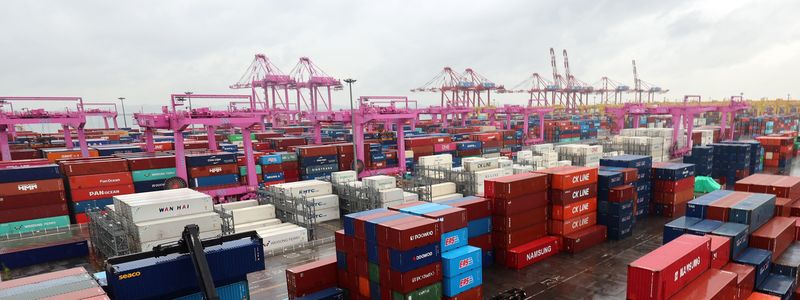
[Financial News] As the semiconductor boom continues, both the current-account and goods-account balances posted surpluses of more than $40 billion in July. The current-account surplus was the largest ever recorded for the month of July.
On the 4th, the Bank of Korea announced that the current account recorded a $42.08 billion surplus, approximately 57 trillion won, in its preliminary July balance-of-payments data. This was an increase of $30.13 billion from the same month a year earlier.
On a monthly basis, it was the second-largest surplus ever, following the $49.73 billion recorded in June. It was the largest ever for the same month.
The cumulative current-account surplus for January through July this year reached $233.09 billion, nearly four times the $59.82 billion recorded during the same period last year.
The BOK had previously sharply raised its forecast for this year’s annual current-account surplus from $250 billion to $450 billion.
The goods account posted a surplus of $40.43 billion. This was the second-highest figure ever, following June’s $47.89 billion.
Driven by the semiconductor boom, July exports rose 65.3% year on year to $100.45 billion, while imports increased 21.7% to $60.02 billion. Goods exports exceeding $100 billion was also the second-highest figure ever, following June’s $112.37 billion.
By customs-clearance standards, exports of computer peripherals, including solid-state drives (344.5%), semiconductors (176.3%), petroleum products (35.7%), and chemicals (19.1%) posted particularly large increases.
By region, exports rose sharply to China (96.2%), Southeast Asia (74.7%), and the United States (69.1%).
Imports increased 36.7%, led by capital goods such as semiconductor manufacturing equipment (60.1%), semiconductors (56.7%), and transport equipment (50.5%). Consumer-goods imports, however, fell 3.0%, as passenger cars (-25.4%) and durable consumer goods (-6.6%) declined significantly. This marked the first decrease in 15 months.
The services account recorded a deficit of $1.97 billion, mainly due to other business services and processing services.
The travel account swung to a $340 million deficit after three months as the number of outbound travelers increased.
Influenced by the designation of Constitution Day as a public holiday and the summer vacation season, the number of outbound travelers in July reached 2.419 million, exceeding the 2.093 million inbound travelers.
The primary-income account posted a surplus of $4.35 billion, driven mainly by dividend income.
Net financial-account assets, calculated as assets minus liabilities, increased by $40.32 billion. This was the second-largest increase ever, following June’s $46.71 billion.
[email protected] Jung Sang-gyun Reporter