Are Samsung Electronics and SK hynix Shareholders on Alert? What Will the Stock Market’s Report Card Look Like a Year From Now?
- Input
- 2026-09-04 06:16:47
- Updated
- 2026-09-04 06:16:47
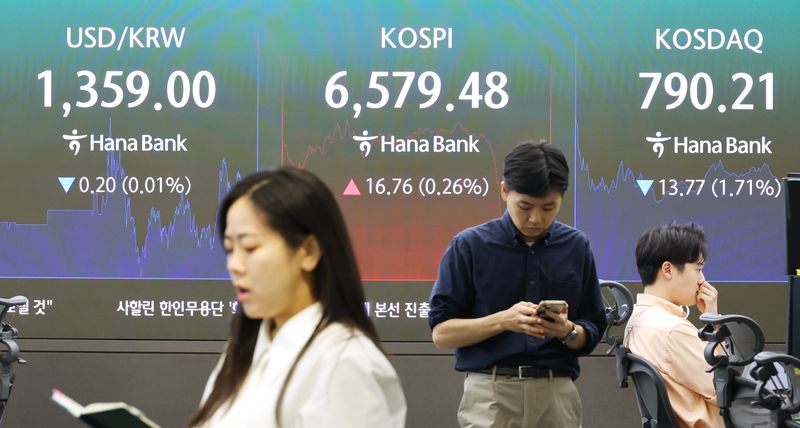
[Financial News] A forecast has emerged that global stock markets, which have maintained a steep rally over the past year, will deliver only modest, single-digit returns over the next year. Analysts say simultaneous surges in government bond yields across major economies and rising international oil prices are increasing valuation pressures on equities.
Peter Oppenheimer, chief global equity strategist at Goldman Sachs, said in a Yahoo Finance interview on the 2nd local time, "Global stock markets, including the S&P 500, have posted extraordinary returns over the past year and so far this year." He forecast that "after already achieving substantial gains, returns over the next 12 months will be lower than those of the past year, remaining in the mid-to-high single digits, or 5% to 9%." However, he added that "as long as economic growth continues, that would still be a relatively healthy level," predicting a gradual upward trend rather than a sharp market decline.
With the S&P 500 up about 12% since the start of the year, market participants are pointing to interest rates and oil prices as potential headwinds that could weaken the market’s upward momentum.
The biggest source of concern is the simultaneous rise in long-term government bond yields worldwide. The yield on the U.S. 10-year Treasury note surged as high as 4.818% during intraday trading, its highest level since November 2023. The 30-year yield also approached its highest level in 20 years. The sharp rise in bond yields is spreading beyond the United States across global markets. Japan’s 10-year government bond yield surpassed 3% for the first time since 1996, while the U.K.’s 10-year yield reached its highest level since mid-2007. Germany’s 10-year yield also climbed to its highest level since 2011, when the European debt crisis was at its peak.
Matt Maley, a strategist at Miller Tabak, noted, "The stock market has absorbed the shock of rising interest rates so far, but history shows that high rates eventually become a burden on the market, often quite suddenly."
Meanwhile, international oil prices have again broken above the $90-per-barrel level as geopolitical tensions escalate in the Middle East, fueling concerns about a renewed inflationary surge. A sharp rise in West Texas Intermediate crude oil (WTI) prices is increasing cost pressures across transportation and manufacturing while also driving up agricultural commodity prices, including sugar and corn.
Tom Essaye, founder of Seven Report Research, explained, "The structure is one in which rising oil prices push up inflation and government bond yields, while higher rates weigh on the stock market." He added, "Until this macroeconomic environment eases, adjustment pressures could persist, particularly on growth stocks and economically sensitive shares."
South Korea’s stock market is also expected to remain vulnerable to prolonged global tightening and uncertainty over commodity prices. Analysts say the room for further gains among large-cap semiconductor stocks, which have driven the KOSPI Composite Index higher, is limited.
An official in the financial investment industry said, "Samsung Electronics and SK hynix have already priced in a substantial portion of expectations for demand for AI and high-bandwidth memory (HBM)." The official added, "Along with rising long-term government bond yields and pressure from oil prices, concerns over weaker profitability at export companies due to a decline in the won-dollar exchange rate and growing concerns that the semiconductor cycle has peaked could overlap. As a result, the additional upward momentum of the KOSPI Composite Index in the second half of the year is highly likely to gradually weaken."
[email protected] Moon Young-jin Reporter