The Spark of 'Workforce Redeployment' Remains Without Substance... Business Groups Call for 'Legal Standards' [Revised Guidelines for the Yellow Envelope Act]
- Input
- 2026-09-03 18:51:33
- Updated
- 2026-09-03 18:51:33
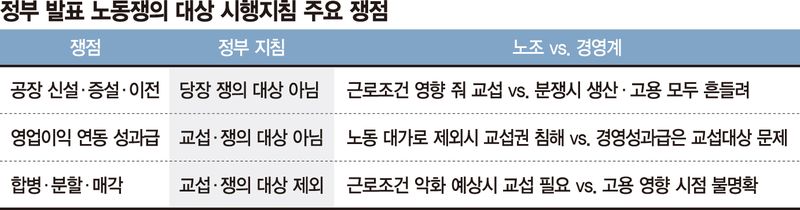
Although the Ministry of Employment and Labor (MOEL) has issued implementation guidelines specifying the scope of labor disputes, including the position that workforce redeployment itself is not immediately subject to labor-management disputes, business groups are becoming even more dissatisfied. Because the guidelines are not strongly binding and could change depending on circumstances, the possibility remains that workforce redeployment essential to carrying out investments could still lead to labor-management disputes.
In advanced industries such as semiconductors, delays in assigning skilled workers could disrupt the launch of new factories and investment schedules. Business groups are therefore calling for clearer legal standards.
■ "Uncertainty Remains"
Business groups believe that the draft implementation guidelines on subjects of labor disputes, including management performance bonuses, announced by the MOEL on the 3rd still leave open the possibility that workforce redeployment required to carry out new investments could become a subject of disputes. In advanced industries such as semiconductors and artificial intelligence (AI), redeploying skilled workers from existing operations is unavoidable when launching new factories or equipment. If negotiations over personnel transfers are prolonged, investment schedules and the start of production could be disrupted.
A business community official said, "Large-scale investments such as those in semiconductors are difficult to execute without a concrete workforce redeployment plan. Workforce redeployment is not a secondary task in an investment; it is central to carrying out the investment."
Similar concerns have been raised over the construction of Samsung Electronics' new semiconductor plant in Honam. The National Samsung Electronics Union (NSEU) said in July that it would place matters related to the construction of the Honam semiconductor plant on next year's bargaining agenda, citing workforce redeployment and other issues.
Business groups say the guidelines alone will not sufficiently resolve the uncertainty. Some are calling for more explicit and stable legal standards, such as an enforcement decree.
In industries where competitiveness depends on megaprojects involving massive capital investments or timely business restructuring, uncertainty can become a tangible burden. The Federation of Korean Industries (FKI) said, "We hope the guidelines will continue to be supplemented so that confusion in the field can be minimized during their future application," adding, "We expect more explicit and stable legal standards, including an enforcement decree, to be established promptly."
Amid the uncertain supplementary measures, observers warn that if a conflict arises over the assignment of skilled workers, separate from the construction of the factory itself, the date for normal operations could be delayed. In the semiconductor industry, for example, existing facilities' skilled engineers must be deployed during the initial phase of launching a new production line to stabilize the process and improve yields.
■ Further Revisions Needed for Performance Bonuses
Business groups also believe that the criteria governing management performance bonuses require further revisions.
Although the MOEL excluded management performance bonuses linked to corporate profits from mandatory bargaining, business groups are concerned that if bargaining subjects are distinguished solely by whether they are linked to profits, unions could change the form of their demands, such as requesting a fixed payment, and bring excessive performance bonuses to the bargaining table.
Under the MOEL's guidelines, for example, if a union demands a management performance bonus of 700 million won regardless of corporate profits, the issue would have to be treated as a bargaining subject, critics say. Ultimately, the guidelines have been criticized for providing a workaround through which unions can change only the basis or wording of their demands and claim that they are subject to bargaining.
As long as they avoid linking the demand to corporate profits, unions could demand excessive performance bonuses in other forms, such as requesting a fixed amount. If management refuses to accept the demand, it could lead to industrial action. KEF therefore noted, "More specific criteria are needed to determine when management performance bonuses constitute wages or working conditions."
[email protected] Reporters Park Ji-yeon, Park So-hyeon, and Kim Dong-chan