Mandatory Bargaining Over 'n% Performance Bonuses' Not Allowed... Labor Movement Hurt by 'Big Business Union Obstruction' [Yellow Envelope Law Guidelines Revised]
- Input
- 2026-09-03 18:51:30
- Updated
- 2026-09-03 18:51:30
■ Blocking n% Performance Bonuses... Unions Hurt Themselves
The Ministry of Employment and Labor (MOEL) announced on the 3rd the 'Implementation Guidelines on Matters Subject to Labor Disputes, Including Management Performance Bonuses,' which specify the matters that can be subject to labor disputes. The announcement came a month and a half after President Lee Jae-myung ordered revisions to the guidelines under the Trade Union Act.
The key point of the guidelines is that they establish bargaining standards for performance bonuses linked to corporate profits and large-scale investments in mega-projects, issues raised mainly by unions at major companies this year.
Regarding negotiations over performance bonuses, which have remained controversial throughout the year, MOEL made clear that management-performance bonuses linked to a fixed percentage of a company's profits are difficult to regard as matters subject to mandatory bargaining or to mediation and industrial action under the Trade Union Act. The interpretation also holds that negotiations over bonuses linked not only to operating profit, which does not reflect corporate taxes or dividends, but also to net income, which includes non-operating expenses, are not subject to mandatory bargaining.
As a result, negotiations over the n% performance bonuses demanded by unions this year are highly likely to become virtually impossible starting next year. MOEL plans to provide administrative guidance through the National Labor Relations Commission's mediation functions and other measures if unions do not follow its interpretation of the guidelines.
A MOEL official explained, "Wages differ from performance bonuses that set aside n% of operating profit because there is room to adjust wages while taking taxes and shareholder dividends into consideration." As previous experts have diagnosed, whether such bonuses qualify as bargaining matters is ultimately expected to depend on their nature, including whether they constitute wages.
The guidelines also clarify when business-management decisions can and cannot be subject to bargaining. This concerns Samsung Electronics labor union's announcement that it would make next year's investment in the Honam semiconductor project a bargaining agenda item. In effect, issues that unions strongly demanded could return as a boomerang next year, labeled 'not subject to bargaining.'
■ Confusion in Next Year's Wage-and-Collective Bargaining Inevitable
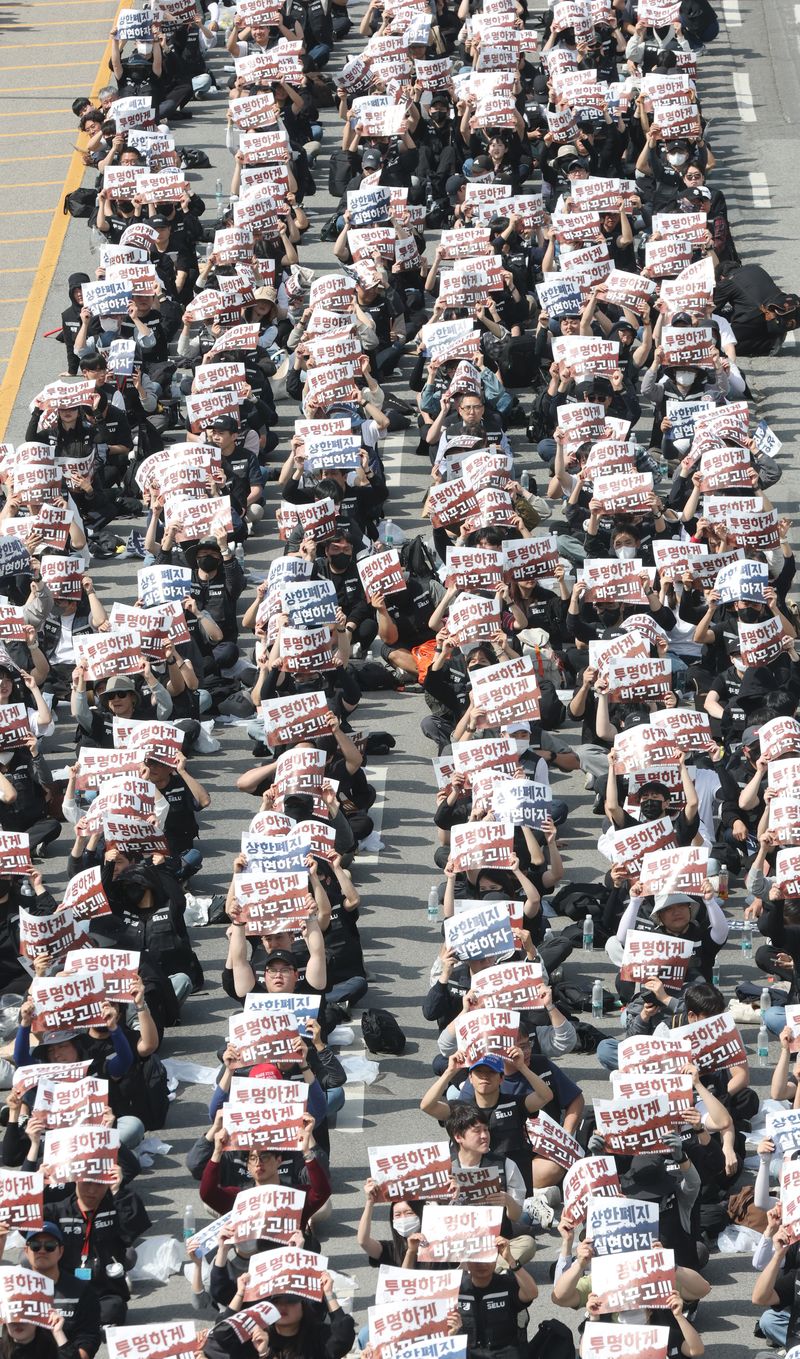
Both labor and management have objected. Labor groups urged the guidelines to be "immediately scrapped," arguing that they excessively narrow the scope of bargaining and give management more room to avoid negotiations. Management groups, meanwhile, are concerned that the guidelines remain ambiguous and that labor groups could apply pressure through indirect negotiations involving base wages and other items. They argue that the guidelines or an enforcement decree should make it clearer that performance bonuses and personnel assignments do not qualify as matters subject to bargaining or strikes.
Some also warn that the gray area between performance-bonus and wage negotiations could instead reduce the predictability of collective bargaining.
The Federation of Korean Trade Unions (FKTU) pointed out, "Although these are the same management-performance bonuses, a demand based on operating profit would not be subject to bargaining or a labor dispute, while a demand based on base wages or annual salaries would be allowed. Under the guidelines, unions would have no choice but to make new demands each year for the amount or payment rate for that year. Ultimately, bargaining and conflict will be repeated through demands for a certain percentage of base wages or annual salaries, or for a fixed amount."
In addition, the guidelines conflict with the wage-and-collective bargaining agreements concluded by Samsung Electronics and many other major companies this year, although they will not be applied retroactively to collective agreements already signed. The government's new interpretation is therefore expected to create even greater confusion starting with next year's wage-and-collective bargaining negotiations.
For example, Samsung Electronics and its labor union agreed in this year's negotiations to apply a special management-performance bonus linked to operating profit for 10 years. Some observers point out that the two sides could clash over how to interpret such terms starting with next year's negotiations.
Regarding this issue, a MOEL official replied, "It is difficult to address diverse and specific cases uniformly," but added, "The guidelines do not invalidate collective agreements reached through existing commitments between labor and management."
[email protected] Kim Jun-hyeok Reporter