Seoul Metropolitan Area Housing Starts in Crisis... Expected to Reach Only 200,000 Units This Year
- Input
- 2026-09-03 18:51:18
- Updated
- 2026-09-03 18:51:18
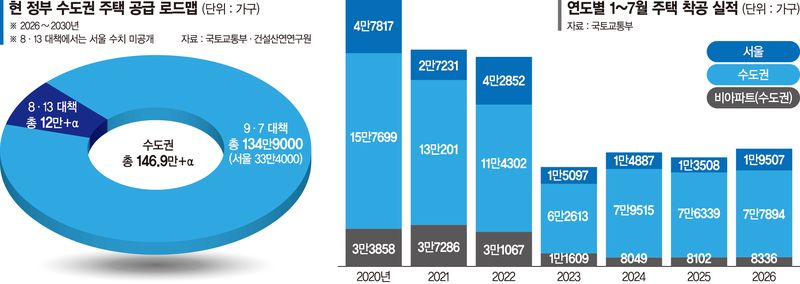
According to industry sources on the 3rd, total housing starts in the Seoul metropolitan area are expected to reach only about 200,000 units this year, far below the government’s target, given the current trend. The industry says more sweeping regulatory easing and additional measures are needed.
■ 180,000 Housing Starts Needed to Reach 300,000 Annually
According to Ministry of Land, Infrastructure and Transport (MOLIT) statistics on housing starts in the Seoul metropolitan area from January through July, the figure exceeded 100,000 units, ranging from 110,000 to 180,000 units, between 2016 and 2022. The annual average during this period was approximately 280,000 units. In 2024 and 2025, about 70,000 housing units were started during the first seven months of each year. Annual housing starts in those years totaled approximately 160,000 units.
An analysis of housing-start statistics indicates that at least 100,000 units must have been started in the first seven months of this year to expect annual housing starts of 200,000 units or more. However, this year’s figure has reached only about 77,894 units over the seven-month period.
An industry official said, “The statistics show that even if public-sector construction is concentrated toward the end of the year, at least 100,000 units must have been started from January through July to come anywhere close to the annual housing-supply target for starts.” The official added, “In 2016, construction began on 360,000 units for the year, and housing starts during the first seven months stood at about 180,000 units.” Sunghwan Kim, a research fellow at the Construction Economy Research Institute of Korea, said, “The public sector may be able to meet the numbers to some extent, but it appears difficult for the private sector.”
Starts of non-apartment housing, which can produce results in the short term, have also barely increased. In the Seoul metropolitan area, the figure rose only slightly, from 8,049 units in the first seven months of 2024 and 8,102 units in the same period of 2025 to 8,336 units this year. The annual figure is expected to remain at approximately 13,000 to 14,000 units.
■ Can the Public Sector Supply All 300,000 Units Annually?
Experts advise that several difficult issues must be resolved to come as close as possible to the supply target. They say it is first necessary to recognize that “the public sector cannot handle the entire volume.” The government plans to secure “public interest” by directly implementing development in existing land development districts as well as in new housing sites to be designated in the future.
Kim said, “The private sector accounts for 70% to 80% of housing supply, and public-sector-led development will ultimately delay housing starts.” He added, “We need to devise a plan that allows the public and private sectors to work in harmony.”
The article also says that financial regulations on homebuyers need to be eased. Under the August 13 Measures, the government significantly eased financing regulations for suppliers and developers. However, borrowing restrictions on homebuyers have remained largely unchanged. An official at a development company said, “Financing for suppliers is important for building homes, but ultimately there must be people willing to buy them.” The official added, “If financing for homebuyers is restricted, smooth housing supply cannot be achieved.”
The article further calls for bold regulatory easing and support for non-apartment housing. The government introduced the concept of “general housing” for the first time in the August 13 Measures. The market interprets this as a sign of the government’s intention to promote non-apartment housing. To achieve this, the registered rental business operator system must be restored to normal, the article says.
Kim Deok-rye, director of the Housing Industry Research Institute, said, “For general housing (non-apartment housing), supply cannot increase unless the registered rental business operator system is restored as a system for rental products.” She added, “Restoring confidence in rental business operator policy is more important than anything else.”
[email protected] Jong-bae Lee, Jun-ho Kwon Reporter