Already Investing Tens of Billions of Dollars in the U.S.... Samsung Electronics and SK hynix "Watching the Impact Closely"
- Input
- 2026-09-03 18:51:12
- Updated
- 2026-09-03 18:51:12
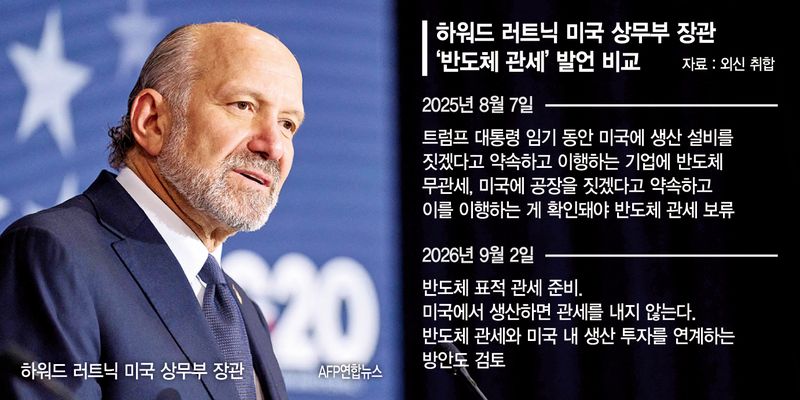
According to industry sources on the 3rd, Lutnick appeared on CNBC in the United States on the 2nd local time and said, "If you build a manufacturing facility in the United States, we will give you tariff relief on semiconductors. If you do not, you will have to pay tariffs to enter the world's largest market."
Compared with Lutnick's remarks last August that he would "hold off on semiconductor tariffs for companies that promise to build factories in the United States during President Donald Trump's term and follow through on those commitments," the latest comments appear to represent a significant escalation.
Experts analyzed the remarks as an effort to increase pressure on South Korean and Taiwanese companies that have benefited from the artificial intelligence boom to expand their memory semiconductor plants in the United States.
Samsung Electronics is currently building an advanced foundry, or contract semiconductor manufacturing, plant in Taylor, Texas, with an investment of at least $17 billion. The plant is scheduled to begin operations by the end of this year. Including its existing Austin plant and research and development facilities, Samsung Electronics' planned investment in Texas is expected to exceed $37 billion.
SK hynix is also investing more than $4 billion to build an advanced high-bandwidth memory (HBM) packaging plant in West Lafayette, Indiana. Advanced wafers produced in South Korea will be shipped to Indiana for packaging and testing before being supplied to local customers as “Made in the U.S.” products. Mass production is scheduled to begin in the second half of 2029.
Jonghwan Lee, a professor in the Department of System Semiconductor Engineering at Sangmyung University, said, "The products making money from the surge in AI demand are AI semiconductors, and the United States strongly wants to have production facilities within its borders. However, what the United States wants is a memory semiconductor plant using the latest technology, and from South Korea's national perspective, it is strategic technology, so it is not easy to hastily build production lines." Lee advised, "From a corporate perspective, considering demand from U.S. big tech companies that need AI semiconductors, it is not unfavorable in terms of profitability. However, if there are concerns about technology leakage or the issue could directly affect national competitiveness, companies should respond flexibly in consultation with the government."
The semiconductor industry views the planned targeted semiconductor tariffs as an extension of the Trump administration's existing policies.
An industry official said, "It is difficult to assess because no specific policy has been announced, but the remarks are intended to encourage production in the United States, so the direction or overall policy stance of the U.S. government has not changed. The industry is watching the specific policy developments closely." Another industry official also held back, saying, "It would be best to monitor how the remarks develop and respond accordingly."
[email protected] Park So-hyun Reporter