[Editorial] Public Institutions Must Shed Wasteful Management and Transform into Efficient Organizations
- Input
- 2026-09-03 18:44:32
- Updated
- 2026-09-03 18:44:32
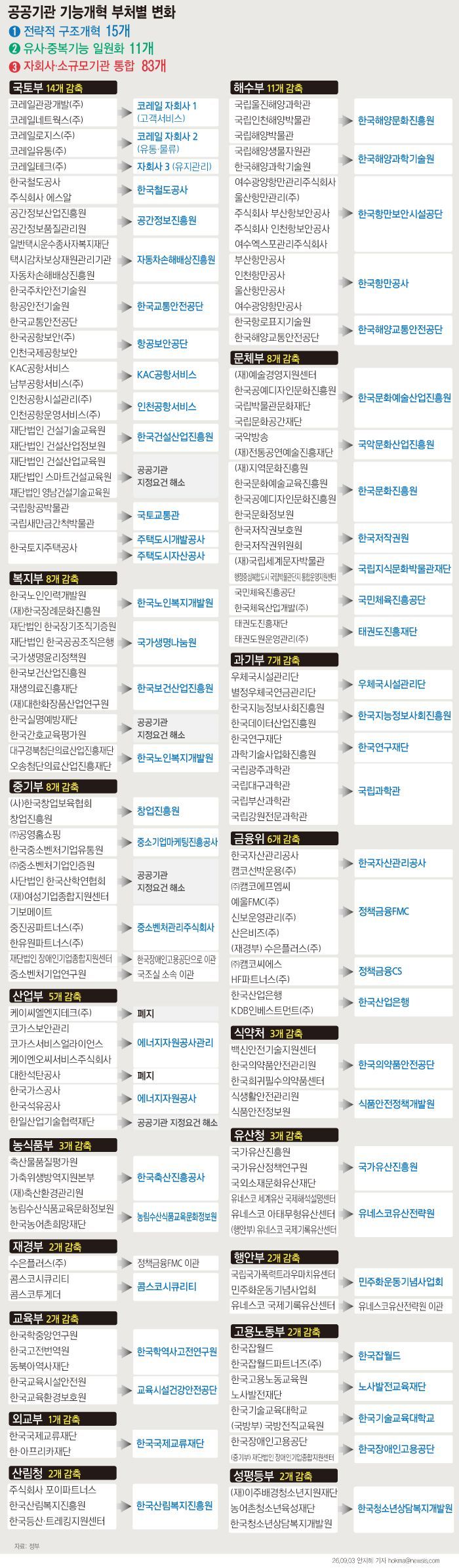
The longstanding problem with public institutions, including state-run enterprises, has been wasteful management. As their workforces and organizations have expanded, productivity has declined. As a result, more than a few public institutions have accumulated deficits and fallen into capital impairment. Many are also regarded as “jobs of the gods,” offering high wages and secure employment as organizations without owners.
From that perspective, this structural reform is desirable because it would improve the efficiency and effectiveness of public institutions that perform roles directly linked to people’s daily lives. The 109 institutions slated for reduction account for 20% of the total, making this a sweeping reform of a scale not seen in many years.
The importance of public institutions responsible for core national functions—including energy, housing, finance and transportation—cannot be overstated. The very reason they are operated as public institutions is that their roles are closely tied to people’s livelihoods. They should provide the public with the best possible services through more effective management, but that has not been the reality.
Through this reform, institutions with particularly large accumulated deficits must undergo workforce and organizational restructuring. They should be reborn as strong, highly productive entities capable of competing with private companies.
The government and politics bear much of the blame for public institutions becoming inefficient organizations. Many institutional heads have been filled through parachute appointments without relevant expertise, and they have often left after serving merely as shields against political pressure rather than managing their organizations. The essence of reform is to first end the harmful practice of sending unqualified appointees to take charge of these institutions.
The merger of KNOC and KOGAS, along with the consolidation of the Five Major Power Generation Companies, is the result of a process that followed years of difficulty. As demonstrated by the recent situation in the Middle East, KNOC performs the critical role of securing oil supplies. Yet it has become an enterprise that is difficult to sustain because of capital impairment. The primary reason for that impairment was its indiscriminate mobilization by past governments for overseas resource development.
The purpose of merging KNOC with KOGAS, which is in relatively better financial condition, could be misconstrued as an attempt to resolve KNOC’s deficits. Various problems may also emerge during the merger process. As the integration proceeds, KNOC must not rely on KOGAS; it should first carry out its own restructuring and develop the ability to stand on its own.
After public institutions were relocated to regional areas in the first phase, those remaining in the Seoul metropolitan area are also on the verge of relocation. The government reportedly plans to announce its second-phase relocation plan in the fourth quarter. It must devise the best possible approach to avoid repeating the mistakes of the first phase, which reduced operational efficiency through politically apportioned relocations and failed to revitalize the regions. Since relocation has already been decided, public institutions must play a leading role in reviving regional areas.