"At Risk of Delisting": Seven in 10 Penny Stocks and Companies Below Market-Cap Threshold See Share Prices Plunge
- Input
- 2026-09-03 18:38:25
- Updated
- 2026-09-03 18:38:25
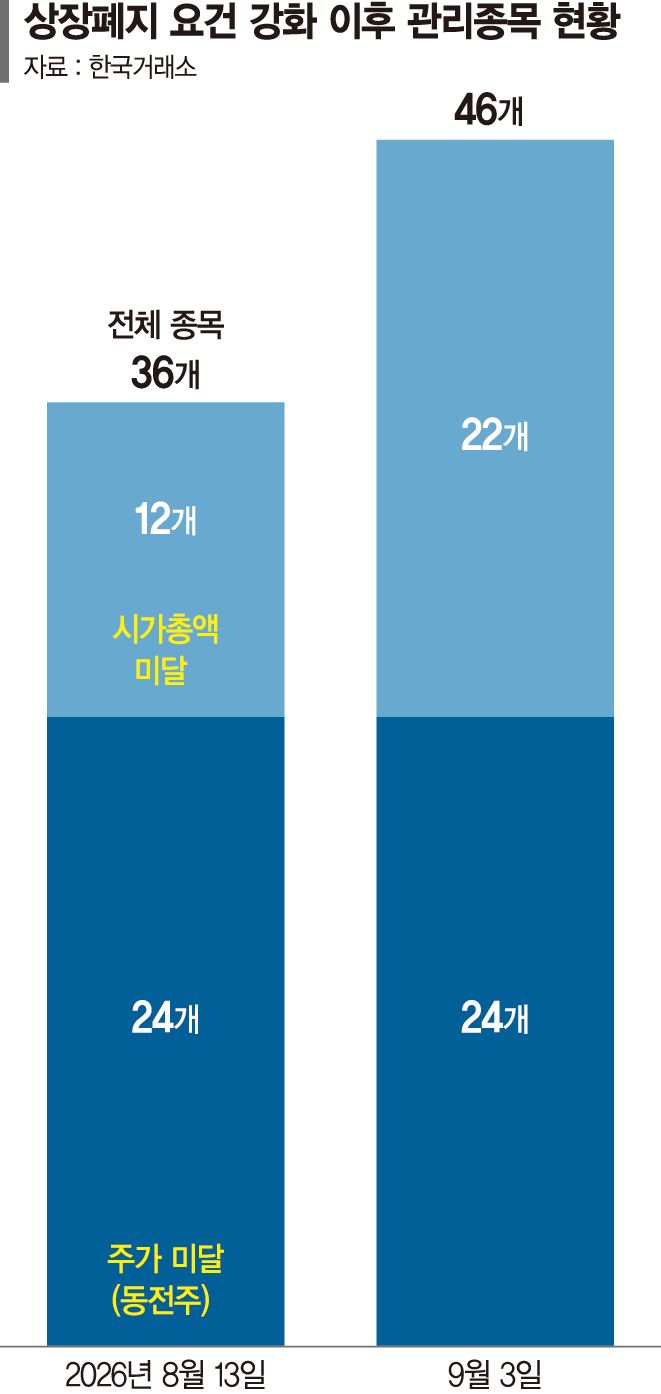
According to the Korea Exchange (KRX) on the 3rd, 36 stocks became subject to designation as administratively managed stocks on the 13th of last month, when the strengthened delisting requirements were applied for the first time, because they were penny stocks or fell below the market-capitalization threshold. As additional designations followed, the number of stocks subject to administrative management for these reasons rose to 46.
The proportion of companies below the market-capitalization threshold is rising particularly quickly. When the first designations were made on the 13th of last month, 12 of the 36 stocks, or 33.3%, fell below the market-capitalization threshold. By the 3rd of this month, 22 of the 46 designated companies, or 47.8%, were in that category.
The problem is that designation as an administratively managed stock due to a low share price or insufficient market capitalization can deepen a stock’s decline. A comparison of the closing price on the day before designation with the closing price on the 3rd found that 34 of the 46 stocks had fallen, while only 12 had risen. The share prices of all 46 stocks declined by an average of 5.65%. Noul plunged 49.09% from the day before its designation, while MoAdata fell 42.81%. E8, down 37.68%; ESTaid, down 35.71%; and Daewon Hwasung, down 34.89%, also suffered steep declines.
The negative impact of administrative-management designation appears to be greater for companies below the market-capitalization threshold.
An industry source in the securities sector said, "Stocks that fall short of the share-price requirement can meet the standard through a reverse stock split, but companies below the market-capitalization threshold have limited options for responding. They can resolve the reason for their designation only if their share prices actually rise in the market, so they may be affected more severely by the deterioration in investor sentiment and the resulting share-price declines following designation as administratively managed stocks." The source added that if share-price weakness continues after designation, market capitalization will shrink further, increasing the risk of delisting and potentially dampening investor sentiment again.
Companies are voicing dissatisfaction with the fact that continued listing is judged solely by market capitalization, which is determined by market supply and demand regardless of their earnings or business conditions. They argue that even companies listed through the technology-special listing system whose businesses are improving or that are consistently profitable can become subject to delisting if their share prices fall. Among the administratively managed stocks below the market-capitalization threshold, 16 have share prices lower than they were on the day before designation.
An official at a listed company said, "Some companies may fall below the market-capitalization threshold because their share prices decline due to market supply and demand even though their business conditions have continued to improve since they were listed through the technology-special listing system. It is unreasonable for even companies that consistently generate profits to become subject to delisting solely because of falling share prices, rather than because of a problem with the companies themselves."
However, some observers say it is too early to conclude that the designations caused the share-price declines, given that the system is still in its early stages. A capital-markets expert said, "No actual delisting case under the strengthened standards has occurred yet, so it is too early to assess the system’s side effects. Since the system is intended to remove marginal companies that have remained in the market for a long time and encourage companies to improve their management, it is necessary to watch the situation carefully."
[email protected] Bae Han-geul Reporter