KOSPI Composite Index Freezes Up... One in Four Stocks Trades Less Than KRW 100 Million
- Input
- 2026-09-03 18:18:34
- Updated
- 2026-09-03 18:18:34
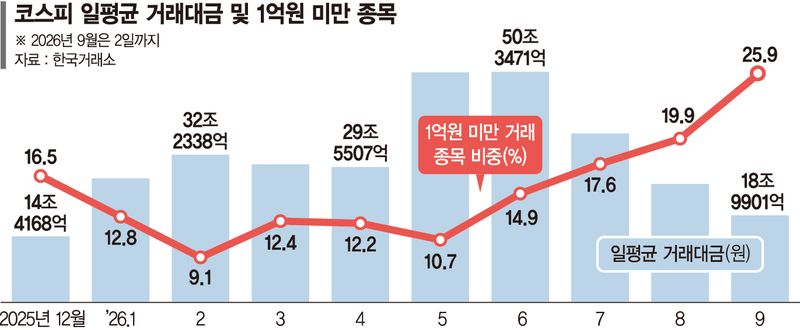
■ One in Four Stocks Trades Less Than KRW 100 Million
According to the Korea Exchange (KRX) on the 3rd, average daily trading value on the KOSPI Composite Index stood at KRW 18.9901 trillion through the previous day, down 26.5% from the previous month. Compared with June, when trading value reached a record KRW 50.3471 trillion, the current level is less than 40% of that figure.
After enduring extreme market volatility in July, investors rapidly reduced their inflows of funds. Average daily trading value was in the KRW 50 trillion range in May and June, but fell to KRW 36.8754 trillion in July and then to KRW 25.8460 trillion last month.
As the market loses momentum overall, neglected stocks are moving even further out of investors’ focus. This month, 244 stocks on the KOSPI Composite Index recorded less than KRW 100 million in daily trading value, accounting for 25.9% of the market’s 943 listed stocks. Given that stocks with average daily trading value below KRW 100 million accounted for 13.7% through last month, the neglect of such stocks has become considerably more pronounced this month.
■ Neglected Stocks Bypassed by Sector Rotation
Although sector rotation from semiconductors to non-semiconductor industries has recently spread, the benefits have been limited. Analysts say that as uncertainty over external variables, including interest rates and geopolitical risks, grows, investors tend to concentrate on stocks with clear earnings momentum. Stocks lacking sufficient scale or earnings support are therefore bound to become even more neglected.
Lee Jeong-bin, a researcher at Shinhan Investment & Securities, noted, "The recent market is not seeing earnings improvement disappear; rather, the pace of earnings momentum is slowing, and leading industries are changing in the process." He added, "When performance gaps between industries widen instead of the market moving in a clear index direction, it becomes more important to identify industries with new stock-price momentum than to focus on the direction of the market as a whole."
He continued, "As earnings trends are diverging by industry, investors need to select industries where actual earnings growth and upward revisions to earnings per share (EPS) are occurring simultaneously, rather than simply diversifying their holdings into industries outside semiconductors."
Some analysts also say that small and midsize companies need to make their own efforts to improve. They argue that enhancing corporate value is necessary to restore investor confidence and secure liquidity.
An official in the securities industry said, "When liquidity is insufficient, trades cannot be executed properly, reducing investor preference. This leads to sluggish trading and inevitably creates a vicious cycle." The official added, "Although the government is working to improve the fundamentals of the capital market, companies ultimately need to make voluntary efforts to support their share prices."
[email protected] Seo Min-ji Reporter