The U.S. ‘Liquidity Reservoir’ That Once Exceeded $2 Trillion Has Disappeared...The Next Warning Light for $40 Trillion in Debt [Issues Worth Knowing]
- Input
- 2026-09-05 09:56:03
- Updated
- 2026-09-05 09:56:03
[Financial News]"It is not that there is not enough water. But one emergency water tank has run dry."That was the assessment recently offered by Kim Eun-yoo, a lawyer at Kangsan Law Firm known as a real estate and finance specialist, in an analysis of liquidity in the U.S. financial market.
As concerns over fiscal soundness grow after the United States’ total national debt surpassed $40 trillion for the first time last month and long-term Treasury yields surged, Kim presented several warning signs to watch for in order to detect the risk of a sharp decline in U.S. stocks early from a liquidity perspective.
Kim told Financial News on the 3rd, "Liquidity in the U.S. financial market is not currently in crisis. However, the buffer has become thinner," adding, "Going forward, we need to watch closely for whether a decline in bank reserves and a widening of credit spreads occur at the same time."
What to watch closely: ‘the flow of money’
Kim disclosed seven ‘liquidity warning signs’ with these points in an online community.
The key indicators are bank reserves—the excess funds U.S. banks hold at the Federal Reserve System (Fed)—the Fed’s total assets, the Secured Overnight Financing Rate (SOFR), the rate financial companies pay when borrowing overnight against U.S. Treasuries, and the high-yield credit spread, or the yield gap between U.S. Treasuries and high-yield bonds.
He also included the National Financial Conditions Index (NFCI) provided by the Federal Reserve Bank of Chicago, the Treasury General Account (TGA), the U.S. government’s checking account, and reverse repurchase agreements, or reverse repos, where financial institutions deposit excess funds with the Fed.
The logic is simple. If the U.S. government issues large amounts of Treasury securities to cover its fiscal deficit, investors’ money can move into the government’s account, reducing the amount of cash available in private financial markets.
In the past, there was a huge ‘reservoir’ to absorb such a decline in cash. As money flooded the market after the COVID-19 pandemic, more than $2 trillion was at one point accumulated in the Fed’s reverse repos. The Fed later pursued quantitative tightening (QT), and the funds accumulated in the facility flowed back into the market, easing the shock.
The problem is that the reservoir is now effectively depleted. He explained, "In 2021 and 2022, more than $2 trillion had accumulated, serving as a massive liquidity reservoir," and analyzed that this buffering effect has now almost disappeared.
He emphasized that observers should watch whether risks spread in the following order: a decline in bank reserves, a rise in SOFR, and a widening of high-yield credit spreads. This process could lead to greater stock-market volatility and falling share prices. He also said, "Stock prices are the last indicator to look at," stressing that investors should first check the flow of money and cracks in credit markets.
Has the ‘emergency water tank’ actually run dry?
How closely, then, does Kim’s warning match the actual data?
The conclusion is that the assessment that the ‘emergency water tank, or liquidity reservoir, has run dry’ is close to the facts. However, it is not yet time to say that the U.S. financial market is actually short of liquidity.
First, Federal Reserve data confirm that reverse repos, identified as the ‘liquidity reservoir,’ have been virtually exhausted. In its monetary policy report last July, the Federal Reserve Board said usage of reverse repos was at ‘near zero’ on most days.
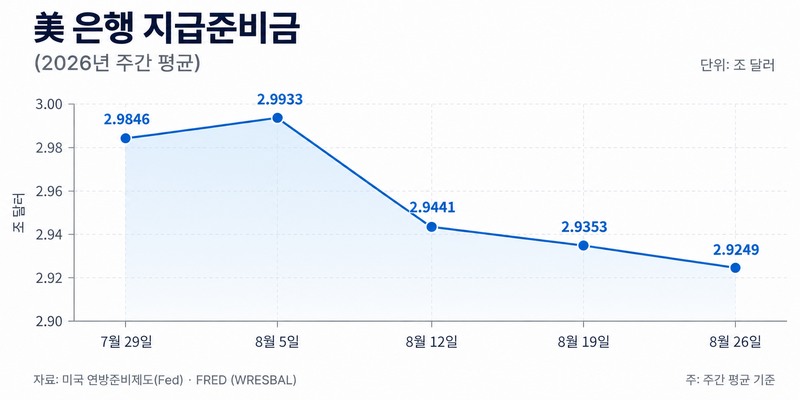
Bank reserves have also declined. According to Federal Reserve Economic Data (FRED) from the Federal Reserve Bank of St. Louis (St. Louis Fed), reserves fell from $2.9846 trillion on July 29 to $2.9249 trillion on the 26th of last month, a decrease of about $60 billion in one month.
However, the fact that reserves have fallen below $3 trillion cannot immediately be interpreted as meaning that ‘there is not enough money.’ The Fed currently assesses reserves as being at an ‘ample’ level for operating the financial system. In other words, ‘the emergency water tank is empty, but the main tank is not short of water.’
Does issuing Treasuries really reduce banks’ money?
Another point to watch is that bank reserves can decline when the U.S. government raises funds through large-scale Treasury issuance and deposits the proceeds in the TGA, the government’s account. The Fed has offered a similar explanation.
Federal Reserve Vice Chair Philip Jefferson said in January, "When money moves into the Treasury’s account on tax payment dates or on days of large Treasury settlements, bank reserves can decline and upward pressure can emerge on short-term funding-market rates."
In other words, a chain can form: ‘Treasury issuance and the movement of funds into the government account → a decline in bank reserves → pressure on short-term funding markets.’
Moreover, with U.S. national debt exceeding $40 trillion, Treasury issuance to cover fiscal deficits could continue to weigh on financial markets. In the past, the enormous funds held in reverse repos absorbed the shock, but the difference now is that this buffer has almost disappeared.
Are U.S. stocks at risk?
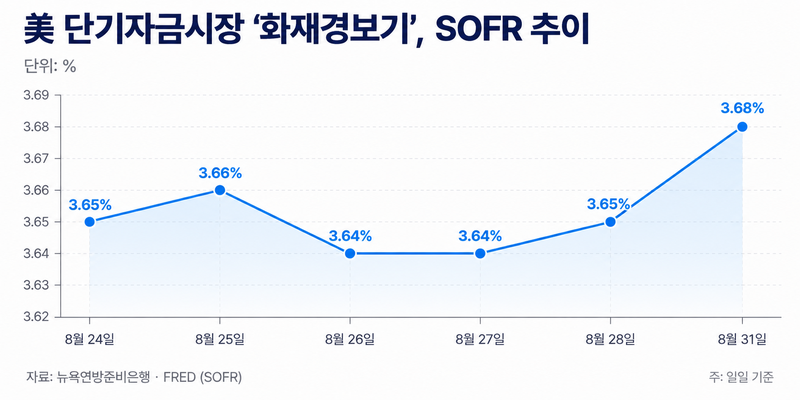
Some argue that the alarm signaling a financial crisis has not sounded so far. The basis for that view is SOFR. This is the rate financial companies pay to borrow money for one day against U.S. Treasuries, and it can surge when cash becomes scarce.
However, according to the Federal Reserve Bank of New York (FRBNY), SOFR remained broadly stable in the 3.6% range in August. On the 20th of last month, it stood at 3.63%, not far outside the Fed’s target range for its policy rate at the time of 3.50% to 3.75%.
The corporate credit market is also quiet. The high-yield spread—the difference between yields on bonds issued by riskier companies and U.S. Treasuries—narrowed to around 2.6 percentage points at the end of August. That is far from a situation in which investors demand high yields out of concern over corporate default risks.
Therefore, although bank reserves have declined, there is so far no evidence that the situation has progressed to the next stages, such as ‘a surge in SOFR → an expansion of corporate credit risk.’
Reverse repos, which once exceeded $2 trillion, have nearly disappeared, and bank reserves have fallen below $3 trillion. The Fed has also confirmed the mechanism by which Treasury settlements and the movement of funds into the government account can reduce bank reserves and pressure short-term interest rates.
However, there is insufficient evidence to conclude that the U.S. financial market has already entered a liquidity crisis.
Experts assessed, "The current situation is closer to ‘a state in which the market has become sensitive to shocks because the emergency water tank has disappeared’ than to ‘a crisis caused by insufficient water.’"
[email protected] Reporter Seo Yoon-kyung Reporter