Where will the Ministry of Justice go next in the second relocation to Sejong? ... Additional targets, including the Financial Services Commission, to be determined in the fourth quarter
- Input
- 2026-09-03 16:55:33
- Updated
- 2026-09-03 16:55:33
[Financial News] The government is embarking on the second phase of relocation to Sejong for central administrative agencies remaining in the Seoul metropolitan area, including Seoul and Gwacheon. Following the relocation of 43 entities—including 22 central administrative agencies and 21 affiliated agencies—between 2012 and 2021, the remaining agencies in the metropolitan area will be relocated in stages starting in the first half of next year, beginning with the Ministry of Justice and the Ministry of Gender Equality and Family.
The government plans to announce additional relocation targets, such as the Financial Services Commission (FSC), along with the regions and specific timing, in the fourth quarter of this year. Its plan is to reorganize government agencies around Sejong after comprehensively reviewing the functions and characteristics of each agency.
Yun Ho-jung, Minister of the Interior and Safety (MOIS), stated at a press conference on the 'Relocation of Administrative and Public Institutions and Functional Reform of Public Institutions' held at Government Complex Seoul on the 3rd, 'We will push for the relocation to Sejong of central administrative agencies and their affiliated organizations located in the capital area,' adding, 'We will comprehensively review the specific targets based on the functions and characteristics of each agency and the interagency links between their work.'
Approximately 17,000 public officials currently work in Sejong City. About 15,400 work at Government Complex Sejong, while approximately 1,700 work in leased buildings. As the government begins the second phase of relocating central administrative agencies, the administrative workforce in Sejong City is expected to grow further.
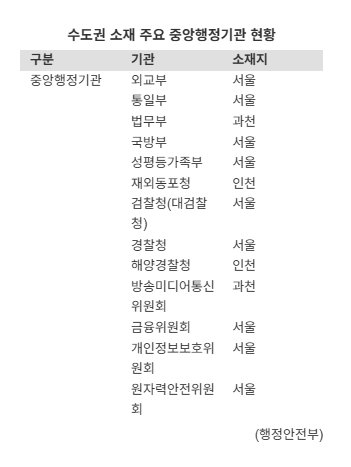
However, even after the first phase of relocation was completed, a considerable number of government agencies remain in the metropolitan area. According to MOIS, excluding affiliated agencies, 25 agencies have their main offices in the metropolitan area: 20 in Seoul, three in Gwacheon, and two in Incheon. Seoul is home to the Ministry of Foreign Affairs (MOFA), the Ministry of Unification (MOU), the Ministry of National Defense, the Ministry of Gender Equality and Family, as well as the Korean National Police Agency, the Supreme Prosecutors' Office of the Republic of Korea (SPO), the Financial Services Commission (FSC), the Personal Information Protection Commission (PIPC), and the Nuclear Safety and Security Commission (NSSC). Gwacheon houses the Ministry of Justice, the Korea Media and Communications Commission (KMCC), and the Corruption Investigation Office for High-ranking Officials (CIO), while Incheon is home to the Overseas Koreans Agency and the Korea Coast Guard (KCG).
The first agencies to move will be the Ministry of Justice and the Ministry of Gender Equality and Family. Through this second relocation, the Ministry of Justice is entering the process of ending its 'Gwacheon era' 44 years after moving into Government Complex Gwacheon in 1983. The government plans to prioritize relocating the two ministries beginning in the first half of 2027.
However, the law must first be amended. Article 16 of the current Special Act on the Construction of Administrative City excludes the Ministry of Foreign Affairs, the Ministry of Unification, the Ministry of Justice, the Ministry of National Defense, and the Ministry of Gender Equality and Family from relocation to Sejong. The government is pursuing an amendment to remove the Ministry of Justice and the Ministry of Gender Equality and Family from the list of excluded agencies.
The procedures for the Financial Services Commission (FSC) and the Personal Information Protection Commission (PIPC) are different. Because these agencies are not excluded from relocation under the Special Act on the Construction of Administrative City, there is no need to first amend the exclusion provisions, as is the case with the Ministry of Justice. The key question is whether they will be included in the 'Relocation Plan for Central Administrative Agencies, etc.' that the government will finalize in the fourth quarter.
The Ministry of Foreign Affairs (MOFA) and the Ministry of Unification (MOU) will review whether to relocate to Sejong in line with the schedules for the Presidential Office in Sejong and the National Assembly Sejong Complex. Both ministries are also excluded from relocation under the current Special Act on the Construction of Administrative City, so an amendment to the law would be required for an actual move. The goal is to complete the Presidential Office in Sejong in August 2029 and the National Assembly Sejong Complex in 2033. The plan is to make Sejong City the central axis of state administration by extending the relocation of central ministries to include the Presidential Office and the National Assembly.
The Korean National Police Agency, along with the planned Public Prosecution Office and Serious Crime Investigation Agency, will also pursue relocation to Sejong. Minister Yun stated, 'For agencies that require separate buildings, such as the Public Prosecution Office, the Serious Crime Investigation Agency, and the Korean National Police Agency, we will pursue relocation after new buildings are constructed.'
Once the additional relocation targets for the fourth quarter are finalized, the Minister of the Interior and Safety must prepare a 'Relocation Plan for Central Administrative Agencies, etc.' under the Special Act on the Construction of Administrative City, specifying the targets, methods, timing, and relocation costs. The process involves drafting a revised relocation plan through meetings with relevant ministries, holding a public hearing and consultations with the agencies, obtaining presidential approval, and publishing the plan in the Official Gazette. Notice of the public hearing must be issued 14 days before it is held.
Preparations for the relocation will proceed simultaneously. The government plans to review not only the budget, personnel, and government buildings, but also education and settlement conditions. The working-level meeting of relevant ministries will include the Office for Government Policy Coordination, MOIS, the ministry responsible for the budget, the Ministry of Personnel Management, the Ministry of Land, Infrastructure and Transport (MOLIT), the National Agency for Administrative City Construction, the Ministry of Education, and Sejong City.
Minister Yun stated, 'Rather than relocating all agencies uniformly at the same time, we will proceed in stages, taking into account each agency's working conditions and state of readiness so that there is no administrative gap.'
[email protected] Lee Bo-mi Reporter