One in Two Fatal Industrial Accident Victims Works in Construction... “Punishment-Centered Safety Management Must Change”
- Input
- 2026-09-04 06:00:00
- Updated
- 2026-09-04 06:00:00
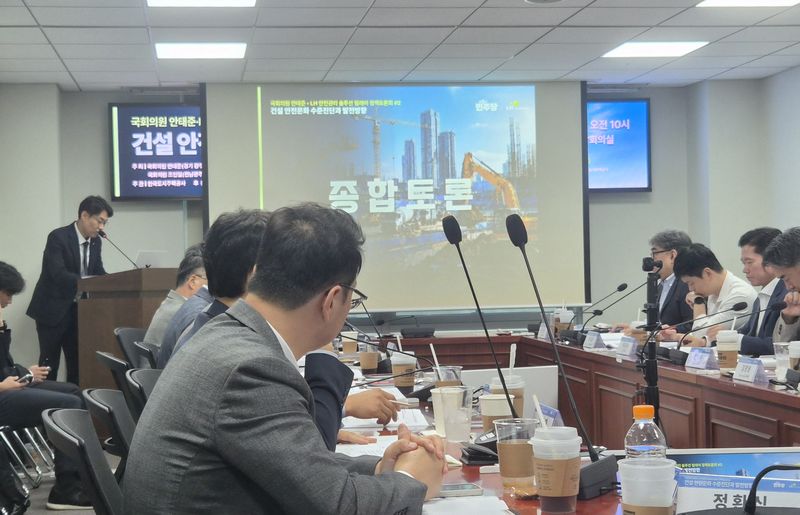
[Financial News] The number of fatal accidents in the construction industry is declining following the implementation of the Serious Accidents Punishment Act and the government’s intensified on-site inspections. However, accidents that could be prevented through basic safety measures, such as fall prevention, continue to occur. Repeated accidents at small-scale construction sites, where safety personnel and expertise are limited, have prompted calls to change the industry’s “safety culture” rather than relying solely on regulation and punishment.
At the policy forum “Assessing and Advancing Construction Safety Culture,” held at the National Assembly Members’ Office Building on the 3rd, Choi Woo-jae, a professor at Cheongju University, pointed out, “In organizations with poor safety cultures, accidents are repeatedly concealed, people who report risks are penalized, and shortening the construction schedule is prioritized.”
The assessment is that although the number of construction-related deaths is falling as regulations are tightened, similar accidents continue because safety culture at worksites has not kept pace.
According to the Ministry of Employment and Labor (MOEL), 105 of the 253 people killed in accidents subject to disaster investigations during the first half of this year were construction workers, a decline of approximately 24% from the same period last year.
This was the lowest level since related statistics began being compiled in 2022, but construction remains the industry with the highest number of industrial accident fatalities. Last year, 286 construction workers were killed in accidents, accounting for approximately 47% of the 605 total accident fatalities subject to disaster investigations.
The safety gap at small-scale sites has also been difficult to close. Last year, the number of accident fatalities at construction sites with project values below 500 million won increased by 25 from the previous year. Experts say a structural problem at small sites—where safety personnel and budgets are more limited than at large sites and basic safety measures are not properly implemented—is leading to accidents.
Falls continue to occur despite the decline in fatalities. On the 11th of last month, at the Chungbuk Cheongju Dongnam public housing construction site, a worker fell while dismantling a safety guardrail to install a vertical protective net in a break room. The worker died 18 days after the accident while receiving treatment.
In June, three workers also died in separate falls at small-scale construction sites in Yeongam County, Muan County, and Sinan County in South Jeolla Province over the course of a month. These accidents are recurring even though they could have been prevented if basic safety measures, such as guardrails and fall-prevention facilities, had functioned properly.
Experts emphasized the need for a system that goes beyond establishing regulations and conducting one-time inspections. Under such a system, site members could freely report hazards, while workplaces would assess and improve their own safety levels.
HWAN SIK CHUNG, deputy director of the Safety Planning Department at the Smart Construction Safety Division of Korea Land and Housing Corporation (LH), advised, “We must establish a PDCA cycle through diagnosis, the development of improvement measures, implementation, and reassessment.” He added, “We must also move away from the existing top-down communication system so that opinions from the worksite can be conveyed in both directions.”
[email protected] Lee Dong-hyuk Reporter