Hanwha Ocean Proposes Naval MRO Orders; Ruling Party and Government Push for a 1.5 Trillion-Won Cluster
- Input
- 2026-09-03 17:56:48
- Updated
- 2026-09-03 17:56:48
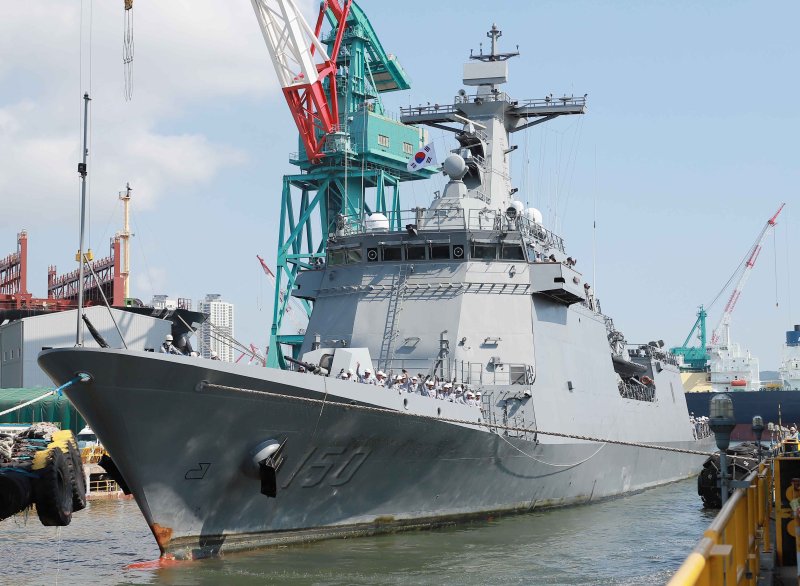
[Financial News] As the Make American Shipbuilding Great Again (MASGA, South Korea-U.S. shipbuilding cooperation) project gathers momentum, strengthening competitiveness in maintenance, repair and overhaul (MRO) has become an urgent priority. Hanwha Ocean proposed entrusting the maintenance and repair of South Korean naval vessels to private shipyards, while the government and ruling party announced plans to establish a 1.5 trillion-won MRO and ship-repair cluster.
On the 3rd, Hanwha Ocean held a forum with OkJu Song of the ruling Democratic Party of Korea and Busan titled “A Forum on Building a Maritime MRO and Ship-Repair Cluster to Open the MASGA Era.” Kim Dae-sik, an executive in charge of Hanwha Ocean’s special-ship MRO business, proposed that the Navy actively place MRO orders.
Kim said, "We are confident that our warship-building technology and production capacity can compete with those of any country. However, it is true that we lack the experience in MRO to have the same level of confidence as we do in shipbuilding. The best way to expand our capabilities quickly is for the Navy to place maintenance and repair orders with domestic shipyards so they can build experience."
In fact, Hanwha Ocean won the MRO contract for the Navy’s Sejong the Great Aegis destroyer last month. It was the first time that large-scale MRO work on a naval surface ship had been entrusted to a private company.
Hanwha Ocean also proposed assigning MRO work to domestic shipyards from the time major warships are introduced into the South Korean military. Specifically, it suggested maintenance and repair work for the KDDX-class destroyer (KDDX) after delivery. Hanwha Ocean previously signed a contract with the Defense Acquisition Program Administration (DAPA) for the detailed design and construction of the lead KDDX vessel. The company is seeking to handle the vessel’s maintenance and repair after delivery as well, allowing it to build a track record in MRO.
Hanwha Ocean also called for institutional reforms to promote MRO through Navy orders. It said that the current system for selecting private contractors, which considers only price competitiveness once certain requirements are met, should be changed to one centered on technical capabilities. In particular, it raised the need to ease security regulations, including allowing cameras and communications equipment, to apply artificial intelligence (AI) and robotics, as well as the need for the Navy to provide maintenance data.
It urged the government to prevent intellectual property disputes with original equipment manufacturers, resolve warranty issues, and digitize technical data to support the supply chain for repair parts. These matters require institutional improvements at the national level.
The government did not provide a specific response to the proposal for Navy MRO orders. Instead, it presented supply-chain support measures, South Korea-U.S. cooperation initiatives, and a plan to build a 1.5 trillion-won cluster.
The Ministry of Trade, Industry & Resources proposed performance evaluations and technical support for materials and components on the premise that MRO work would be carried out on U.S. military vessels, along with activating South Korea-U.S. networks.
The Ministry of Oceans and Fisheries explained a road map to build a cluster in the southern area of Busan New Port at a cost of 1.5 trillion won. The plan calls for three docks, three outfitting berths, breakwaters, and access roads on a 120,000-pyeong site. Construction is targeted to begin in 2028, with the cluster scheduled to open in 2033.
[email protected] Kim Yun-ho Reporter