Hanwha Ocean Secures KRW 2 Trillion in Orders in Two Days, Bringing Year-to-Date Total to KRW 9.6 Trillion
- Input
- 2026-09-03 15:49:50
- Updated
- 2026-09-03 15:49:50
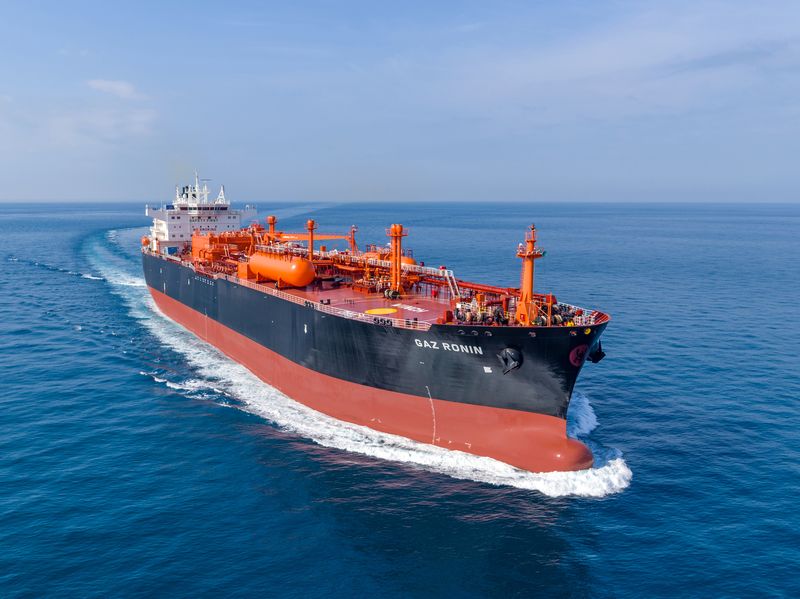
[Financial News] Hanwha Ocean hit a jackpot, securing shipbuilding orders worth more than KRW 2 trillion in just two days. After winning orders for very large gas carriers, the company also secured LNG dual-fuel container ships, bringing its cumulative orders for the year close to KRW 10 trillion.
Successive orders from Taiwan’s Yang Ming Marine Transport
Hanwha Ocean announced on the 3rd that it had won an order from Taiwan’s Yang Ming Marine Transport for six 13,650-TEU LNG dual-fuel container ships worth approximately KRW 1.5527 trillion. The vessels will be built at Hanwha Ocean Geoje Shipyard and delivered sequentially by the second half of 2029.
Earlier, on the 1st, Hanwha Ocean signed a KRW 477.8 billion contract with a shipowner based in Oceania to build three Very Large Gas Carriers (VLGCs). As a result, the company secured a total of KRW 2.0305 trillion in orders over the two-day period.
The Yang Ming Marine Transport order is also significant because it is a follow-up order to last year’s initial contract. After Yang Ming Marine Transport commissioned Hanwha Ocean to build seven 15,880-TEU LNG dual-fuel container ships in September last year, it placed an additional order for six vessels about a year later. The order is seen as a result of the customer’s confidence in Hanwha Ocean’s technological competitiveness.
Hee-Chul Kim, CEO of Hanwha Ocean, said, "The trust in our design and production technologies and project execution capabilities, demonstrated through the first project, led to this large-scale follow-up order just one year later. We will continue to enhance our green technologies and quality competitiveness and develop our cooperative relationship with Yang Ming Marine Transport into a long-term partnership."
Hanwha Ocean will apply its proprietary Type-B LNG fuel tank based on high-manganese steel to these vessels. High-manganese steel maintains high toughness and strength even in extremely low-temperature environments of minus 163 degrees Celsius, while offering a price advantage over nickel-alloy steel and aluminum. The company also plans to apply the latest hull-form optimization technology to improve fuel efficiency and operational and cargo-loading efficiency.
38 vessels and projects secured this year alone
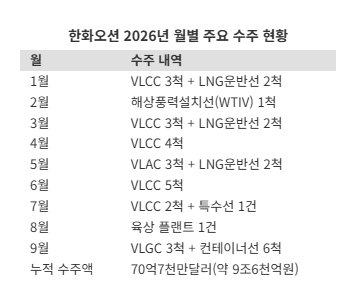
With the successive orders, Hanwha Ocean’s order performance for the year is also growing rapidly. To date, the company has secured orders for a total of 38 vessels and projects: 17 Very Large Crude Carriers (VLCCs), six LNG carriers, six container ships, three Very Large Ammonia Carriers (VLACs), three VLGCs, one Wind Turbine Installation Vessel (WTIV), one special-purpose vessel, and one onshore plant project.
Starting with five vessels in January, Hanwha Ocean has secured an average of four to five orders each month during the first half of the year. This month, in particular, it secured nine vessels—three VLGCs and six container ships—in just three days, marking its largest monthly order volume. The company’s cumulative orders for the year have therefore risen to 38 vessels and projects worth USD 7.07 billion, or approximately KRW 9.6 trillion.
The company’s portfolio is also becoming more diversified as it continues to win orders for gas- and alternative-fuel-related vessel types, including LNG carriers, LNG dual-fuel container ships, VLACs, and VLGCs. As global shipping companies begin replacing aging vessels and transitioning to greener fleets in earnest, the possibility of additional orders for these vessel types is also increasing. Hanwha Ocean plans to continue expanding orders, focusing on high-value-added and eco-friendly vessels.
An industry source said, "Regardless of the type of vessel, decarbonization options are now an indispensable element. It appears that competitiveness in decarbonization technology is translating into competitiveness in winning orders."
[email protected] Jung Won-il Reporter