[On the Ground] "Standing on the Left Is Inconsiderate"—Despite Public Debate Over Two-Line Standing, Subway Stations Still Favor One-Line Standing
- Input
- 2026-09-07 10:34:30
- Updated
- 2026-09-07 10:34:30
[Financial News]"Standing still on the left would be inconsiderate."Although the government has begun a public discussion on standing in two lines to establish safer escalator-use practices, the custom of standing in one line and leaving one side open for people in a hurry continues at Seoul subway stations.
At around 8 a.m. on the 3rd, passengers poured out of a Metropolitan Area Rapid Transit Line A (GTX-A) train at Seoul Station and raced toward the only two high-speed elevators leading to the ground level. Those who could not get on an elevator immediately turned toward the escalators.
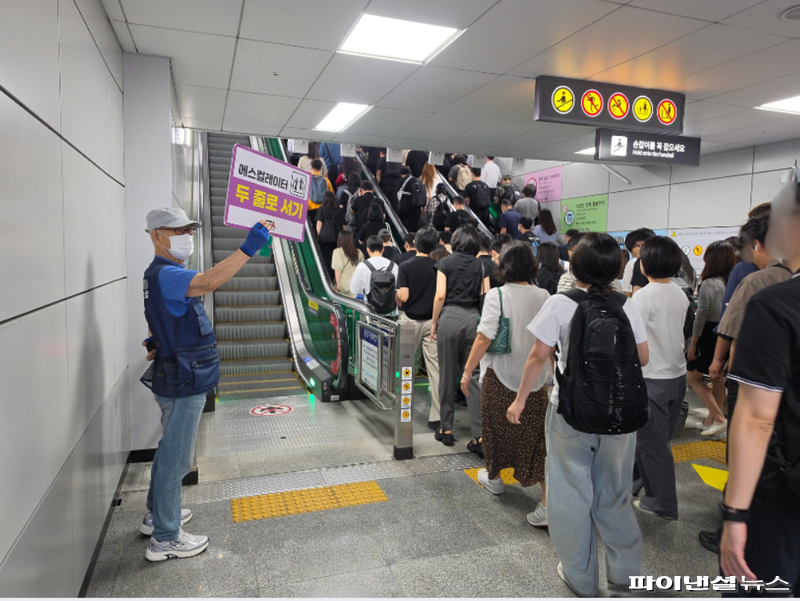
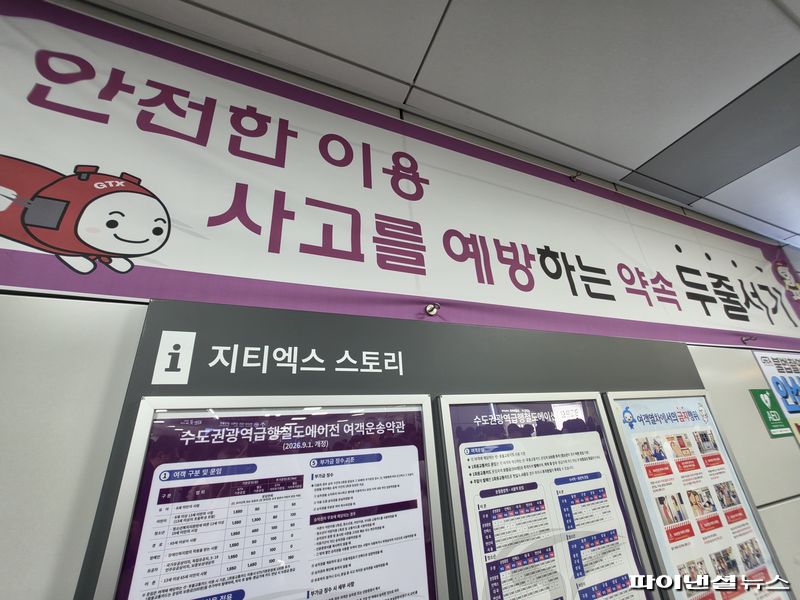
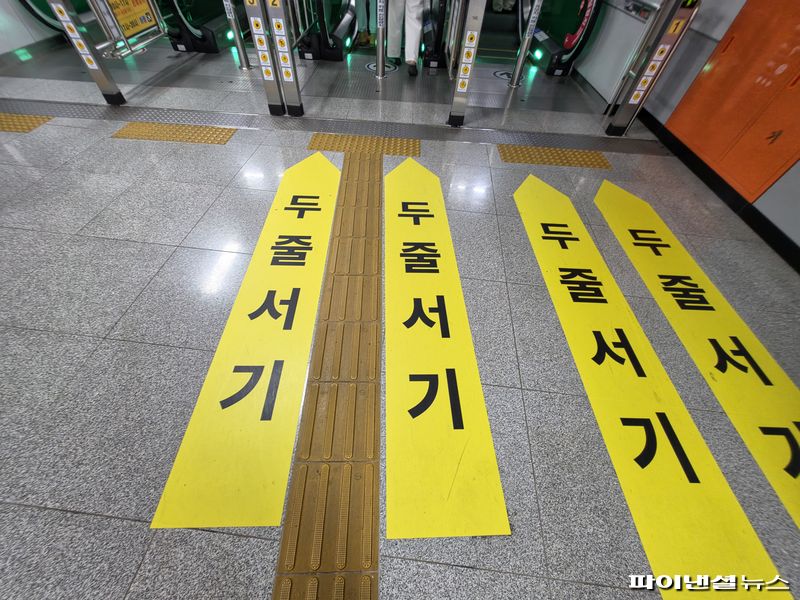
A large banner reading "A promise to prevent accidents: Stand in two lines" hung on the wall near the escalator entrance. A prominent floor marking instructing passengers to "stand in two lines" was also clearly visible. An 81-year-old guide from the Seoul Central Senior Club stood beside the escalator holding a hand-held sign that read "Stand in two lines."
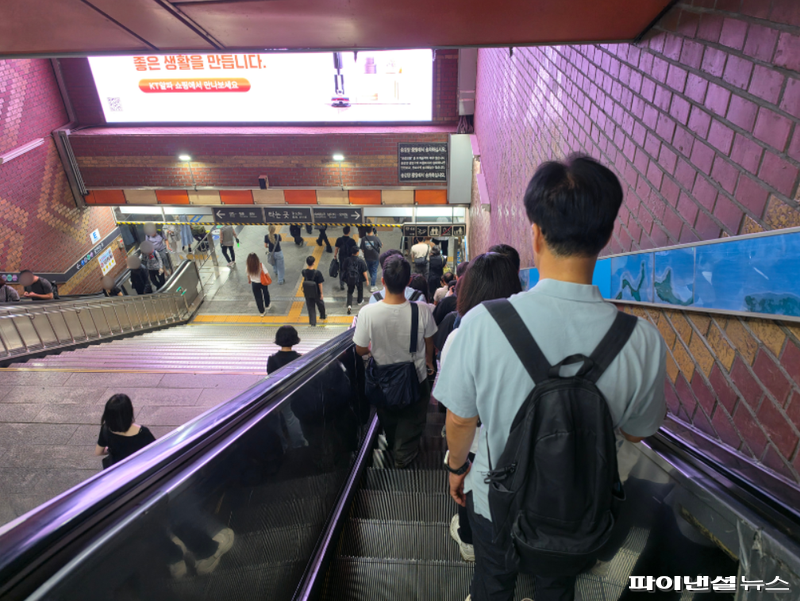
Despite the guidance, passengers stood in one line on all three escalators installed side by side. Long lines of stationary passengers formed on the right, while a steady stream of people walked up on the left. When one passenger stopped midway while walking up the escalator, those behind said, "I’ll just pass for a moment," and squeezed through the narrow gap.
Mr./Ms. Lee, who has been responsible for promoting two-line standing since February, said, "Especially during commuting hours, so many people are in a hurry to transfer to Seoul Subway Line 1 or Seoul Subway Line 4 that, no matter how much we encourage two-line standing, it ends up being an empty cry every time."
Meanwhile, citizens who chose to stand in one line said it was unavoidable, either to reduce travel time or to accommodate passengers in a hurry. Mr./Ms. Park, a 32-year-old office worker traveling to City Hall Station on Seoul Subway Line 1, said, "If everyone stands in two lines and no one walks, it takes too long to get up and feels frustrating. I walk so I can transfer even a little faster."
Mr./Ms. Choi, a 29-year-old office worker who stood on the right side of the escalator throughout, said, "I usually make way so that people who are in greater haste can pass first. I feel self-conscious about standing alone on the left, and it also seems like I would be inconveniencing others for no reason."
Even between 10 and 11 a.m., after the morning rush had eased, the same pattern continued on every line at Seoul Station, prompting concerns about safety accidents. Mr./Ms. Kang, a 75-year-old passenger met on the Seoul Subway Line 4 platform, said, "I worry that I could be hit and fall when people pass quickly beside me. Unless it is an especially urgent time, such as the morning or evening commute, I wish people would not walk on escalators."
On the 29th of last month, the Ministry of the Interior and Safety (MOIS) held a "Forum for Everyone" at Yonsei University in Seodaemun-gu, Seoul, with 200 members of the public and experts participating, to discuss ways to use escalators safely. According to briefing materials released before the forum, a survey of 1,000 adults in seven major cities found that 50.1% usually stood in one line and 49.9% stood in two lines.
Experts at the forum raised the view that the key problem is the mixing of different usage patterns in the same space. Jang Gye-ryeon, head of the Public Administration Division at the Korea Institute for Industrial Relations Research, said, "The core issue is not whether there should be one line or two," and suggested, "We need to consider a common standard that everyone can share and anticipate." From a safety perspective, participants also concluded that standing in two lines is preferable. Lee Sang-min, a professor at the Korea National University of Transportation (KNUT), explained, "Contact between pedestrians and stationary users that occurs when people stand in one line can lead to a chain-reaction fall, so standing in two lines is safer."
Escalator-use practices have changed several times over the past 30 years. Standing in one line began in 1998, when the Central Council for the Cultural Citizen Movement proposed leaving one side open for people in a hurry, and spread nationwide after the 2002 Korea-Japan World Cup. As concerns grew over safety accidents involving people walking and uneven loads on escalator equipment, elevator safety agencies and subway operators began promoting two-line standing in 2007, and the government launched a related campaign in 2009. However, when two-line standing also failed to take hold, the government ended campaigns promoting a specific standing arrangement in 2015. It has since recommended three key safety rules: hold the handrail, do not walk or run, and stay within the yellow safety line when boarding.
MOIS plans to formulate measures based on public opinions and expert recommendations presented at the forum.
[email protected] Park Seong-hyeon Reporter