Expectations Rise for Resolving the PF Bottleneck Affecting 180,000 Metropolitan-Area Homes; FSS Begins Close Management of 325 Sites
- Input
- 2026-09-03 15:36:51
- Updated
- 2026-09-03 15:36:51
The Financial Supervisory Service held a meeting on the 3rd with representatives from the financial sector to discuss measures for closely managing residential PF sites and promoting the rapid supply of homes. The meeting followed up on the “Comprehensive Financial Measures for Real Estate Market Stabilization Announced on August 13.” Lee Chan-jin, Governor of the Financial Supervisory Service, instructed executives at a meeting on the 1st to focus their capabilities on financial support so that large numbers of homes could be supplied early in Seoul and the wider metropolitan area. He also called for expanding the staffing system for residential real-estate Project Financing (PF) from a single dedicated department to a cooperative system involving each relevant inspection bureau.
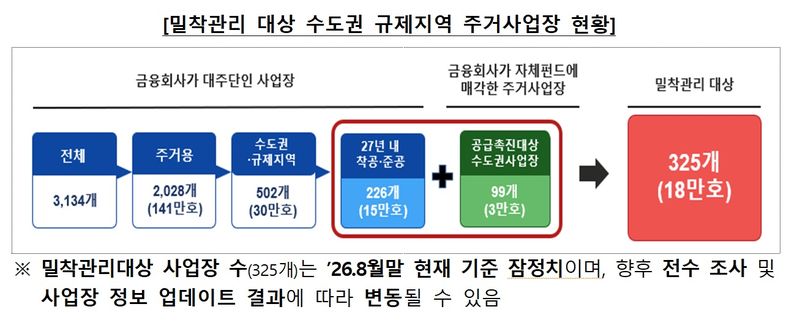
There are 502 residential PF sites in regulated areas of the Seoul metropolitan area where financial institutions participate as lending groups, representing approximately 300,000 homes. Including 99 metropolitan-area residential projects, totaling about 30,000 homes, that financial institutions have sold to their own funds, the combined total reaches 601 sites and approximately 330,000 homes. The Financial Supervisory Service decided to prioritize 325 sites among those directly financed by financial institutions or held by industry-owned funds, where construction is expected to begin or be completed by next year. It will also periodically monitor the remaining sites and add projects to the close-management list if resolving delays could enable rapid supply.
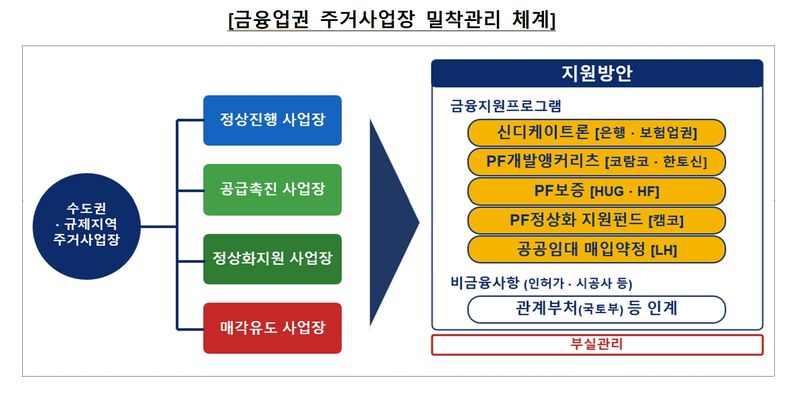
Each of the 325 sites will be assigned one official from the Financial Supervisory Service and one from a financial institution. After identifying the causes of delays across all sites, the projects will be divided into four categories—normal progress, supply promotion, normalization support, and sale facilitation—for tailored assistance.
Sites delayed by temporary funding difficulties or similar problems will be linked to syndicated loans, PF Development Anchor REITs, and the KAMCO Fund. Projects requiring PF guarantees will be connected with the Korea Housing & Urban Guarantee Corporation (HUG) and the Korea Housing Finance Corporation (HF), while sites seeking conversion to public rental housing will be connected with the Korea Land and Housing Corporation (LH). If nonfinancial issues such as permits and approvals are blocking progress, the cases will be referred to relevant ministries, including the Office for Government Policy Coordination and the Ministry of Land, Infrastructure and Transport (MOLIT), for assistance in resolving them.
For projects where selling the site is effectively the only means of normalization, the authorities will encourage a swift sale so construction can resume. Even normally progressing sites will be linked to support measures if financial or permitting assistance could bring forward their construction or completion schedules.
To support these efforts, the Financial Supervisory Service has established the “Housing Supply Promotion Financial Support Team” and expanded the number of staff assigned to PF sites from five to 25. Financial institutions will also designate officials for each site and immediately report any warning signs to the FSS. Since the 1st, the FSS has operated the “PF Financial Difficulties Resolution Center,” which receives difficulties reported by PF lending groups, developers, and others. The center handles inquiries about funding-support programs and proposals to improve soundness regulations, connecting each case with the relevant institutions. It will also cooperate with the “Rapid Supply Promotion Task Force,” overseen by the Office for Government Policy Coordination, as well as MOLIT, the Financial Services Commission (FSC), the Korea Development Bank (KDB), and LH.
An FSS official said, "Rapid housing supply is the top priority in addressing public concerns about housing, so we ask the financial sector to carefully monitor conditions at PF sites."
[email protected] Park Moon-soo Reporter