Shin Won-sik Says Yoon’s Remarks on the Military’s Role Were “An Overly Sensitive Association Triggered by Trauma from the 12/12 Military Insurrection”; Corrects Testimony in Court
- Input
- 2026-09-03 16:09:36
- Updated
- 2026-09-03 16:09:36
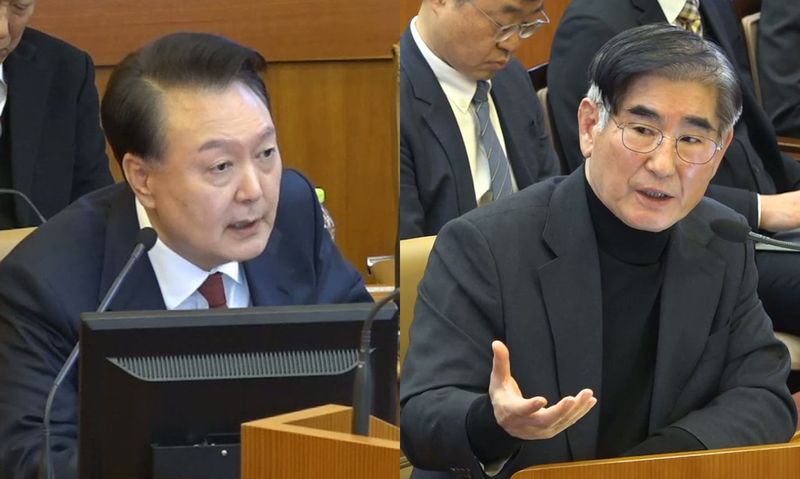
[Financial News] Shin Won-sik, the former head of the Office of National Security who appeared as a key witness in former President Yoon Suk Yeol’s appellate trial, corrected his testimony regarding Yoon’s past reference to an “emergency measure,” saying it was a “subjective association.” Although Shin’s recollection of the drone operation that raised concerns about a North Korean provocation differed somewhat from that of former Defense Minister Kim Yong-hyun, he drew a line at any connection to Martial Law, calling such an interpretation “unreasonable by common sense.”
Seoul High Court Criminal Division 12-1 held the 13th hearing on the charges, including being the leader of an insurrection, against eight key military and police defendants, including former President Yoon Suk Yeol and former Defense Minister Kim Yong-hyun, and questioned former ONS chief Shin Won-sik as a witness.
The central issue at the hearing was the March 29, 2024, dinner meeting at a safe house in Samcheong-dong, which has been identified as the starting point for the declaration of Martial Law. The special counsel’s indictment states that Yoon discussed emergency powers and the military’s role at the meeting, attended by Shin, Kim, former NIS Director Cho Tae-yong, and former DCC commander Yeo In-hyung, and that they made advance plans for Martial Law.
Shin drew a clear line in court, saying, "The president never directly used expressions such as ‘the military needs to step forward and play a role’ or the term ‘emergency powers.’"
He then corrected his testimony, stating, "The expression suggesting an extraordinary measure merely came up in passing while he was expressing frustration about the situation and the difficulties of running the state." He added, "As someone from the military who experienced the 12/12 Military Insurrection while attending a military academy, I took it overly sensitively and made that association on my own because of my trauma. It had nothing to do with the president."
Shin also testified that the special counsel’s account of the appointment of Ground Operations Commander Kang Ho-pil, which it has suspected was intended for a “pro-government coup,” lacked credibility. Regarding the allegation that Kang expressed his intention to retire after hearing Yoon’s agitated remarks during Yoon’s visit to Hawaii in July 2024, Shin said, "It was an incident that was resolved that same day after a misunderstanding arising from a drinking gathering was cleared up." He added, "The special counsel’s claim that a coup was being planned by appointing someone who opposed Martial Law as commander of Ground Operations Command, the key post for mobilizing large-scale forces, goes too far."
Shin also rejected the theory that the government sought to create grounds for Martial Law by provoking a local conflict through a drone operation against North Korea. He emphasized, "Since the division of the peninsula, there has not been a single historical case in which Martial Law was declared because of a local provocation, apart from the Korean War."
He explained, "If a clash were to escalate and DEFCON were raised, operational control would pass to the commander of the ROK-U.S. Combined Forces Command, meaning the South Korean president could not mobilize troops at will." He added, "Linking the drone infiltration to Martial Law is close to impossible under the current combined defense system."
However, Shin’s recollection differed from Kim’s regarding the reporting chain. Kim claimed, "After reporting to the president, I clearly told Shin, ‘It is true that we sent them, but we decided to respond with Neither Confirm Nor Deny (NCND).’" Shin, by contrast, said, "At first, I remember hearing that it was not known who had sent them, and later being told that the matter had been settled as NCND." He added, "I will not argue over differences in the details of our memories."
[email protected] Chang-hoon Lee Reporter