Jeju Sees Growing Concern Over Missing Persons, Plans ‘Safe Travel Organization’ for Solo Travelers
- Input
- 2026-09-03 14:24:25
- Updated
- 2026-09-03 14:24:25
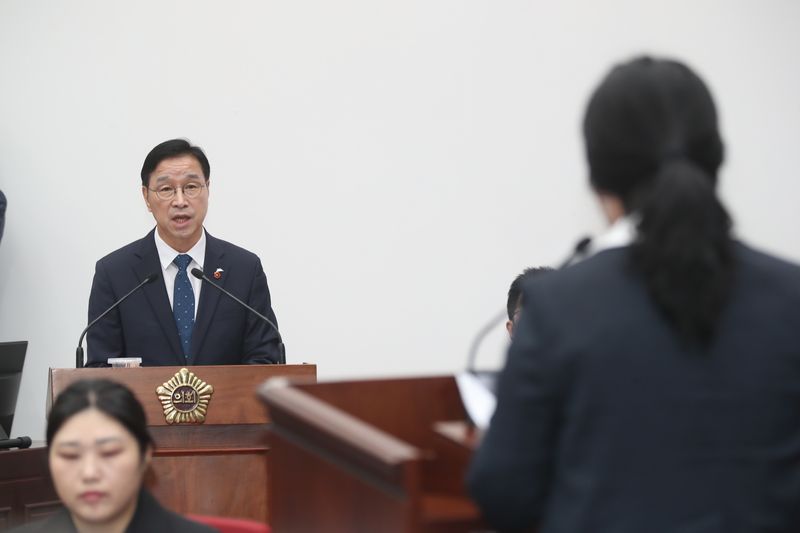
【Financial News Jeju = Reporter Jeong Yong-bok】 Jeju Province is pursuing the establishment of a Safe Travel Organization through which solo travelers can request safety assistance in emergencies. As concerns over public safety and tourism security in Jeju grow following a case involving the false closure of a missing-person report, the province plans to add a separate safety system that allows tourists to seek help directly to the existing police- and fire service-centered missing-person response network.
During provincial administration questioning at the 454th First Regular Session of the Jeju Special Self-Governing Provincial Council on the 3rd, Wi Seong-gon said in response to a question from Jeong Da-woon, a lawmaker from the Democratic Party of Korea, about an emergency response system for solo travelers, "The province plans to establish and operate a Safe Travel Organization."
Under the plan, the Jeju digital tourism pass platform, NOWDA, would serve as the point of contact for the tourism safety network.
Wi explained that the province is considering adding safety-related programs to NOWDA and providing the necessary assistance when travelers visiting Jeju alone request safety services.
However, his response did not disclose whether the Safe Travel Organization would be established as a separate entity or operated as a collaborative system linking existing departments and agencies. The launch date, operating personnel and required budget have also not been presented.
Therefore, at this stage, it is more accurate to view the plan as the initial specification of a policy direction to build a new safety-support system for solo travelers, rather than as confirmation that a separate agency will be established.
Wi also cited existing private-sector services as a reference. The province is considering whether a system similar to the Safe Olle Service provided by the Jeju Olle Foundation’s call center to people traveling alone could be expanded across Jeju’s tourism sector.
Jeju has many places suited to solo travel, including the Jeju Olle Trail, oreums, and coastal and mid-mountain areas. However, many of these areas are sparsely populated, making it difficult to quickly determine a person’s location when an accident or emergency occurs. If a digital channel is created through which tourists can directly request safety assistance, the key will likely be connecting existing CCTV monitoring with the police, fire services and private safety organizations.
Jeju Province is also redesigning its safety network following the false closure of a missing-person case.
On July 27, the province agreed to establish a joint response system for missing-person and emergency cases involving the provincial government, police, fire services, maritime police, autonomous police, local administrative cities and private safety organizations. It is also working on an integrated manual that defines each agency’s role from the filing of a report and situation assessment to search and rescue, information disclosure, family support and case closure.
CCTV coverage and capabilities will be expanded together. AI-based intelligent monitoring currently applies to 58% of CCTV systems in Jeju. Jeju Province plans to raise that figure to 75% by 2030 and reduce blind spots in vulnerable areas such as the Jeju Olle Trail and coastal zones.
The range of situations detected by AI will also expand from missing persons and falls to fires, flooding, violence and coastal hazards. To prepare for long-term missing-person cases, the province is pursuing a plan to extend CCTV video retention from the current 30 days to at least 60 days. At a safety-measures meeting last month, Wi said adding 30 days to the retention period was expected to require more than 8 billion won and that he would consult with the central government on securing the necessary funding.
Jeju will also make use of the region’s private safety resources. Wi said that day, "Jeju has more people participating in local safety activities, including volunteer firefighters, autonomous disaster-prevention groups and resident autonomous police units, than other regions," adding that the province would use private safety organizations alongside public agencies such as the police and fire services.
The key challenge for Jeju Province is to connect all of these safety measures into a single system. For the service to work in practice, the province must specify which agency will receive a rescue or safety-assistance request made through NOWDA or another platform, how location information will be verified, and which of the police, fire services, autonomous police or private organizations will respond at the scene.
The scope of personal and location information use is another challenge. Because both extending CCTV video retention and providing location-based safety services for travelers are directly linked to privacy protection, the province must consult relevant agencies and comply with applicable laws.
Wi Seong-gon, governor of Jeju Special Self-Governing Province, said, "I will do my utmost to make Jeju a place where people can stay safe even when they travel alone," adding, "We will review the overall safety system again, including the expansion of CCTV coverage."
[email protected] Reporter Jeong Yong-bok Reporter